



Calpers Cuts Magnificent Seven Stake by 26% as AI Trade Comes Under Scrutiny
Calpers Makes a Strategic Retreat From Big Tech
In the world of institutional investing, Calpers is the heavyweight whose every move is dissected for hidden meaning. The California Public Employees’ Retirement System — the largest public pension fund in the United States and the fifth-largest in the world — has done something that will occupy financial strategists for weeks: it has sharply reduced its direct ownership of the very technology stocks that have defined the modern market era. According to a Financial Times analysis of regulatory filings, Calpers cut the combined number of shares it directly holds in the so-called Magnificent Seven by 26% during the first half of 2025. That amounts to billions of dollars filtered out of the market’s most prominent names: Apple, Microsoft, Alphabet, Amazon, Nvidia, Meta Platforms and Tesla, the seven companies whose fortunes have come to dominate everything from index returns to individual retirement accounts.
This is not a hedge fund making a short-term tactical bet. Calpers manages more than $600 billion on behalf of more than two million public employees and retirees in California. It measures success over generational timescales, and its investment choices are guided not by the whims of quarterly earnings but by the cold mathematics of long-term liability funding. When an institution of this magnitude begins trimming its stake in the companies that have powered nearly all of Wall Street’s recent advances, the financial community takes notice. The move also carries political resonance: Calpers is a bellwether for dozens of other state pension systems that look to its strategy as a lodestar. If the fifth-largest pension fund in the world no longer believes the Magnificent Seven deserve their current valuations, one has to wonder whether the broader market is pricing in something that the rest of us are missing. The decision, in short, is a quiet but unmistakable warning shot fired across the bow of the AI-fueled stock rally.
The Magnificent Seven: A Rally Unlike Any Other
To fully understand what Calpers has done, it is first necessary to grasp the extraordinary grip these seven companies have exerted on global financial markets. The Magnificent Seven have taken on an almost mythic status in recent years. They have been the unstoppable engines of the S&P 500’s climb, generating a disproportionate share of the index’s overall gains. At various points over the past two years, the group has been responsible for a jaw-dropping percentage of the entire U.S. equity market’s returns. The phenomenon has been driven by a tidal wave of enthusiasm for artificial intelligence, a technology that has captured the imagination of investors and executives like nothing since the early days of the internet. Nvidia, the chipmaker whose processors form the backbone of AI data centers, saw its market value explode at a pace rarely seen in corporate history. Others, like Microsoft and Amazon, have been pouring billions into AI infrastructure, positioning themselves to dominate what many believe is the next great computing cycle.
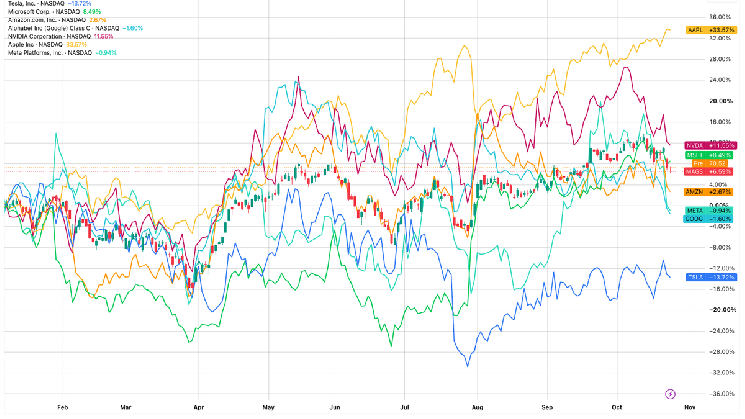
Yet behind the narrative of boundless growth lies a more complicated picture. The Magnificent Seven are no longer a monolith moving in lockstep. The Roundhill Magnificent Seven ETF, a popular vehicle that tracks the group, has managed a gain of just 7% so far this year — hardly the stuff of legend. The days of uniform, linear gains for the entire cohort are over. Apple has delivered an impressive 34% gain, cementing its status as the group’s standout performer. Nvidia has advanced a more modest 12%, a reflection of the scale that makes further explosive growth mathematically harder. The rest of the group, however, has moved in the opposite direction: Meta, Alphabet and Tesla have all fallen for the year, a divergence that signals investors are becoming far more discriminating within the cohort. The AI trade, in other words, is no longer a rising tide lifting all seven boats. It is a story of winners and losers, of massive bets on future technologies competing against old-fashioned valuation math. And for a long-term investor like Calpers, that sort of divergence is precisely when a portfolio needs fresh eyes and a lighter touch.
Parsing the Numbers: What a 26% Reduction Really Says
The details of the Calpers trade offer a fascinating glimpse into the machinations of a giant investor. Based on the Financial Times’ calculations from securities filings, the pension fund reduced its combined direct share count in all seven stocks by 26% over the six-month window from January through June. This is not a complete exit — Calpers clearly remains a shareholder in each of the seven — but it is a decisive reduction that places one of the world’s largest institutional portfolios on a distinctly different footing. For a fund managing more than $600 billion, percentage shifts of this kind represent enormous absolute sums. Selling into a rally is never easy, particularly when the stocks in question have been market darlings for so long. The fact that Calpers chose to lighten its load during a period of continued market strength suggests a disciplined, premeditated process, not a reflexive response to a sudden downturn.
The use of the word “directly” is itself significant. The figures released in regulatory filings capture only the stocks Calpers holds outright in its own name. They do not account for exposure through derivatives, index funds, or external fund managers. In reality, the fund’s total exposure to the tech megacaps is likely higher than the direct numbers suggest. Yet the paper trail reveals a clear directional intent. It also underscores a growing concern among professional investors about the concentration of the U.S. equity market. The top handful of stocks now account for a share of the S&P 500’s total market capitalization that has not been seen in many decades. For institutions tasked with diversifying risk, such concentration is an inherent problem, regardless of how brilliant the underlying companies might be. Calpers’ reduction is, in that sense, a portfolio-construction decision as much as a statement about the future of technology. It is an acknowledgment that even the strongest-growing businesses in the world cannot grow forever at a rate that outpaces the fundamentals of the wider economy.
‘No Longer Worth the Price’: Valuation Fears and the AI Sustainability Debate
The reasoning behind Calpers’ move was articulated with characteristic restraint by its Deputy Chief Investment Officer, Anton Orlich, in an interview with the Financial Times. Orlich said that public equity valuations look expensive and that the technology giants could underperform other investments. The statements, while carefully worded, capture a sentiment that has been quietly spreading through the institutional investment community: the era of cheap money has inflated asset prices, and the best-performing stocks of the past decade may now be fighting against the gravity of their own success. Underpinning that concern is the sustainability of the AI investment boom, a question that has moved to the center of global economic discourse. Artificial intelligence is undoubtedly a transformative technology with the power to affect everything from healthcare to transportation. But the scale of capital being committed today creates a problem: what happens if the returns do not arrive on schedule? Technology companies are investing astronomical sums in data centers, semiconductors and energy infrastructure to support AI operations. These projects have long lead times, and the revenues they generate will take years, possibly a decade, to materialize — if they materialize at all.
The market’s recent history is littered with cautionary tales. The fiber-optic boom of the late 1990s promised to connect the world in ways that few could imagine. The promise was genuine, but the investing public eventually paid the price for over-optimistic deployment of capital. Then came the dot-com crash, which taught investors that a disruptive technology and a viable business model are two entirely different things. The parallels with today’s AI boom need no elaboration. What Orlich is signaling is that Calpers, as a responsible fiduciary, is not willing to pay dot-com premiums for promises that might take a decade or longer to mature. Even among the Magnificent Seven, the earnings outlook is tightly coupled to AI progress. Nvidia’s growth is rooted in GPU sales that could stagnate at the first sign of weakened demand from the very cloud providers that have been stocking up on its chips. Microsoft and Amazon are engaged in capital expenditure wars that could compress margins. The potential is genuine; the valuations, at 20 or 30 times forward earnings, leave little room for error. Calpers does not seem inclined to wait and see whether that error occurs.
A Strategic Pivot From Public to Private Markets
If the reduction in Big Tech holdings is the splash, the destination of the capital is the ripple that matters. Calpers has been steadily shifting its portfolio toward private equity, and this year’s moves have accelerated that trend. The logic is straightforward: private markets offer access to companies at an earlier stage, with less competition from public market participants and, theoretically, a greater opportunity for outsized returns. There is also a compelling diversification benefit. Private equity returns are not tied to the daily whims of the stock tape; they are driven by the operational performance of the underlying businesses, a time horizon that aligns nicely with the long-dated liabilities of a pension fund. By increasing its allocation to private equity, Calpers is spreading its bets across a broader range of sectors, geographies and company sizes, reducing its dependence on a handful of public market darlings.
But the strategy is not without complications. Private credit and private equity have themselves become crowded, with institutional investors piling in at unprecedented speed. Unlike publicly traded stocks, private investments are illiquid — capital is often locked up for seven to ten years, with no guarantee of a profitable exit. Fees, too, are a perennial point of contention: the 2% management fee and 20% carry structure common in the private equity world eats into returns over time. Critics of the pension fund’s strategy argue that Calpers may simply be trading one type of overvaluation for another. Private companies, after all, can trade at valuations that are as frothy as anything in the public market, without the transparency of daily mark-to-market pricing. In Calpers’ telling, however, the move is about prudent portfolio construction rather than a dramatic market forecast. In a world where public stock valuations are stretched and the durability of the AI boom remains unproven, a portfolio that leans on the fundamentals of a diverse set of businesses is, in the fund’s view, a more resilient construct for the decades ahead.
What It All Means for the Market
The ripple effects of Calpers’ decision will be felt across the investment landscape for some time. For starters, it adds weight to the argument that the concentration of the U.S. stock market is a systemic risk rather than a temporary quirk. When an institution this large and this risk-averse reaches for the exit, it emboldens others to do the same. It also complicates the narrative of the AI boom. For the past two years, the story has been one of inexorable progress: new models, new capabilities, new billion-dollar fundraises, and a stock market that rewarded every participant with the faintest connection to the technology. Calpers’ move injects a dose of skepticism into that narrative. It suggests that at least one major player is looking at the same set of facts and seeing a potential mispricing — or, at best, an unfavorable risk-reward trade-off. If other institutional investors follow suit, the sell-off in the tech giants could accelerate, with meaningful consequences for anyone holding these stocks in their 401(k) or pension portfolio.
Still, it is important to keep things in perspective. Calpers has not sold everything. It remains an investor in all seven companies, and a 26% reduction in share count, while meaningful, does not amount to a wholesale exodus. The Magnificent Seven are, by most fundamental measures, extremely profitable businesses with formidable competitive moats, enormous cash flows and balance sheets that are the envy of the corporate world. Apple, for example, generates annual profits that exceed the entire market capitalization of most publicly traded companies. Microsoft’s cloud and software franchises enjoy pricing power that few competitors can even approach. It is entirely possible that Calpers’ caution will prove overdone — that AI will deliver the transformational returns that its most bullish advocates promise, and that the Magnificent Seven will continue to be magnificent for many years to come. But Calpers’ job is not to predict the future; it is to prepare for it. The next few quarters of market activity, corporate earnings reports and regulatory filings will reveal whether other institutions share that view. For now, the world’s fifth-largest pension fund has cast its vote. And it is a vote that gives even the most bullish tech investor some reason to pause.