


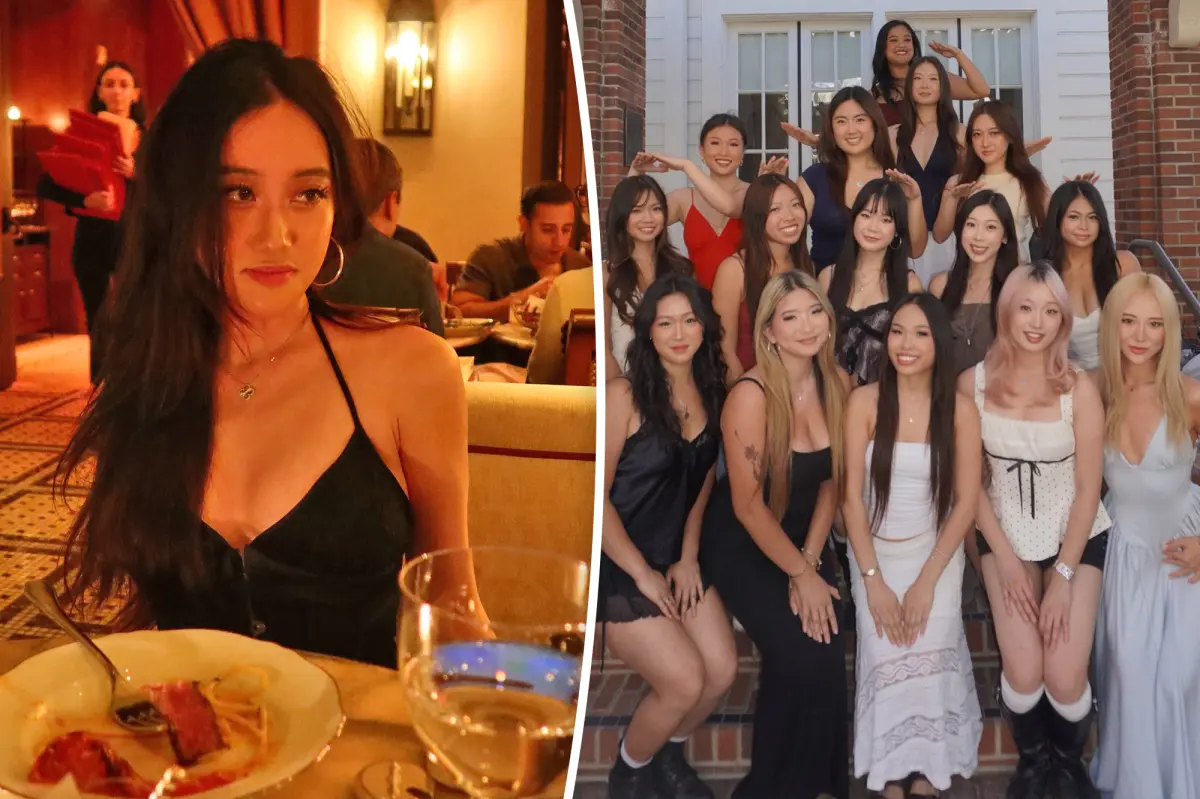
When Elsa Cai first moved to San Francisco, she did not expect to feel so alone in a city so full of people. On paper, everything was going according to plan. She had a sharp title, creative director at Ditto, a dating startup that was quickly becoming a fixture in Silicon Valley’s tech scene. She worked with brilliant engineers, attended meetings where people spoke about AI agents with the kind of reverent enthusiasm usually reserved for sports teams, and lived inside the relentless rhythm of startup life. But somewhere between another discussion about machine learning and another late night at the office, she noticed a quiet absence in her life: women. Not just any women, but the kind of ambitious, warm, funny, driven women she used to surround herself with in college—friends who could laugh with her, cry with her, and remind her that she was more than her output. She put it plainly in a now-viral post on X, admitting, “ever since i moved to sf, my world has been all work. talking about agents all day and spending 90% of my time with my engineers.” It was a confession that many in the Bay Area likely recognized all too well. She wanted more girlfriends, real ones, in a city where male-dominated tech culture often leaves women feeling isolated. So rather than wait for fate to deliver a best friend, she did what anyone in her position would do: she built a solution. That is how Bay Area Bestie was born—a free, AI-powered platform designed to connect young, ambitious women in the Bay Area with new platonic matches every week.
Bay Area Bestie is, in many ways, a dating app for friendship. But it has a specifically tender, almost nostalgic mission: to help women who want to build big things also find friends to do life with. According to Ditto’s website, the service is open to all adults, not just women, but the spirit of the project is clearly aimed at the “girlies” in the Bay Area who are tired of living inside their own heads. The sign-up process is simple and thoughtful. Users need a work or school email address for identity verification, which adds a layer of trust in an online world where catfishing and ghosting are all too common. Once inside, you tell the AI agent what kind of person you want to meet—shared interests, values, sense of humor, maybe someone who also spends Friday nights brainstorming startup ideas or hiking the trails in Marin. Then, on Wednesdays, the algorithm serves up your next potential friend. It is actually quite beautiful in its simplicity. Friendship, unlike romance, is often treated as accidental, something that happens in school or through proximity, but as adults we know how hard it is to make genuine connections. Cai is treating friendship with the same intentionality and infrastructure we usually reserve for dating. And it seems to be working. Allen Wang, a co-founder at Ditto, claimed that within just ten hours of the announcement, Bay Area Bestie had already received over 250 sign-ups. That number is not just a metric; it is a testament to how many women in the Bay are starving for this exact kind of connection. They want to meet each other, support each other, and build a community that exists outside the echo chamber of venture capital and technical jargon.
What makes Cai’s launch even more interesting is the cultural moment she chose to attach to it. She announced Bay Area Bestie with a story referencing San Francisco’s so-called “hot girl bubble,” a phenomenon that has been making waves in the city’s media and social circles. The article described how gorgeous women are “flocking to the city” as AI companies, flush with cash from the latest boom, hire these women to charm investors, entertain clients, and add a certain glossy allure to the industry. There is something here that feels complicated and very Silicon Valley: a highly driven woman building a platform for female friendship, while at the same time the city itself is being caricatured as a place where women are sometimes valued for their looks and their ability to make powerful men feel at ease. The Post also reported that Chinese and Chinese-American women, in particular, are moving to Silicon Valley from across the country and around the world, often hoping to land a husband who works in artificial intelligence. This is a strange and sometimes uncomfortable reality in a region that prides itself on meritocracy. Women like Cai are navigating a world where they are expected to be brilliant, beautiful, ambitious, and socially graceful—often all at once. Friendship, in that context, becomes not just a personal comfort but a survival strategy. If you are going to try to build a career and a life in a hyper-competitive, male-dominated environment, you need people who truly see you, who remind you that your worth is not tied to your matching percentage with a tech founder or the number of business cards you hand out at a rooftop happy hour.
This is not the first time San Francisco’s social landscape has made headlines for being oddly difficult to navigate. Dating in the city has become a particularly fraught subject, with one startup employee going viral for her exhaustive, almost comical list of dating must-haves. The pressure is real. Everyone is busy, everyone is ambitious, and somehow, in a city of more than 800,000 people, it feels impossible to find a partner or even a friend who genuinely gets you. Ditto, the company Cai works for, seems to understand this ache better than most. Founded by two UC Berkeley dropouts who set out to solve the dating problems of college students, Ditto has managed to grow into a serious player in the relationship tech space. The startup boasts that it has arranged more than 80,000 dates and maintained a 67 percent success rate, numbers that made it an object of fascination in the tech press. But now, with Bay Area Bestie, Ditto is making a deeper point: people do not just want to find love; they want to find connection in all its forms. They want to be known. They want to send a text to someone who will reply within the hour, not because it is good business practice, but because they genuinely care. There is an intimacy to the idea of a weekly friend match that feels both vulnerable and hopeful. It says, yes, I am lonely, and yes, I am willing to do something about it. It says, I believe that somewhere out there is another woman who, like me, is tired of small talk about funding rounds and wants to talk about everything and nothing at all.
What Cai is really doing, beneath the technology and the algorithms, is acknowledging how hard it is to make friends as an adult—especially in a city that glorifies productivity above all else. She included in her announcement a photo of herself posing with a member of her college sorority, and that image feels heavy with meaning. It is a reminder of the kind of friendship that is formed in dorm rooms, in late-night study sessions, in the messy, joyful intimacy of youth. But life moves forward, and those structures disappear. We graduate, we move, we take jobs that demand everything from us, and suddenly we realize that the people who used to know us best are now scattered across time zones, living their own lives. For many women in Silicon Valley, the dominant experience is one of being outnumbered—walking into a room full of men in hoodies and sneakers, trying to prove that you belong at the table. It is exhausting. It can be lonely. And yet, the very existence of Bay Area Bestie suggests that women are not simply accepting this loneliness as the price of ambition. They are building their own tables. They are matching each other up like pen pals, except the goal is not romance but a friendship that might anchor them in a world that feels increasingly unstable. There is something quietly radical about that. In a culture that often tells us we should have everything figured out, that we should be independent and self-sufficient and never need anyone, admitting that you want a best friend is an act of defiance.
Ultimately, Bay Area Bestie is more than a niche service for a few overworked women in San Francisco. It is a mirror of the times—a reflection of how technology is now the means by which we seek the most human things: love, belonging, understanding. As AI continues to transform the economy and reshape the way we live and work, initiatives like this one are a reminder that our fundamental needs have not changed. We still want to be seen. We still want to laugh with someone who knows us. We still want to call someone at the end of a terrible day and hear them say, “I get it.” Elsa Cai built Bay Area Bestie because she wanted more girlfriends in her world, and in doing so, she created a doorway for countless other women to walk through together. There will surely be wrinkles to iron out—algorithmic biases, scheduling conflicts, the inevitable awkward first coffee dates. But the impulse behind it is beautiful and pure. It says that ambition does not have to mean isolation. It says that success is sweeter when you have people to share it with. And it says that even in the heart of the AI boom, with all its talk of agents and models and scale, there is no technology more powerful than a friend who shows up for you. Bay Area Bestie is a small step, but it is a step toward something we all need more of: a community where women can be brilliant and soft, driven and warm, ambitious and deeply, proudly human.