

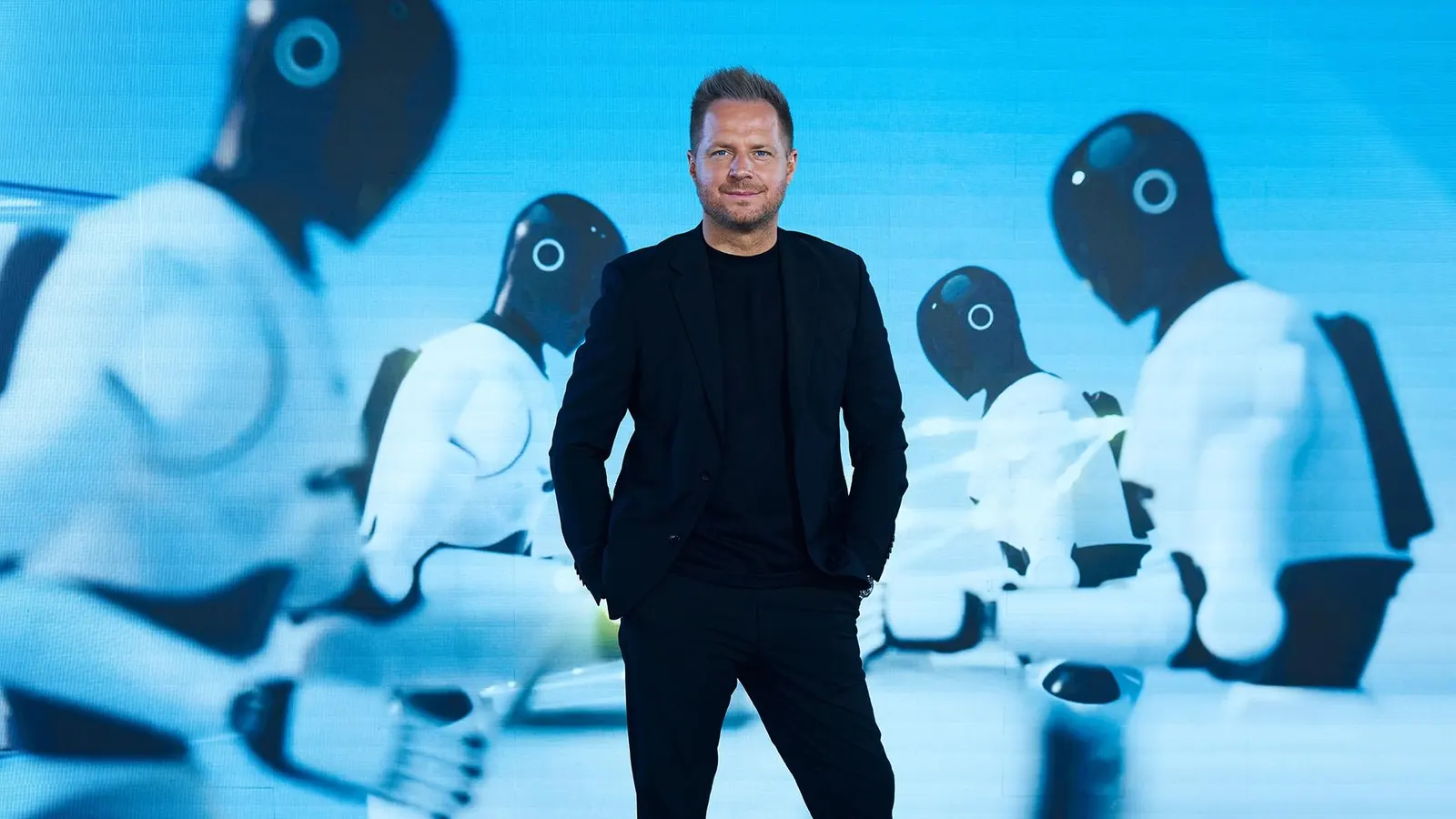
David Reger, a 38-year-old robotics entrepreneur with an outsized and infectiously confident ambition, does not want to merely build clever machines. He wants Neura Robotics to become the largest taxpayer in Europe one day—a strange goal for a young startup, but one that reveals how deeply he believes in the industrial rebirth of his home country. Founded in 2019 in Metzingen, a small town twenty miles south of Stuttgart, Neura operates in the cradle of German automotive power, surrounded by the ghosts and pioneers of Mercedes-Benz, Porsche, and Bosch. But Reger has chosen a different lane: cognitive robots, machines that can think, learn, and collaborate with people, including humanoid robots that look like they belong on a movie set. In June, Neura closed a financing round of up to $1.4 billion, led by Tether, the controversial cryptocurrency company behind the world’s largest stablecoin, with additional backing from Nvidia, Amazon, Qualcomm, Bosch, Schaeffler, and the European Investment Bank. The round valued Neura at roughly $7 billion, making it one of Europe’s most valuable robotics startups. Reger owns about 20 percent of the company, giving his stake a paper value close to $1.5 billion. One of his most enthusiastic supporters is Stephen J. George, a former Goldman banker and ex-manager of billionaire Jeff Skoll’s family office, whose Omaha-based firm InterAlpen Partners made its first investment in Neura in 2023. George, with a nod to the carmaker headquartered half an hour away, compares Neura to “Apple meets Mercedes-Benz.” It is a lofty comparison, but Reger thrives on lofty comparisons.
The most unusual part of Neura’s strategy is what Reger calls robot gyms—facilities where clients can rent dedicated training cells equipped with simulation environments and tracking technology to teach the robots they purchase from Neura how to do specific jobs. When one robot learns a skill, that knowledge can be uploaded to Neura’s cloud-based platform, Neuraverse, and transferred to other machines owned by the same customer. In Reger’s vision, companies will eventually trade and lease those skills too, creating an economy around robot experience that has never existed before. For now, much of this is still promise rather than reality. Neura’s actual revenue, which the company declines to disclose, still depends heavily on more conventional collaborative robots—mechanical arms, wheeled carts, and combinations of the two. The company’s most recent financial statement, from 2022, showed a loss of nearly $7 million, but Neura says its orderbook now exceeds $1.1 billion, about half of it tied to its existing cobot fleet, and it claims an $11 billion pipeline of signed agreements with varying levels of commitment, roughly 80 percent of which relates to humanoids, robot gyms, and the Neuraverse. The machine Neura is pinning its future on is the 4NE1, a five-foot-eleven, 176-pound humanoid in white and black that looks as though it could have been cast for a dystopian sci-fi thriller. Yet the competition is brutal. Chinese manufacturers shipped 19,100 humanoids in the first half of the year, about 97 percent of all the humanoids sold worldwide, and Silicon Valley’s Figure was valued last year at $39 billion—more than five times what Neura is currently worth. None of that seems to shake Reger’s conviction that he can put Europe back in a technology race it has mostly watched from the sidelines.
Reger’s commitment to Europe is not abstract. It was forged in San Francisco in 2009, when, at twenty-one and just after the financial crisis, his family urged him to do social work before beginning his career. He moved to California and became a case manager for homeless people, planning to stay in America. But what he saw on the job sent him home after eighteen months with a newly awakened appreciation for Germany’s social safety net. That safety net, he realized, depends on workers—and Germany is running out of them. As baby boomers retire, the country’s workforce is expected to shrink by about 4.3 million people by 2036, according to the German Economic Institute. Robots, Reger argues, will have to fill part of that gap, and if Germany is going to depend on them, it should build them itself. He worries that Europe has become dangerously reliant on foreign countries for critical resources, from oil to semiconductors, and he sees AI-driven physical technology as a chance to rebalance. “Europe cannot preserve its prosperity, its social systems and its relevance in the world if we only consume the next generation of technology from somewhere else,” he says. “We have to create enormous new value here again. Physical AI gives us that opportunity.” Born in 1988 and raised near Rottweil in southwestern Germany, Reger grew up as the oldest of eleven siblings. His father worked at a nearby automotive supplier, his mother stayed home, and on Saturdays the boy cleaned machinery at the plant. He skipped university in favor of a three-and-a-half-year apprenticeship as a mold maker, learning to build the tooling used to cast industrial parts. He had never touched a robot when MABI, a Swiss machinery maker, hired him in 2011 and offered him a choice between robotics and 3-D printing. He picked robots because he figured they might someday do the printing anyway. “I had no clue about robots,” he admits. “I pretended I had a clue.” He taught himself at night from YouTube videos, and within a year his small team was demonstrating a large robotic industrial arm at Automatica, Munich’s big automation fair.
In 2018, after seven years at MABI, Reger brought a bigger idea to its board. Most factory robots then sat behind fences, repeating the same task over and over. He wanted machines that could be taught new jobs, with what they learned stored on a shared software platform so engineers would not have to rebuild the automation every time. The board liked the idea but told him he was five or six years too early. Reger concluded that waiting would only make him late, so he partnered with Han’s Robot, a Shenzhen-based cobot maker backed by automation giant Han’s Laser Technology, to establish a German-based collaborative robotics venture called Han’s Robot Germany. He recruited about a dozen robotics scientists and engineers, including some of his former colleagues at MABI, and the Chinese company took a 70 percent stake, combining its robotic hardware with the German team’s software, sensor, and systems expertise. The venture eventually became Neura. In June 2023, Reger arranged for a group of European investors to buy out Han’s ownership for $11 million—by which point ChatGPT had made artificial intelligence the hottest trade in the world and investors were searching for ways to put AI into physical form. A month after the Chinese sold, Neura announced another $55 million raise from European investors. Why did Han’s sell what looks in hindsight like a bargain? The relationship remained close. Neura continued to buy a large share of its collaborative industrial robots and components from Huayan Robotics, as Han’s Robot was later renamed, and Neura supplied Huayan with high-performance reducers, the precision gearboxes that move a robot’s joints. Huayan built those reducers into the robots it made for Neura and was free to use them in robots for other customers. Reger insists that neither Han’s Robot nor Han’s Laser retained any equity or rights to Neura’s intellectual property. To date, Neura has made most of its money selling robot arms priced between roughly $18,500 and $44,000, wheeled robots that carry parts around factories for about $50,000, and machines that combine both functions. Reger is deliberately vague about how many machines he has sold since the launch of Neura’s first robot in 2021, estimating only between five thousand and eight thousand, many sold under the brands of partner robot makers such as Kawasaki Heavy Industries, Omron Robotics, and Taiwan’s Delta Electronics. He argues that Neura owns the entire core stack of its technology—motors, encoders, and safety detection sensors—even if it does not manufacture every part itself. German suppliers like Bosch and Schaeffler provide components for its humanoids, including actuators, the muscles of robots that can account for half of a robot’s component cost. Nvidia supplies simulation and AI computing, Amazon hosts the cloud-based Neuraverse, Qualcomm supplies processors for the robot’s brain and nervous system, and Tether wants to embed its wallet software inside Neura’s robots so that autonomous machines can eventually transact with each other. Paolo Ardoino, Tether’s billionaire chief executive, says autonomous machines need to process information locally, make decisions, and transact without centralized intermediaries. Reger shares that vision. “The future will be that every robot has its own wallet,” he says.
Demand for humanoid robots, at least in the form of eagerness and pilot projects, seems enormous. Reger claims twelve thousand companies contacted Neura in the last year, mostly about its humanoids, but he says Neura currently has the ability to make only enough robots for about a hundred customers. Companies are willing to pay $300,000 to $550,000 for what he calls a “nice demo,” which includes the price of a single humanoid robot—about $110,000 for Neura’s latest model—plus annual fees for training, deployment, and maintenance. Running humanoid pilot programs for customers is resource-intensive, often requiring Neura’s own engineers to travel to someone else’s factory and disrupting progress on improving the technology. That is why Reger decided to build robot gyms where companies can rent space and have their own workers train the robots themselves. Unlike large language models that learn from information online, robots need to learn how to interact with the physical world. To pick up a car part, a robot must learn where to reach, how firmly to grip, and how to place the part in the right location. That requires demonstrations and repeated practice. It is also expensive: Neura and its partners committed $19 million to a facility at Munich Airport, not including staffing, and rent at such gyms can run into tens of thousands of dollars. The gyms are already attracting customers, some booking as many as twenty training cells for at least a year. Universities are also part of Reger’s plan. Research institutions lack money and lose promising PhDs to startups, so a robot gym on campus can give them access to expensive machines and provide Neura with researchers to help train its robots. The Technical University of Munich is a partner in the airport facility, and a three-thousand-square-meter site is being developed at RWTH Aachen University’s Melaten research campus. Neura expects to have five gyms operating by the end of the year—three in Germany, one in China, and one in the United States—with ten more in development, including facilities in Detroit and San Diego. Data collected during training can be stored on Neura’s “brain accounts” on Neuraverse, allowing companies to transfer skills across their fleets or eventually sell those skills to others. “Ultimately, our goal is that once a skill has been learned, it does not have to be engineered again for every individual robot,” Reger says. But the gyms already face competition. Supplier Schaeffler operates its own humanoid gym in Erlangen, has invested in rival Agility Robotics, and is using Digit humanoids in its American factories. Neura’s humanoids are also still finding their footing. At the high-profile unveiling of the 4NE1 at Automatica in June 2025, Reger could only show a motionless prototype because, according to a spokesperson, an unexpected highway closure delayed the working robot. A year later at Computex in Taipei, a newer version of the robot walked onstage carrying a tray of Qualcomm hardware and then collapsed backward; Qualcomm blamed a communication glitch that triggered the robot’s built-in safe-collapse sequence. Neura’s latest humanoid, Gen 3.5, is priced at an estimated $110,000, or $62,000 each when purchased in quantities of twenty or more, but the company refuses to say how many humanoids it has actually built and deployed. Reger nonetheless says Neura will be able to deliver five million cognitive robots by 2030, including humanoids. By comparison, the International Federation of Robotics counted only about seven thousand full-size humanoid robots sold worldwide last year, many bought not to work but to generate training data for AI models.
China is leading the humanoid race. Shanghai-based AgiBot accounted for 44 percent of global humanoid shipments in the first half of 2026, about 8,400 robots, according to market research firm Smart Analytics Global. Runner-up Unitree, based in Hangzhou, sells its basic G1—a stripped-down humanoid that can walk but lacks dexterous hands and cannot be programmed by its owner—for about $13,500, roughly an eighth of the price of Neura’s 4NE1. Unitree booked $253 million in revenue in 2025 and shipped more than 5,500 humanoids, though research firm SemiAnalysis estimates only about 250 of those are doing real work. After Unitree listed in Shanghai in August 2026, investors briefly valued the company at $66 billion, before the market value plunged to $24 billion as the gulf between enthusiasm for humanoid robots and their actual commercial usefulness became impossible to ignore. American makers still have plenty to prove as well. Figure has built about a thousand humanoids, though it is unclear how many have been deployed, while Tesla is building several hundred Optimus humanoid robots a week but cannot yet get them to reliably handle a wide range of tasks. Neura also faces international trade barriers: in July, the U.S. Federal Communications Commission added foreign-made advanced robotic devices to its Covered List, a national-security roster of equipment barred from FCC authorization, covering humanoids, four-legged robots, and autonomous mobile robots. Fixed industrial arms, a good chunk of Neura’s business, and previously authorized models are exempt, but foreign makers can bring a new robot to the American market only after a review of manufacturing and supply chains. Neura told Forbes it is developing manufacturing capacity in Detroit for wheeled robots and humanoids, targeting 2027, and until then it will need clearance for its new machines. Reger’s larger ambition, however, remains anchored at home. For more than a century, the world has driven machines built in this corner of Germany. Now he wants the region to build the machines that do the world’s work. “Europe has the engineering talent, industrial knowledge, manufacturing base and thousands of companies that understand the physical world,” he says. “If we combine that with AI and move fast enough, I believe we can create an industry that becomes bigger than automotive.” Whether that dream becomes reality or remains a beautiful, human-sized delusion, Reger has already made robots the symbol of Europe’s fight to stay relevant—and turned his own unlikely career into a story about believing you can learn anything if you care enough to pretend and then work through the night to make the pretense true.