


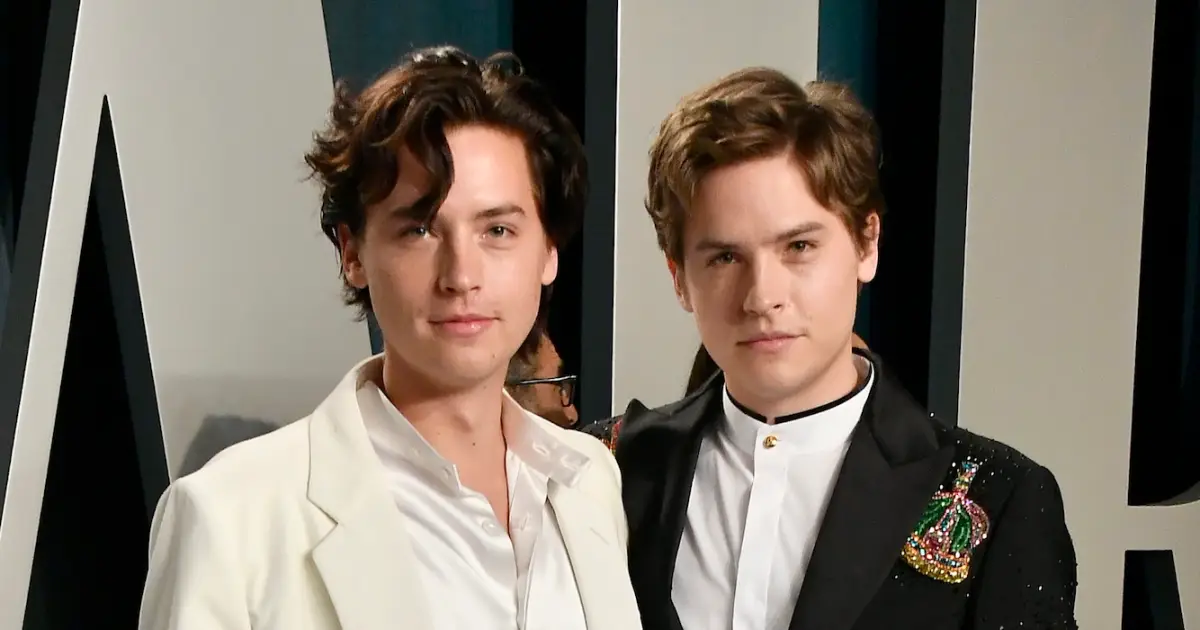
Here is the story of a Tuesday like no other, a story that begins with two brothers who once ruled Disney Channel lunchboxes and ends with a genealogy report that sounds less like a family tree and more like a tangled vine. On the morning of October 20, Cole Sprouse did what most of us would do after reading a headline about ourselves: he picked up his phone, took a screenshot, and posted it to his Instagram Story with a caption of pure, unvarnished bewilderment. “No media training on earth can prep you to read this clickbait headline at 10am,” he wrote. The headline in question was about his twin brother, Dylan Sprouse, and it contained a phrase that no one ever expects to see attached to their own siblings: “children of incest.” It sounds like the setup to a joke or the plot of a very strange telenovela, but for Cole and Dylan, it was just another Tuesday in a life that has been public since childhood. To anyone who grew up watching The Suite Life of Zack & Cody, the Sprouse twins feel like familiar fixtures of our own youth—the mischievous redheads who made hotel living look like the greatest adventure ever imagined. Now, all these years later, they have given us a different kind of adventure: a family mystery so strange, so personal, and so awkwardly hilarious that the internet had no choice but to sit up and pay attention.
The whole thing started when Dylan appeared on the Wildmen podcast and decided to talk about his experience using Ancestry, the genealogy company that has turned millions of ordinary people into amateur detectives. Dylan, who rose to fame alongside Cole in Big Daddy and later in the Suite Life franchise, explained that his father’s side of the family had always been something of a mystery. It was fractured, he said, and the process of tracing his roots through Ancestry had introduced him to relatives he had never even known existed. But the deeper he dug, the closer he got to something genuinely shocking. “Long story short, Cole and I are children of incest,” Dylan said. It was one of those sentences that makes you rewind the tape, certain you must have misheard. But he wasn’t joking, and he wasn’t being sensational. He was simply telling a story that had, until recently, been completely unknown to his parents. “It’s my dad and my mom. They had no idea,” Dylan continued. The revelation apparently came after a long conversation with his father’s side of the family, during which Dylan discovered things that made him question everything he thought he knew about his own bloodline. Among those discoveries was a detail that sounds pulled from a medical textbook and a horror film at the same time. One of his aunts had been a twin, but her twin had been absorbed in the womb, a phenomenon often referred to as a vanishing twin. Even stranger, when doctors later cut open a cyst in that aunt’s shoulder, they found teeth and hair inside. It is the kind of detail that stops you cold, and Dylan shared it with the tone of a man who was still processing the sheer strangeness of his own family history.
The genealogy research painted a picture that was less about scandal and more about coincidence, timing, and the strange ways human beings migrate. Dylan explained that both sides of his family, his mother’s and his father’s, had traveled to California during the Gold Rush era. At the time, California was a place of promise and possibility, a destination for people willing to risk everything for a chance at something better. One set of Dylan’s relatives, apparently, struck gold, and that success allowed them to bring even more family members to the Golden State. Both families settled, grew, and eventually, their paths crossed. In the late 1800s, members of these two families were joined by marriage, an event that at the time seemed ordinary, perhaps even inevitable, given how close their communities were. But then, as Dylan described it, the family lines diverged. They went their separate ways, married other people, and carried on with their lives. Generation after generation, the memory of that earlier union faded, and the two branches of the family tree stopped looking like branches at all. They became two separate trees, planted in the same yard, with roots that quietly touched beneath the surface. Then, in what Dylan calls “the last generation,” his mother and his father fell in love and married each other, unknowingly bringing those two distant branches back together again. It was not the kind of incest that immediately calls to mind something taboo or intentionally hidden. It was the result of hundreds of years of movement, chance, and the simple truth that the world is smaller than we think. Still, when the Ancestry data loaded and the connections became clear, Dylan found himself staring at the screen with a sense of disbelief that bordered on existential vertigo.
For Dylan, the most suspicious clue was the twins. He had always believed that twins, or at least the tendency to have them, came from his mother’s side of the family. That belief seemed reasonable enough. His mother’s family had a history of twins that stretched back through multiple generations. But when he started talking to his father’s relatives, he learned something that shattered that assumption. His father’s uncles were identical twins. That was a problem, because identical twins do not just happen randomly; they are often the product of a genetic predisposition, and if both sides of the family had a strong history of twins, it suggested something deeper was going on. “I’d only ever thought that identical twins or twins in general came from my mom’s side of the family,” Dylan said. The more he looked, the more the pattern emerged. “We had seven sets of twins in four generations,” he explained, “because it’s the same family!” That was the moment everything clicked into place. The reason so many twins had been born across the Sprouse family tree was not a coincidence, and it was not simply genetics smiling on one lucky side of the family. It was because the mother’s side and the father’s side were not as separate as everyone had believed. The family tree was not a tree at all. It was a circle. Dylan called Cole immediately, eager to tell him what he had uncovered, and the conversation that followed must have been one of the strangest calls between twin brothers in recent memory. He described the moment almost with amazement, as if he were telling the plot of a mystery novel that happened to star his own parents. There is something unexpectedly moving about the image of Dylan, sitting with a pile of documents and a screen full of names, calling his brother to say, “Dude, I just found out some f**king crazy s***.”
Cole’s response, after he got over the shock of seeing it turned into sensational headlines, was surprisingly lighthearted. He did not issue a denial, and he did not seem particularly offended by his brother’s blunt wording. Instead, he seemed resigned to the absurdity of the situation, the way anyone might be after years of tabloid attention. But the day had one more twist waiting for him. That evening, Cole shared a second Instagram Story, and this time it was about something entirely different. He posted a selfie and casually mentioned that it was that time of year again when he gets tagged in Victoria’s Secret content because people still do not know who married Barbara Palvin. For those unfamiliar with the intersection of celebrity and social media, Barbara Palvin is a Hungarian model and a Victoria’s Secret Angel, but, more importantly, she is Dylan Sprouse’s wife. The confusion is understandable, at least in a surface-level way. Cole and Dylan are identical twins, and for decades, the public has had trouble telling them apart. So when Palvin posts something glamorous and daring, and one Sprouse brother gets tagged by fans who cannot quite remember which brother is the husband, Cole becomes the accidental recipient of a flood of fashion content he had nothing to do with. “It’s that time of the year again,” he wrote, neatly capturing the weary humor of a man who has been confused for his brother his entire life. It was a perfect comedic follow-up to the morning’s incest headline, and it reminded everyone that, at the end of the day, these two men are just brothers trying to live their lives in a world that constantly confuses them with each other.
What makes this story so compelling, beyond the sheer strangeness of the revelation, is the way the Sprouse brothers have chosen to handle it. They have taken something that could be deeply unsettling and processed it with humor, wit, and a genuine sense of wonder. It would have been easy for Dylan to keep the discovery private, to sit with the knowledge and let it become a family secret. Instead, he went on a podcast and told the world, not because he wanted to shock anyone, but because it was just too interesting not to share. And it would have been easy for Cole to respond with anger or embarrassment after seeing his name attached to such a provocative headline. Instead, he made a joke, shrugged his shoulders, and moved on. That is the mark of people who have been in the public eye since childhood and have learned that the only way to survive the absurdity is to embrace it. The story also speaks to something larger about the age we live in. DNA testing has become a kind of modern oracle, revealing secrets that our grandparents never imagined could be uncovered. Families are being reunited, histories are being rewritten, and occasionally, people are forced to confront the fact that their ancestors’ lives were far more complicated than they ever expected. This is not unique to the Sprouses. It is happening in living rooms all over the world every day. But because the Sprouses are famous, their story becomes a mirror for the rest of us, a reminder that we are all made of a thousand stories, some of them beautifully ordinary and some of them strange enough to make you pause. In that way, the most human thing about this entire saga is not the genealogy report itself, but the fact that two brothers, born minutes apart, can face a bizarre family secret together and still find a way to laugh about it. They did not choose the family they were born into, but they did choose how to respond to the news, and they chose to respond as brothers: facing the absurdity side by side, cracking jokes, and reminding us all that family, no matter how tangled, is still family.