


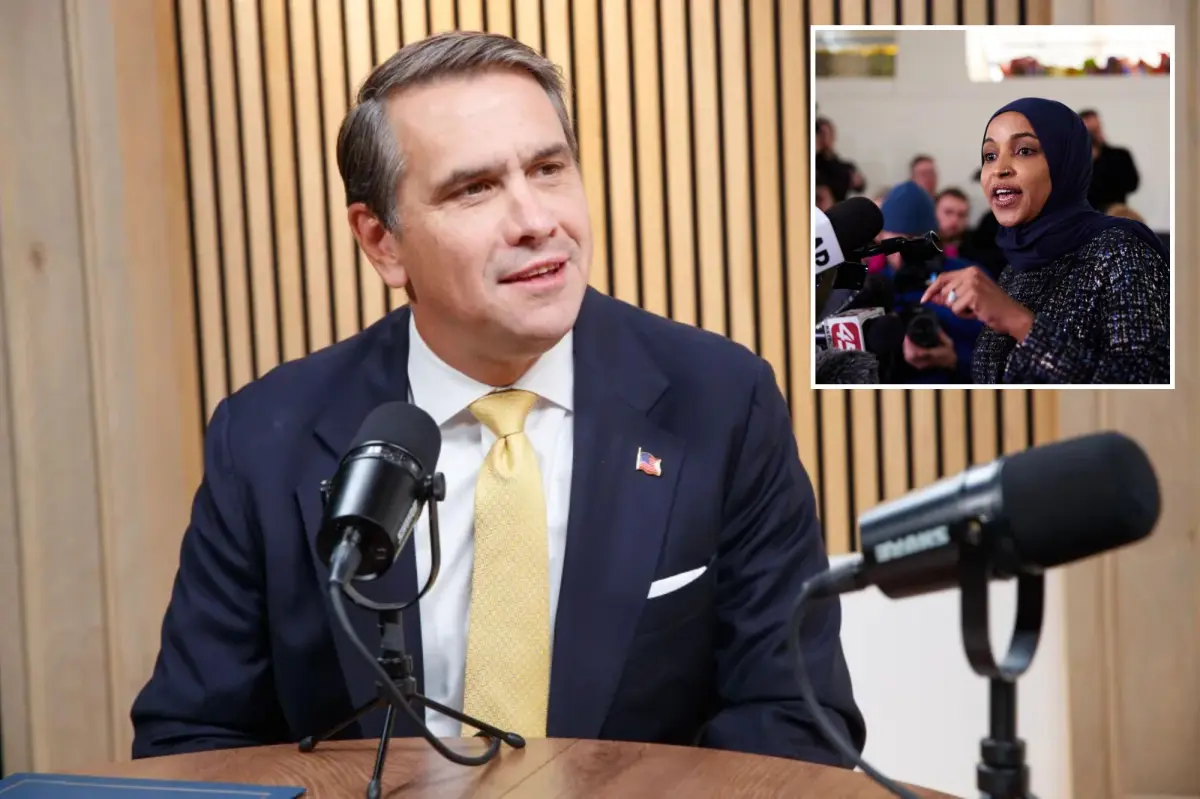
There’s something almost surreal about watching the machinery of American justice touch a sitting member of Congress, especially one as polarizing as Representative Ilhan Omar. She has been in the news for months because of a federal immigration fraud investigation—a serious matter involving allegations that have fueled endless political commentary. But what stood out recently wasn’t just the investigation itself. It was the fact that Omar has been speaking about it loudly, publicly, and without restraint. She has insisted she will not be silenced. And according to Attorney General Todd Blanche, that’s exactly how it should be. Speaking on the latest episode of “Pod Force One,” a weekly show hosted by New York Post columnist Miranda Devine, Blanche made an important point about the difference between how the Justice Department is handling Omar’s case and how the prior administration handled investigations involving Donald Trump. Blanche, who served as Trump’s personal attorney when the then-president was juggling four criminal indictments during the 2024 campaign, couldn’t discuss the details of Omar’s case. But he could speak about the principle, and he did so with clarity: his Justice Department is not trying to keep Omar quiet. In fact, he said, the opposite is true. There’s no effort to muzzle her, no rush to impose gag orders, no attempt to make an example of her. That, he was quick to add, marks a sharp departure from the recent past.
Blanche’s comments carry weight because he lived through the alternative version of American justice. He was at Trump’s side during the federal indictment in Washington, the classified documents case in Florida, the election interference charges, and the state-level cases in New York and Georgia. He saw how the legal system was used against his client in ways that went far beyond courtroom procedure. He watched judges issue gag orders that limited what Trump could say about his own legal troubles, often while the accusations were being blasted in every news cycle. So when Blanche says that the Department of Justice under his leadership is not trying to silence Ilhan Omar, he isn’t just making a clean legal point. He’s drawing a direct comparison that feels deeply personal. “To the extent that she’s commented on it, one of the things that she said is that we’re not going to keep her quiet, right? We’re not trying to keep her quiet,” Blanche told Devine. He went on to emphasize that there is no effort by the Department of Justice to suppress her speech, and then he contrasted that with the last DOJ, which he said “worked very hard to keep President Trump quiet by getting gag orders and the like.” For him, this isn’t a technicality. It’s a difference in philosophy.
The history here matters. Former Special Counsel Jack Smith aggressively pursued gag orders against Trump in both the election interference case and the classified documents case. Smith was successful in getting limits imposed in the election interference matter, but a judge denied the request to silence Trump in the classified documents case. Those were federal efforts, but Trump also faced gag orders in state-level proceedings, including his civil fraud trial and the “hush money” case in Manhattan. At one point, Trump was under multiple court-imposed restrictions simultaneously, barred from discussing witnesses, court staff, and even prosecutors in some instances. His lawyers argued that those restrictions were unfair and unconstitutional, especially for a presidential candidate trying to communicate with the American people during a campaign. Democrats and legal observers defended the gag orders, arguing that the former president’s public statements could intimidate witnesses and undermine the integrity of the proceedings. Regardless of which side you believe, the reality is that Trump was heavily restricted in what he could say about his legal battles. Now, a Democratic congresswoman is under federal investigation, and she is speaking freely. Her case has generated enormous media attention, and she has appeared on television and social media, publicly criticizing the investigation and framing it as a political attack. Blanche, echoing the broader frustration within the Trump world, sees that as a glaring inconsistency.
That inconsistency, Blanche argues, is why Democrats are now “gaslighting the American people” when they suggest that Trump is “weaponizing” the Justice Department against the “Squad” congresswoman. The accusation is that Trump, now back in the White House, is using federal law enforcement to retaliate against his political enemies. It’s a serious claim, one that has been repeated by Omar and her supporters since the investigation became known. But Blanche pushed back hard, noting that the weaponization narrative ignores what Democrats and their allies did to Trump over the past several years. He pointed out that Trump was not just indicted once, but multiple times, in multiple jurisdictions. And it wasn’t just federal prosecutors coming after him. Blanche referenced the New York attorney general, Letitia James, who pursued a civil fraud case that threatened Trump’s business empire, his family, and his legacy. “There’s an attorney general in your state in New York that tried to destroy not only him, his family, his children, his business, okay, but yet we’re weaponizing,” Blanche said. He was clearly frustrated by the double standard, and he wasn’t shy about calling it out. He noted that the Trump administration has actually spent significant time at the Department of Justice working on an anti-weaponization task force, specifically looking at what happened over the past several years. In other words, the current DOJ sees the previous handling of Trump’s cases as a cautionary tale, not a model to follow.
For Blanche, the public is not fooled by the Democrats’ sudden concern about prosecutorial overreach. “I don’t think, I know, the American people see right through that,” he said. That’s a bold assertion, but it reflects a belief held by many Trump supporters and even some independents who watched the former president endure years of legal warfare while campaigning for reelection. They watched federal agents execute a search warrant at Mar-a-Lago. They watched a mugshot of a former president being taken in Fulton County, Georgia. They watched judges issue orders that limited his speech while he was running for the highest office in the land. And now, they see a member of the far-left “Squad” being treated with a level of deference that Trump never received. For Blanche, that’s not justice. That’s a double standard dressed up as fairness. And he’s not alone in noticing. The conversation on “Pod Force One” touched on the deeper emotional toll of those years, and Blanche opened up about what it was like to watch Trump navigate one of the most extraordinary legal dramas in American history. Asked about Trump’s mood when the justice system was bearing down on him, Blanche described a man who was angry, frustrated, and deeply aware of the gravity of the situation, but somehow never broken. He was “frustrated and mad and angry,” but he was also remarkably resilient. There was never a moment, Blanche recalled, when Trump seemed defeated. Even when the walls appeared to be closing in, Trump found a way to channel the chaos into energy.
Perhaps the most striking story Blanche told was about the Atlanta mugshot. When Trump was booked in Fulton County, it was a historic and humiliating moment. No former president had ever posed for a mugshot. In the federal cases, authorities didn’t take a mugshot, and they didn’t take one in Manhattan either. But in Atlanta, they did. Blanche remembered thinking, “Oh no.” Here was a man who had once held the most powerful office in the world, now being processed like a common criminal. It would have been the darkest day for almost anyone. But Trump’s reaction surprised even his own lawyer. “What happens? He loved it,” Blanche said. The mugshot, far from being a low point, became a rallying cry. It was turned into merchandise. It was emblazoned on T-shirts and posters. It became the visual symbol of a political movement that refused to bow to the justice system. Trump took something designed to humiliate him and turned it into a weapon of political communication. “So even something that you would think would be, ‘Wow, that must have been the darkest day,’ not for him. Not for him. That became kind of a rallying cry for him,” Blanche recalled.
That story says a lot about Trump’s psychological resilience, but it also says something about the current state of American politics. The country is divided not just over policy, but over the very meaning of justice. To some, the investigation into Ilhan Omar is a long-overdue reckoning for someone who has spent years at the center of controversy. To others, it’s a cynical attempt by Trump to use the power of the federal government against a political opponent. To Blanche, though, the distinction is clear. He sees a Justice Department that is following the law without trying to silence a defendant. He sees a president who went through hell and came out stronger, not because he was treated unfairly, but because he refused to be broken. And he sees a political class that is suddenly worried about due process only when one of their own is under scrutiny. Whether you agree with Blanche or not, his words offer a glimpse into how the people closest to Trump view the legal battles that defined his return to power. For them, the lesson of the past few years is not that justice is blind. It’s that fairness depends on who is in charge. And right now, they argue, the system is finally operating the way it should have been all along. The irony of Omar’s situation is not lost on anyone. She built her political career on being a bold, outspoken progressive who takes on the establishment. Now, she is the one being investigated by a federal government controlled by her greatest adversary. But at least, in this one respect, she is being afforded a right that Trump never had: the right to speak her mind.