


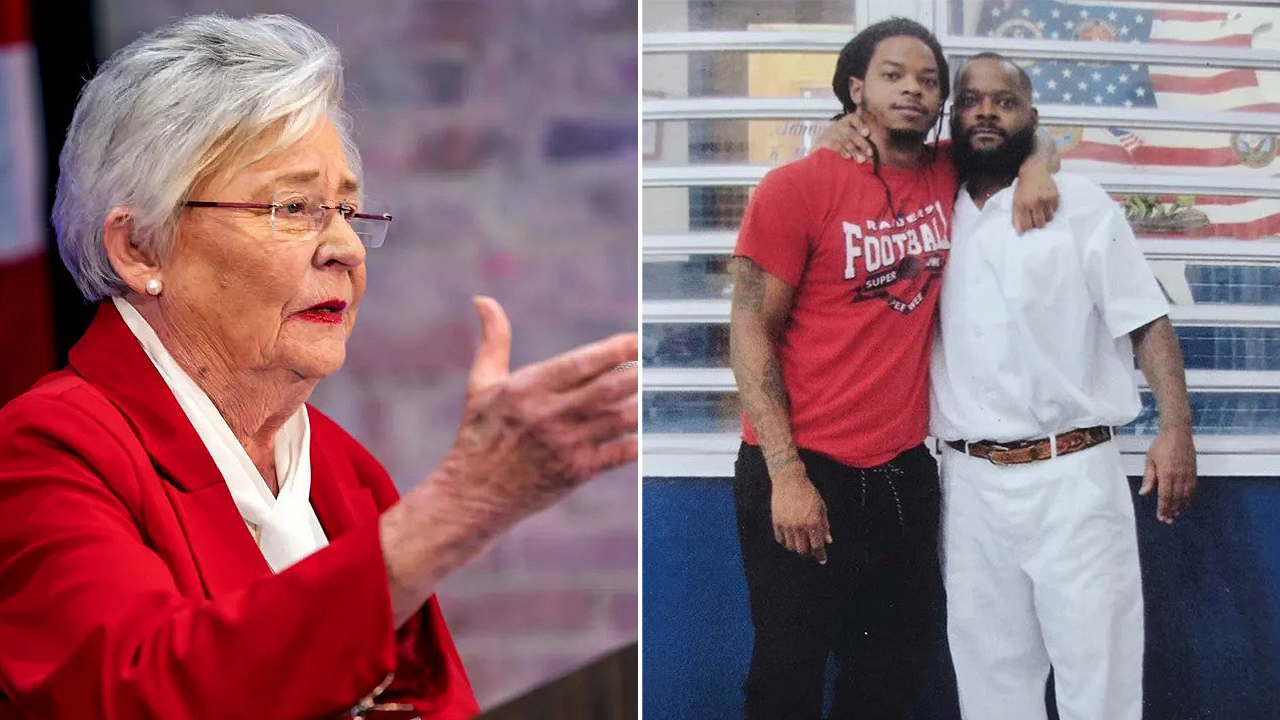
On an otherwise ordinary Tuesday in Alabama, Governor Kay Ivey made a decision that would forever alter the course of a man’s life and reignite an old and painful debate about justice, punishment, and doubt. The Republican governor commuted the death sentence of Toforest Johnson, a man who has spent decades on death row for a crime he insists he did not commit. Johnson was convicted in the 1995 murder of Jefferson County Deputy Sheriff William Hardy, a law enforcement officer who was shot twice in the head while working a private security detail outside a hotel in Birmingham. For years, Johnson has maintained his innocence, and his case has become one of the most closely watched death penalty controversies in the South. With a single stroke of clemency, Ivey did not declare him innocent, but she did spare him from the state’s ultimate punishment. Instead of facing the possibility of execution, Johnson will now spend the rest of his life in prison without the possibility of parole. He remains housed at the Holman Correctional Facility, where death row inmates in Alabama are held. For Johnson, the decision is not freedom, but it is a profound reprieve. For his family, his lawyers, and the many people who have fought for years on his behalf, it is a moment of relief and renewed hope. For the family of Deputy Hardy, it may feel like a betrayal of the justice they were promised. That is the nature of clemency: it is a human act in a system built on rules, and it rarely leaves anyone fully satisfied. But in this case, it means that a man who has always said he was on the other side of the city when the shooting occurred will not be put to death by the state of Alabama.
Governor Ivey’s explanation for her decision was careful and measured. In a statement, she said she had concerns that there was not enough direct evidence to carry out the most serious punishment available under the law. She was careful to say that her decision was not a determination of innocence, but rather a recognition that the circumstances of Johnson’s case justified commuting his death sentence to life imprisonment without the possibility of parole. That distinction matters. In the American criminal justice system, death is supposed to be reserved for the worst of the worst, for cases where guilt is beyond any reasonable doubt and the evidence is so overwhelming that no fair-minded person could question the verdict. Ivey’s words suggested that Johnson’s case did not meet that standard. This is not a governor who is known for being soft on crime. Since taking office in 2017, Ivey has overseen 27 executions in Alabama, one of the most active death penalty states in the country. She has now commuted the death sentences of three death row inmates, a small but significant number in the broader context of her tenure. Her time in office will end in January because she is term-limited and cannot run for re-election. That timing may have given her the freedom to make a decision that could otherwise have been politically dangerous. Attorney General Steve Marshall had urged her just last week to reject the clemency request and to respect the jury’s decision and the rulings of the courts that reviewed Johnson’s case. His opposition was forceful, but in the end, it was not enough. Ivey chose to listen to the voices of doubt, the evidence that had unraveled over the years, and the growing number of legal experts who believed that Johnson’s conviction was not reliable enough to justify the death penalty.
The case against Toforest Johnson has always rested on a complicated and, to many observers, shaky foundation. On July 19, 1995, Deputy William Hardy was doing his job, providing security outside a hotel in Birmingham, when someone approached him and shot him twice in the head. It was a brutal and senseless killing, the kind of crime that demands accountability. But Johnson has always said he was on the other side of Birmingham when the shooting happened, and over the years, witnesses have come forward to support that claim. He was convicted in 1998, but the road to that conviction was not smooth. His attorneys have spent years waging a legal battle to secure a new trial, arguing that the evidence against him was thin, that key witnesses were unreliable, and that prosecutors withheld information that could have changed the outcome. That effort has attracted national attention and won support from an unlikely coalition of people, including prominent lawyers, former judges, former prosecutors, and celebrities like Kim Kardashian. One of Johnson’s attorneys, Ty Alper, said he and his client are grateful to Governor Ivey for diligently reviewing the case and for taking action to spare an innocent man from execution. But he also made it clear that the fight is not over. In a statement, Alper said that Toforest Johnson is innocent and that it is now up to the courts to overturn his conviction and grant him a new trial. “We will keep fighting until he is home with his family,” he said. That is a powerful reminder that commutation, while life-saving, is not the same as exoneration. Johnson is still convicted. He is still imprisoned. He is still fighting to clear his name and prove that he had nothing to do with the murder of Deputy Hardy.
At the heart of Johnson’s appeal is a growing body of evidence that the original case against him has fallen apart under scrutiny. Jefferson County District Attorney Danny Carr, who was elected in 2018 and is the top prosecutor in the very jurisdiction where Johnson was convicted, has joined the call for a new trial. In 2024, Carr filed a court document in which he wrote that the evidence in this case has unraveled over 20 years. That is a striking statement coming from the office that is supposed to represent the state’s interest in finality and justice. Carr pointed to credible alibi witnesses who place Johnson in another area at the time of the shooting. He also raised serious questions about the reliability of the key prosecution witness, a woman who claimed she overheard Johnson confess to the murder during a three-way phone call that she was eavesdropping on. That testimony was central to the conviction, but it was also strange. The woman did not see the shooting. She did not have direct knowledge of what happened. She claimed that she happened to be listening in on a phone call and heard a man she believed to be Johnson admit to the crime. Years later, it was revealed that she received a $5,000 reward in 2001 for her assistance in the case. Johnson’s lawyers have argued that the state withheld evidence of that monetary incentive from the defense, which would have allowed them to challenge her credibility more aggressively. The idea that a conviction so dependent on a single questionable witness, a witness with a financial stake in the outcome, could result in a death sentence is deeply troubling to many people, regardless of where they stand on the death penalty.
The support for Toforest Johnson is not limited to activists or celebrities. It includes some of the most respected legal voices in Alabama, people who have spent their careers in the criminal justice system and who are not typically moved by emotional appeals. Former Alabama Attorney General Bill Baxley, former Chief Justices of the Alabama Supreme Court Sonny Hornsby and Drayton Nabers, and other former judges and prosecutors have submitted briefs or written editorials backing Johnson’s call for a new trial. Even the original prosecutor in the case has expressed concerns, which is almost unheard of in a high-profile murder case. These are not people who oppose the death penalty on principle. They are people who have seen how the system works from the inside, who understand that wrongful convictions happen, and who believe that Johnson did not receive a fair trial. The fact that such a broad and bipartisan group of legal insiders has rallied behind him speaks volumes. It suggests that this is not just a case about innocence or guilt, but about the integrity of the process itself. When a district attorney, former chief justices, former attorneys general, and even the original prosecutor all raise doubts about a conviction, those doubts cannot be easily dismissed. And when a governor is willing to say that there is not enough direct evidence to carry out the death penalty, it signals that something in this case has gone very wrong. That is why this case has drawn so much national attention. It is a story about human fallibility, about the weight of a life, and about the terrifying possibility that the state could have executed an innocent man.
In the end, Governor Ivey’s decision is both an ending and a beginning. It is an ending because Johnson will no longer face the threat of execution. He will spend the rest of his life in prison, but he will die of natural causes, not at the hands of the state. For a man who has spent decades on death row, that is a monumental difference. It is also a beginning because the fight for his freedom is not over. His lawyers have vowed to continue pressing the courts to overturn his conviction and grant him a new trial. They believe he is innocent, and they are determined to bring him home. For the family of Deputy William Hardy, this case is a painful chapter in a long history of grief. They lost a husband, a father, a protector. They were told that justice had been done when Johnson was convicted. Now they must watch as that conviction is called into question and as the man convicted of killing their loved one is allowed to live. There are no easy answers here. Clemency is never easy. It is a decision that requires looking at a human being and seeing not just a prisoner, but a person with a story, with family, with claims of innocence that cannot be ignored. It is also a decision that requires acknowledging that the justice system, for all its power and authority, is made up of human beings who can make mistakes. Governor Ivey will leave office in January, but her decision in this case will follow her. It will be remembered by those who believe she saved an innocent man, and by those who believe she undermined a jury’s verdict. That is the weight of the choice she made. And for Toforest Johnson, it is the difference between life and death.