

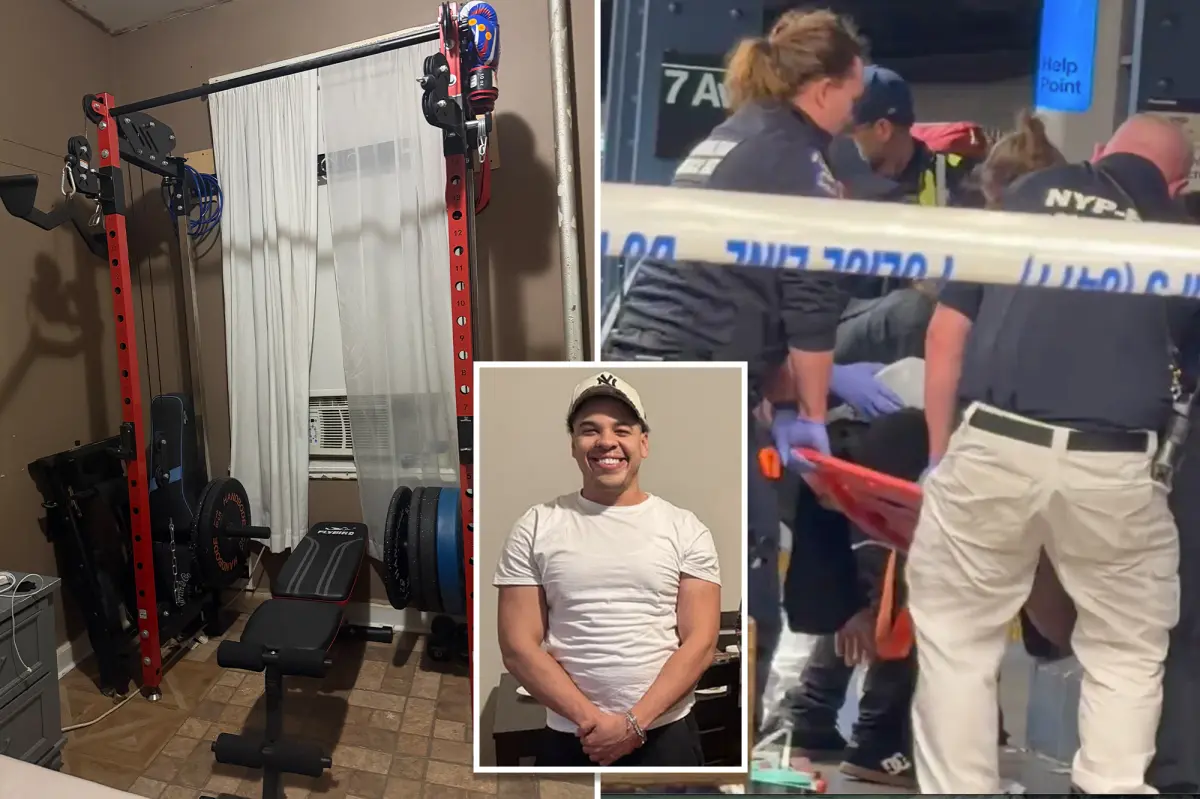
On an ordinary Saturday afternoon, Darrel Rodriguez probably expected to do what he always did: get on the subway, maybe head to work or back to the Bronx apartment he shared with his father. Instead, the 26-year-old straphanger became a name in a headline, a victim of gunfire on a Midtown platform. He was shot in the chest at the 53rd Street/7th Avenue station around 12:20 p.m., and by the time emergency responders arrived, there was little they could do. He died on the northbound E platform, not far from the crowds and noise of a city that barely paused. The news hit his family like a physical blow. His aunt, Ana Pichardo, 61, described a young man who was not a politician or a celebrity, not someone seeking attention, but someone who simply tried to live with purpose. He had two main commitments in life, she said: the gym and work. That is how she remembered him. He was a security guard at a Manhattan building, often manning the front desk, and he would pick up extra shifts whenever he could. He was also a son, and perhaps that was the role he cherished most. Darrel lived with his father, Tony, a man who had suffered a stroke and now struggled to speak. In that small Bronx apartment, Darrel was more than a caregiver; he was a companion, a protector, a kid who still felt a fierce, almost possessive love for his dad. His aunt recalled that Darrel even got jealous when his father started seeing a girlfriend. That image—a young man protective of his father’s attention—shatters the cold word “straphanger” used in the news. He was not just a random commuter. He was someone’s family, someone’s reason to smile. The platform where he died is now a crime scene, but for his family it is the place where the future stopped. They are left with memories, unanswered questions, and a growing sense that the city has lost someone who mattered deeply.
Inside the apartment Darrel shared with his father, the evidence of a full life was everywhere. In his bedroom, he had recently assembled a small home gym with a weight bar. It was modest, but it was his. Tony, his father, can barely speak since the stroke, but when he talked about his son’s workouts, he still managed to convey pride. “Heavy weights, right?” Tony said in Spanish, and his words were translated by his sister, Ana Pichardo. The weight bar was not just exercise equipment; it was a sign of discipline, of trying to stay strong in a world that had already dealt him a difficult hand. Darrel also loved music. He would play rock and roll on his guitar, and he loved to sing. His father could hear him from the next room and feel a sense of peace. There is something profoundly heartbreaking about that image: a young man in his bedroom, lifting weights and playing songs, unaware that his time was short. He was not living a flashy life. He was not posting videos or chasing fame. He was simply showing up—for his job, for his father, for the quiet routine that gave his days meaning. His aunt said he was “crazy about his father.” That phrase carries so much weight. It suggests a bond that went beyond obligation. It was love in its purest form, shaped perhaps by years of watching his father struggle and survive. Darrel was the kind of person who would get jealous when his father had a girlfriend, not out of control, but out of a deep fear of losing his place in his father’s heart. He had made himself indispensable. Now he is gone, and the apartment must feel unbearably empty. The guitar is silent. The weights sit unused. Tony is left with a voice that barely works and a grief too large for words.
The shooting itself was brutally swift and senseless. According to police, Darrel was on the northbound E platform at 53rd Street and 7th Avenue when a masked gunman approached. The man wore a red tracksuit, a black vest, and a facial covering—a costume of anonymity in a city where people usually pass each other without a glance. There was an argument, sources said, but no one knows what started it. Then the gun fired. One bullet struck Darrel in the chest. The masked man ran off into the warren of tunnels and stairways, leaving his victim bleeding on the platform. By the time police and medics arrived, it was too late. In the chaos of a Saturday afternoon, no clear video captured the encounter, and the shooter’s covered face made identification even harder. As of Tuesday night, no arrests had been made. For the family, this is an agony layered on top of loss. They cannot understand why this happened, and they cannot point to a face. His aunt said she had never seen the suspect before. She speculated that the gunman might have been waiting for somebody, chasing somebody—because Darrel was not the kind of person who invited danger. He did not have time for friends, let alone enemies. The lack of video feels like a cruel twist. In a city filled with cameras, the one moment that mattered most slipped through without a record. Police are working to identify the shooter, but the combination of a covered face and no usable footage leaves them with few leads. Meanwhile, the family waits. Every day without an arrest is another day of wondering whether justice will ever come. They are not asking for anger; they are asking for answers. They want someone to be held accountable for taking a 26-year-old man from his father, from his aunt, from the neighborhood that loved him. But for now, there is only silence, broken by grief, and a platform that has been cleaned of blood but not of memory.
To the people who knew Darrel, the shooting seems impossible not because violence is rare but because he was so far from its usual suspects. His longtime neighbor Maddy, 46, had known him since he was a baby. Maddy described him as “a quiet, decent young man” who “didn’t look for problems with nobody.” That phrase—so simple and so devastating—paints a portrait of someone who kept his head down, worked hard, and stayed out of trouble. Maddy was certain that his killer “had to be a stranger,” because “everybody on the block loves him.” That love is easy to believe. In a city where neighbors often become strangers, Darrel was a familiar, reassuring presence. He was the young man who lived with his father, the one who came home from late shifts, the one who nodded hello as he walked to the grocery store. His death has shaken the block in a way that goes beyond shock. It is a reminder that a single bullet can erase a life and transform a community into a waiting room of grief. Maddy’s words also carry an implicit accusation: the shooter did not know who he was killing. He did not see a son, a caregiver, a gym regular, a guitar player. He saw a stranger on a platform, and that was enough. There is something deeply dehumanizing about that. Darrel was not anonymous to the people who loved him. He was a man with a name, a history, a father waiting at home. The fact that his killer did not know him makes the crime feel even more random, more senseless. It also feeds the family’s speculation that the shooter was chasing someone else or waiting for a target that was never Darrel. If so, he died simply by being in the wrong place at the wrong time. That is a hard truth to accept. It makes every subway ride feel less safe, every stranger feel more unpredictable. But for the block, he was not a stranger. He was just Darrel—the good kid, the devoted son, the quiet man who would never look for trouble. And now he is gone.
Perhaps the most intimate window into Darrel’s mind came from a piece of paper on a black clipboard in his Bronx home. It was not a diary or a social media post. It was a handwritten note, clearly meant only for himself. On it, Darrel had written: “I had a hard path, I had no one.” Those words are impossible to read without feeling a knot in your chest. Here was a young man who lived with his father, who worked as a security guard, who seemed so strong and dependable—and yet he privately admitted to feeling alone. In the same note, he wrote what sounds like a pep talk to himself: “What is stopping you is you. Your ineffectiveness to show up for yourself. Always show up for yourself.” He repeated the idea, as if trying to make himself believe it: “Also, that’s the last person to show up for. Show up for yourself. The best person to show up for. Always show up for yourself.” It is the language of self-help, but it is also the voice of someone wrestling with self-doubt. Darrel was not just lifting weights; he was trying to lift himself out of loneliness and uncertainty. He was telling himself to keep going, to be his own champion, because no one else might be there. That note is heartbreaking because it reveals a contradiction. To his father and aunt and neighbors, he was a devoted son and a kind neighbor. To himself, he was someone on a hard path, someone who felt he had no one. Maybe that is why he worked so much. Maybe the gym and the job were ways to fill the silence. At the bottom of the note, he had written: “Need to find a new job.” It is such a mundane, practical reminder—so normal, so human. He was planning a future. He was thinking about paychecks and résumés and next steps. He had no idea that his future would be stolen from him on a subway platform. The note is now a relic, a last trace of a private battle no one fully saw. It also serves as a reminder that we never truly know what the quiet people around us are carrying. Darrel carried his father, his job, his guitar, his weights, and a handwritten promise to show up for himself. In the end, the city failed to show up for him.
Darrel Rodriguez’s death is a tragedy, but it would be even more tragic if he became just another number in the nightly news. He was a 26-year-old who loved his father with a fierce, protective love. He was a gym rat who built a small sanctuary in his bedroom. He was a guitar player who sang rock and roll, maybe off-key, maybe with his eyes closed, lost in the music. He was a security guard who showed up for shifts and wrote himself notes to keep going. He was someone who, despite feeling that he had no one, was surrounded by people who loved him. His aunt is heartbroken. His father cannot speak, and now he cannot even hear his son’s voice. His neighbors are in mourning. And somewhere out there, the masked man in the red tracksuit and black vest is still free. That is a wound that will not heal until justice is done. But even justice cannot bring Darrel back. It cannot return the son to his father or the nephew to his aunt. It cannot undo the argument, the bullet, the blood on the platform. What it can do is say, even imperfectly, that his life mattered. The family’s plea is simple: if anyone knows something, speak. If anyone saw the shooter, come forward. The police need help, and the family needs closure. But beyond the investigation, there is a larger lesson in this tragedy. We live in a city where people rush past each other, headphones on, eyes down. We rarely stop to think that the person next to us on the platform might be carrying a father’s illness, a private note, a heavy weight in a small room. Darrel’s story asks us to look more carefully at the quiet people around us. It asks us to remember that every commuter has a name, a family, a set of dreams and fears. It asks us to hold the ones we love a little tighter, as Darrel held his father. His own note told him to show up for himself. In a way, he did—until a stranger’s bullet took that chance away. The rest of us can honor him by showing up for each other, by refusing to let his death be forgotten, by demanding a city that is safer and more human. Rest in peace, Darrel. You mattered. You still matter. And you will not be forgotten.