



Weekend Crypto Sell-Off Deepens as Risk-Off Mood Grips Markets — Altcoins Hit Hardest
Risk-Off Mood Sweeps Into Digital Assets
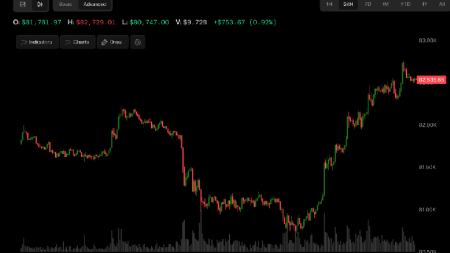
The negative sentiment that has been building in traditional financial markets over recent sessions spilled forcefully into the digital asset ecosystem this weekend, triggering a broad and at times chaotic sell-off that left the crypto market scrambling for footing. The retreat was particularly pronounced among altcoins, which bore the brunt of the selling pressure and provided yet another signal that investors are rapidly losing their appetite for riskier assets. According to market observers, a typical altcoin fell by more than 5 percent over the course of the weekend, and if the decline holds at current levels, it would represent the sharpest weekend drop since April. The move was widely seen as a direct spillover from equity markets, where anxiety over growth, interest rates, and geopolitical uncertainty has been building for weeks. Cryptocurrencies, once regarded as a hedge against traditional financial turmoil, have increasingly traded in lockstep with stocks, and this weekend proved to be no exception. As fear rippled through global markets, digital assets were swept up in the broader wave of de-risking, with traders cutting positions in the most speculative corners of the market first. The result was a familiar but nonetheless jarring spectacle: Bitcoin holding up relatively well while smaller tokens were hammered. By the time trading slowed on Sunday, the damage had been done, leaving investors to wonder whether the weekend’s turbulence was an isolated episode or the beginning of a more sustained correction. What made the sell-off particularly striking was the speed with which it unfolded, with prices deteriorating in a matter of hours as liquidity evaporated and order books thinned. In an environment already characterized by uncertainty, the weekend’s action reinforced the notion that crypto remains a high-risk asset class, vulnerable to the same mood swings that move equity markets.
A Winning Trading Pattern Under Threat
The latest slide has also disrupted a trading pattern that had offered Bitcoin investors a measure of predictability since June. Data from on-chain analytics firm Glassnode showed that buying Bitcoin on Friday and selling on Sunday had been a consistently profitable strategy over the past several months, a trend that reflected the unique rhythms of weekend crypto trading. However, the sharp decline witnessed last weekend has called that trend into question in dramatic fashion. According to Glassnode, the continued selling pressure seen in altcoins suggests that weekend price movements could become considerably riskier for investors going forward. The breakdown of this pattern is significant because it indicates that the market’s internal dynamics are shifting, perhaps in response to the broader macro environment or to changing liquidity conditions. For traders who had grown comfortable with the Friday-buy-Sunday-sell approach, the new reality is likely to require a more defensive stance. The fact that an analytics firm with Glassnode’s depth of data is now flagging this shift adds weight to the concern. Weekend sessions have always been something of a wildcard in crypto, with lower volumes and thinner order books making prices more susceptible to manipulation and sharp swings. But the pattern of buying before the weekend and selling before the new trading week had become a reliable source of alpha for many participants. That edge may now be gone, at least for the time being. More broadly, the disruption of the pattern is a reminder that no trading strategy works forever, and that markets are constantly evolving in response to new information and shifting sentiment. For investors who have been relying on weekend dips and bounces, the message from Glassnode is clear: proceed with caution. The risks are no longer limited to sudden price movements during weekday trading hours; they now extend into what was once considered a quieter period for digital assets. As the market adapts to this new reality, traders will need to rethink their assumptions and build strategies that can withstand the kind of volatility that unfolded over the past weekend.
Altcoins Bear the Brunt
While Bitcoin’s losses were notable, it was the altcoin market that truly captured the attention of analysts at 10X Research, the data-driven analytics firm that closely tracks the digital asset space. According to 10X Research, altcoins experienced a much sharper decline than Bitcoin during last week’s sell-off, a divergence that speaks volumes about the current state of investor sentiment. The firm reported that the 141 cryptocurrencies it monitors lost an average of 14 percent of their value over the course of the decline, while Bitcoin slipped by only 3 percent during the same period. This stark difference illustrates a familiar dynamic in crypto markets: when risk appetite fades, the most speculative assets tend to suffer the most. Bitcoin, as the largest and most liquid cryptocurrency, often functions as a relative safe haven within the ecosystem, attracting capital that is being withdrawn from smaller tokens. Altcoins, by contrast, are viewed as higher-risk plays, and when investors decide to reduce their exposure to digital assets, these are typically the first positions to be cut. The result is a market structure in which Bitcoin can hold up reasonably well even as the broader ecosystem experiences significant damage. 10X Research’s findings also highlighted the breadth of the sell-off, which was not confined to a few underperforming projects but instead swept across a wide range of tokens. From established large-cap coins to smaller, more speculative names, the pattern was the same: heavy selling pressure and little in the way of buyer interest. This kind of indiscriminate decline is often interpreted as a sign that investors are de-risking rather than making fundamental judgments about the long-term prospects of individual blockchain projects. In other words, it is not that traders suddenly lost confidence in particular technologies or use cases; rather, they simply wanted less exposure to the asset class as a whole. For long-term believers in the crypto market, sell-offs like this can present attractive entry points, but they also serve as a sobering reminder of the volatility that is inherent in this space. The divergence between Bitcoin and altcoins is likely to remain a key theme in the days ahead, as investors watch to see whether risk appetite returns or continues to deteriorate.
Liquidity Signals Flash Caution
Beyond the immediate price action, 10X Research flagged several underlying indicators that point to a weakening of market liquidity, a factor that could have significant implications for the recovery effort. Among the most concerning were declining trading volumes, a contraction in stablecoin supply, and net outflows from spot Bitcoin exchange-traded funds. Together, these signals suggest that the sell-off is not merely a function of profit-taking, but rather a reflection of a market that is losing the capital and participation needed to sustain a rebound. Declining trading volumes are particularly telling because they indicate that the recent drop has not attracted significant buying interest. In a healthier market, sharp declines typically draw in bargain hunters looking to acquire assets at discounted prices. The absence of such demand suggests that investors are either unwilling or unable to commit fresh capital at current levels, leaving the market without a natural buyer of last resort. The contraction in stablecoin supply adds to the concern, as stablecoins such as USDT and USDC are often used as dry powder for future crypto purchases. A reduction in their supply implies that funds are being withdrawn from the ecosystem, reducing the pool of capital available to support prices. This dynamic can create a negative feedback loop, in which falling prices prompt further withdrawals, which in turn puts more downward pressure on the market. The outflows from spot Bitcoin ETFs are perhaps the most visible sign of institutional caution. These vehicles have been a major channel for institutional participation in crypto, and sustained outflows indicate that even the most patient investors are trimming their exposure. While daily flows can be volatile, a persistent trend of withdrawals is difficult to dismiss. It suggests that the institutional bid that helped drive Bitcoin’s rally earlier in the year is now being withdrawn, at least for the moment. Taken together, these liquidity indicators paint a picture of a market that is vulnerable to further downside. It is one thing for prices to fall; it is another for the underlying infrastructure of the market to weaken at the same time. Without robust trading volumes, stablecoin growth, and ETF inflows, the foundation for a quick recovery looks shaky. Analysts at 10X Research did not make explicit predictions, but their data made clear that the market’s ability to bounce back will depend on more than just a shift in sentiment.
Weekend Trading Becomes a Minefield
The combination of traditional market jitters and crypto-specific liquidity concerns has created a particularly treacherous environment for weekend traders, who now find themselves navigating a landscape far more dangerous than the one they had grown accustomed to. Historically, weekends in crypto were marked by low activity, with prices drifting within narrow ranges as institutional desks closed and retail traders stepped back. But the events of the past weekend have demonstrated that this is no longer the case, and that when volatility does strike, it can do so with surprising force. Glassnode’s warning that weekend price movements could become riskier for investors is rooted in the observed behavior of altcoins under pressure. Because trading volumes are thinner on weekends, even a modest amount of selling can produce outsized moves, and altcoins are especially vulnerable given their generally lower liquidity compared with Bitcoin. For investors holding positions over the weekend, the risk of waking up to significant price gaps is now higher than it has been in months. The disruption of the Friday-buy-Sunday-sell pattern adds another layer of uncertainty, as traders who had been able to rely on a predictable rhythm are now forced to operate without that edge. Whether the breakdown is a temporary aberration or the beginning of a new trend remains to be seen, but the uncertainty itself is enough to make many participants wary. For those who continue to trade over the weekend, the new environment demands a more cautious approach. Position sizing, stop-loss orders, and a willingness to withstand volatility are becoming more important, particularly for those focused on altcoins. The days of expecting a quiet weekend in crypto may be over, at least for now. As Glassnode’s data suggests, the risks are real, and investors who ignore them do so at their own peril. This is not to say that weekend trading cannot still be profitable, but rather that the margin for error has narrowed considerably. In a market where liquidity is thin and sentiment can shift in an instant, discipline and risk management are more critical than ever. The weekend sell-off was a wake-up call, and how traders respond to it will shape their fortunes in the weeks ahead.
The Week Ahead Holds Key Answers
As a new trading week begins, the cryptocurrency market finds itself at a critical juncture, with the fallout from the weekend sell-off likely to set the tone for the sessions ahead. The key question on the minds of investors is whether this was a short-term correction or the beginning of a deeper downturn. The answer will depend on a range of factors, including the direction of traditional markets, the flow of funds into and out of digital assets, and the broader macroeconomic backdrop. One important indicator to watch will be the response of institutional investors. If spot Bitcoin ETFs see inflows resume over the coming days, it could signal that the sell-off was viewed as a buying opportunity by longer-term players, providing a floor under prices. Conversely, continued outflows would reinforce the narrative that institutions are reducing their exposure and that the market is losing a critical source of demand. Similarly, any stabilization in stablecoin supply would be a positive sign, while further contraction would point to additional downside risks. The performance of altcoins will also be closely monitored, as a sustained divergence between Bitcoin and the rest of the market would suggest that risk appetite remains fragile. A broader rebound, on the other hand, would indicate that confidence is slowly returning to the ecosystem. For now, the balance of evidence suggests caution, but the market has surprised observers before. What is clear is that the weekend’s events have reset expectations and forced investors to confront the possibility that the easy gains of the past few months may not continue. The days ahead will be telling. If buyers step in quickly and stabilize prices, the sell-off may be remembered as a healthy correction in an ongoing bull market. But if the selling pressure continues, it could mark a turning point, with the crypto market entering a more challenging phase. In either case, the weekend’s action has reinforced a timeless lesson: digital assets remain a volatile and unpredictable asset class, and even the most carefully constructed trading strategies can be upended by a sudden shift in sentiment. As Glassnode and 10X Research have both made clear, the market is changing, and investors must adapt accordingly.
This is not investment advice.