

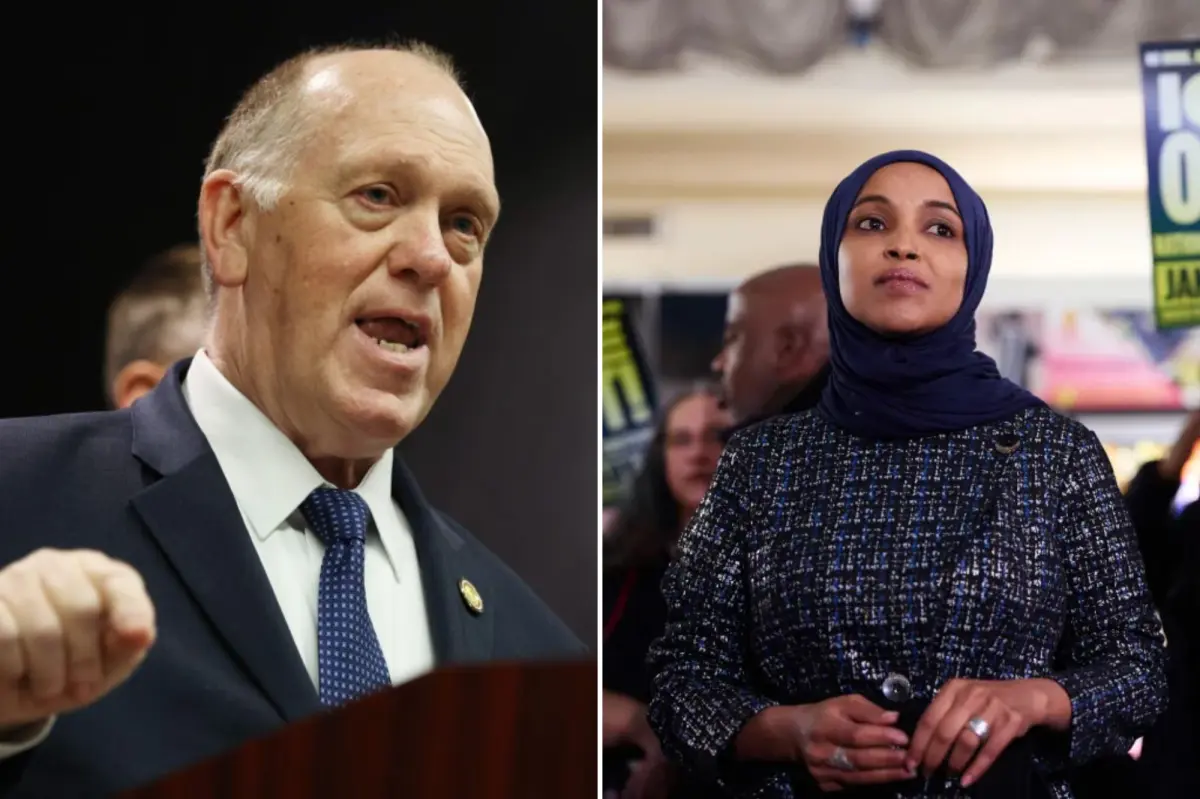
Few moments crystallize the collision between political power and immigration enforcement like the sight of federal agents leaving the home of a sitting member of Congress with her cellphone in an evidence bag. That is the scene now unfolding around Rep. Ilhan Omar, the Minnesota Democrat whose Washington, D.C., residence was raided earlier this week as part of a federal investigation into allegations of immigration fraud. The raid, coupled with the seizure of her phone, has thrust Omar into the center of a high-stakes legal and political storm, one that border czar Tom Homan addressed directly on Saturday while making clear that no office, no title, and no political status places a person beyond the reach of immigration law. Speaking on Fox News’ “The Big Weekend Show,” Homan did not hesitate when asked whether Omar could face the ultimate consequence of unlawfully obtained citizenship. “Of course, if you lie during the naturalization process, there is a process to denaturalize somebody,” he said. “We’ve done it before… And certainly, if the evidence points that way, that could happen.” His words were blunt and deliberate, reflecting an administration that has made enforcement its defining promise. But they also raised a deeply personal question for Omar, a former refugee who fled Somalia as a child and grew into one of the most visible progressive voices in Congress: Can the very citizenship that once represented her family’s escape from war be taken away if the paperwork that secured it was built on a lie?
Homan’s comments went beyond a simple theoretical observation. He reaffirmed that Omar would be treated exactly like anyone else in the immigration system, a statement that sounds fair in principle but carries enormous weight in practice. “She’ll be held to the same standards you and I are held [to],” he said. “If she violated the law, then she’ll be held accountable.” He declined to speak about the specifics of the investigation, citing the need to let federal agents do their work, but he did offer a telling glimpse into where the case might be heading. “I said over a year ago, the allegations were made clear, and it would be investigated, and they are investigating it,” Homan explained. “I’m not going to get ahead of the bureau or HSI, but I’ve been told they have a strong case, and we’ll let the evidence lead where it leads.” That phrase — “a strong case” — hangs in the air, especially because denaturalization is among the most serious tools the government possesses. It is also rare. Courts do not strip citizenship lightly, and the process requires proving that a person obtained it through fraud or willful misrepresentation. But Homan’s reference to past cases is grounded in reality: the government has denaturalized people who concealed criminal histories, who lied about their identities, or who committed wartime atrocities while hiding behind a passport. In Omar’s situation, the alleged fraud is more subtle, rooted not in violence but in a question of age, a birth year, and the fine line between a child who automatically becomes a citizen and an adult who must apply on her own.
The heart of the investigation lies in a decades-old immigration file and a discrepancy that, if proven intentional, could change everything about Omar’s legal status. She and her father left Somalia amid the chaos of civil war in the late 1990s, eventually resettling in the United States as refugees. Her father became a U.S. citizen in 2000, and at the time, Omar was believed to be 17 years old. Under U.S. law, a minor child who is present in the country after a parent naturalizes automatically acquires citizenship, without needing to file a separate application. That is exactly what happened, or so it seemed. But recently, allegations have emerged that Omar was actually 18 at the time, not 17, meaning she would not have qualified for automatic citizenship through her father. If she was truly an adult when he naturalized, she would have needed to navigate the immigration bureaucracy herself, submitting her own petition and meeting the required standards for eligibility. The difference between those two ages is not just a matter of a birthday party or a driver’s license; it is a legal threshold that determines whether becoming an American citizen was an automatic inheritance or a process that required her active participation. Investigators are now reportedly looking into whether Omar, or her father, lied about her birth year on immigration paperworwork in order to make her appear younger and thus sweep her into the citizenry under more favorable rules. Omar’s office has not yet responded to requests for comment, and she has not been charged with any crime. The presumption of innocence still applies. But the political and legal implications are immense, because the question is not only what happened, but whether a person who built a political career in Washington can be held accountable for something that allegedly happened in the paperwork of a refugee family decades ago.
For Omar, the investigation is not just a legal threat; it is a political attack with a target on her back. She is one of the first two Muslim women elected to Congress, a Somali-born refugee who represents the very face of immigrant America that some parts of the political spectrum view with suspicion. She has been a sharp critic of President Donald Trump, so much so that her supporters see the raid as an act of retribution against a prominent dissident just weeks before a critical election. House Minority Leader Hakeem Jeffries, D-N.Y., echoed that sentiment when he denounced the probe as political persecution, suggesting that the timing and the methods point to an attempt to intimidate a voice that refuses to be silenced. There is no question that the raid itself was dramatic: federal agents appeared at Omar’s home, entered her private space, and left with her cellphone and other possessions, the kind of action usually reserved for organized crime suspects or terrorists, not sitting lawmakers. For Omar, who has spoken openly about experiencing displacement, discrimination, and the constant need to prove her belonging, the scene must have felt like a cruel reversal of everything her life story has represented. She escaped a civil war, arrived with nothing, learned a new language, worked her way through college, and became one of the most influential members of the progressive left. Yet now, the very identity she built as an American is being called into question, and the government appears willing to go all the way to denaturalization if the evidence supports it. Her defenders see this as a disturbing precedent, one in which an immigrant who achieves political power becomes the target of an immigration system that is supposed to protect people like her, not weaponize their past against them.
When Homan was asked whether the federal investigation might uncover wrongdoing beyond immigration fraud, he refused to speculate, saying, “That’s a question for the FBI. I know things, but that’s the question for FBI.” That brief, cryptic response only deepens the mystery around what federal agents believe they have found. It also suggests that the inquiry may be broader than a single birth year discrepancy, or that Homan, as border czar, is simply not in a position to disclose the full scope of an ongoing federal case. The phrase “I know things” carries an almost cinematic weight, implying that there is more happening beneath the surface than the public currently understands. But it also underscores the extent to which this story is being shaped by institutional secrecy and carefully leaked fragments. The FBI and the Department of Homeland Security are following the evidence, Homan insists, and the outcome will be determined by facts, not feelings. Yet in a political climate where trust in federal agencies is split along partisan lines, every statement from every side is filtered through a lens of doubt. Fox News Digital reached out to Omar’s office for comment but did not immediately hear back, leaving her side of the story, at least for now, unspoken. The silence is telling. It may mean her lawyers are preparing a legal response, or that she is waiting for a more strategically favorable moment to speak. It may mean she genuinely does not know what agents were looking for beyond the birth-year allegations. Or it may mean that she and her advisers are bracing themselves for the possibility that this investigation, whatever it uncovers, will not end quietly.
In the end, this is more than one congresswoman’s legal battle. It is a collision between two fundamental American promises: that no one is above the law, and that citizenship once granted should feel permanent and secure. For those who support the investigation, the principle is simple — if Omar entered the country through fraud, she should face the consequences just like a person with no political connections, because the integrity of the citizenship process depends on honest paperwork. For those who oppose it, the case feels like a warning to every immigrant who speaks truth to power: your past will never be fully behind you, no matter what you achieve. Homan’s insistence that she will be treated like everyone else cuts both ways, because many immigrants in similar situations have faced deportation, and before this week, few of them had their homes raided by federal agents. The human story here is one of identity, belonging, and the fragility of belonging in an era of aggressive enforcement. Omar’s journey from a refugee camp to the halls of Congress was already extraordinary. Now, that journey is being retold as a legal question, a forensic audit of a birth certificate, a reconsideration of the year she was born, and a federal case that could determine whether America still contains the promise she once believed it had. Whatever the investigators find, the outcome will ripple far beyond one district in Minnesota, shaping how immigrants understand their safety, how politicians understand their own vulnerability, and how America chooses to weigh the stories of those who came here seeking refuge against the strict letter of the law.