


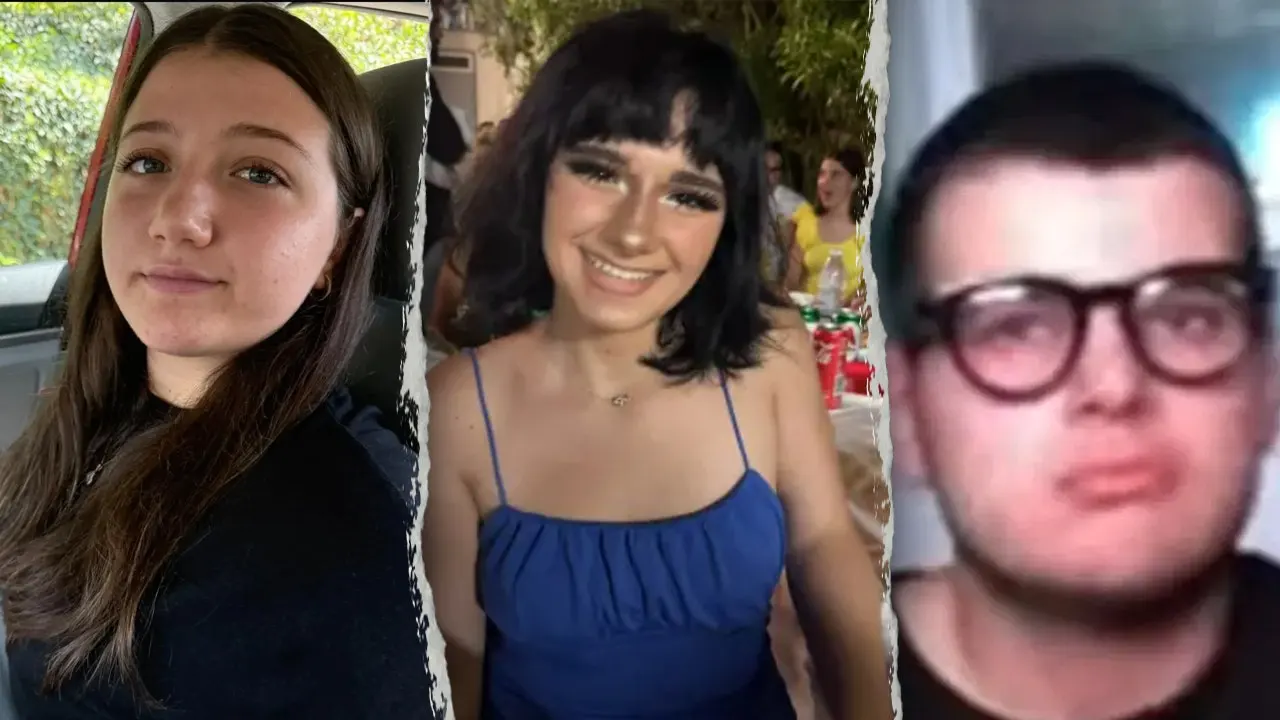
The quiet New Jersey town of Cranford is now at the center of a wrenching tragedy that has moved from unspeakable loss to a formal legal reckoning. Two teenage girls—Maria Niotis and Isabella Salas, both just 17 and best friends—were riding an electric bicycle together on Burnside Avenue when prosecutors say a black Jeep Compass driven by Vincent Battiloro struck them from behind. The impact was so violent, so catastrophic, that neither girl survived. On Wednesday, a Union County grand jury indicted Battiloro, now 18, of Garwood, on two counts of first-degree murder. For the families, the indictment is a crucial step toward justice, but for the attorney representing Maria’s family, the real story may have been preserved in a most unexpected piece of evidence: the defendant’s own dashcam. Brent Bramnick, the Niotis family’s lawyer, told Fox News Digital that the recording from the 2021 Jeep could prove Battiloro deliberately pursued the girls rather than accidentally striking them. The difference between a reckless tragedy and a calculated double murder could rest on what that camera captured in the moments before the girls’ lives were ended.
The details of the crash itself are staggering. Court records show that Battiloro was driving at speeds up to 70 miles per hour through a residential street where the posted speed limit was just 25 miles per hour. The girls were riding together on an e-bike when he allegedly slammed into them, leaving the young women mortally wounded. Cranford police issued citations for speeding, reckless driving, improper passing, and unsafe lane changes, among other offenses. But those traffic citations alone would only describe dangerous driving, not deliberate murder. As Bramnick explained, proving first-degree murder requires demonstrating intent—that Battiloro purposely caused the deaths, not merely that he acted recklessly or negligently. The dashcam, then, becomes the centerpiece. “So I think even more important than the allegations in the tickets, even though obviously everything’s important, is the fact that this was evidently recorded as it’s happening,” Bramnick said. He stressed that reviewing such evidence demands painstaking work: investigators have to lay out, piece by piece, exactly what was going through the defendant’s mind at the moment he turned his vehicle toward those girls. If the recording shows him deliberately turning around and following them, as investigators reportedly believe, it could transform a heartbreaking accident into a damning portrait of intention.
After the crash, the behavior attributed to Battiloro paints a picture that is difficult to reconcile with remorse. Authorities said he abandoned the Jeep and fled on foot, leaving the two teenage girls dying behind him. Police later cited him for leaving the scene of an accident involving personal injury and failing to report the crash. He was also accused of having improper or unclear license plates, failing to provide proof of registration and insurance, and having no proof of a driver’s license. But perhaps even more disturbing to the public and to the victims’ families was what happened the very next day: Battiloro appeared on a YouTube gaming livestream and complained that people were ridiculing him over what he called “false allegations.” Instead of expressing sorrow or regret, he lashed out at those who were judging him online. For the families of Maria and Isabella, that bizarre public appearance must have felt like a slap in the face. Rather than a young person wrestling with the horror of what had occurred, they saw someone concerned with his own reputation, dismissing the mounting accusations against him. The contrast between the two girls’ lost futures and his apparent self-focus could not have been starker.
Beneath the immediate tragedy of the crash, there is an even deeper pattern of alleged behavior that has emerged, one that makes the case feel all the more chilling. Maria’s mother, Foulla Niotis, has said that Battiloro previously attended Lincoln School in Cranford with her daughter and that he had been stalking the girl for months before the collision. She reported her concerns to police, but nothing came of it. “Nobody said to me if there was anything I could do, restraining orders or anything against him,” Maria’s mother previously told Fox News Digital. “They just kept saying, ‘Oh, he’s a juvenile.’” That heartbreaking detail raises painful questions: Could warnings have prevented this? Were the girls’ deaths an avoidable tragedy that slipped through gaps in the system? According to Bramnick, the defendant is also accused of “swatting” the Niotis residence on at least two occasions in September—a dangerous practice in which someone makes a hoax emergency call to send armed officers to a location. If true, that pattern of behavior goes far beyond a single moment of road rage. It suggests an alleged campaign of harassment and terror directed at the family, one that ultimately ended in the worst possible outcome. For the Niotis family, the grief is compounded by the knowledge that they had tried to raise alarms before it was too late.
The legal road to this indictment was neither smooth nor swift. On the day of the crash itself, Cranford police questioned Battiloro, but he was released to his father after claiming that someone had carjacked him at knifepoint. That explanation apparently gave authorities pause, and he was allowed to walk away. It was only after investigators reviewed the dashcam footage, months later in June, that police arrested Battiloro and charged him as an adult. The decision to charge him as an adult is significant, both legally and symbolically, because it treats the alleged crime with the gravity it deserves rather than relegating it to the often more lenient juvenile system. Battiloro has remained in custody since that arrest, in part because his own defense agreed to detention without prejudice—a procedural choice that leaves room to challenge his detention later but keeps him locked up for now. His defense attorney, Brian Biglin, did not immediately respond to requests for comment. Battiloro’s arraignment is scheduled for October 27 at the Union County Courthouse in Elizabeth. For the families, that date represents another step in a long, painful journey. It will be the first time the public sees the defendant in court, and it will give prosecutors an opportunity to begin laying out exactly what they believe the evidence shows.
No outcome in this case can bring back Maria Niotis and Isabella Salas. They were two young women with their whole lives ahead of them, close friends who should have had anniversaries, birthdays, graduations, and decades of shared memories. Instead, their families are attending court hearings and preparing for a trial that could take months or longer. Bramnick acknowledged the importance of transparency in this process, saying, “There’ll be an opportunity to have this play out, where people can see what’s going on, and that is hugely important for the public.” He added that it is enormously important for the family. “The Niotis family certainly is happy we’re here, and, you know, want justice.” This case will now turn on the evidence—especially the dashcam video—and on whether a jury can be convinced that Battiloro purposely chased down two teenage girls and killed them. If so, he faces the possibility of life in prison. But for the families, justice will never fully arrive, because their daughters cannot return. All they can hope for is that the truth is heard in court, that accountability is real, and that the memory of Maria and Isabella is honored by a system that takes their lives seriously. In the meantime, their loss stands as a stark reminder of how fragile life is, how quickly a normal moment can be shattered, and how much pain a single reckless—or worse, deliberate—decision can cause. The road ahead will be long, but for those who loved these two girls, it is the only road left.