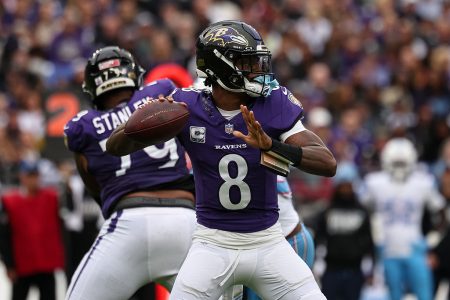


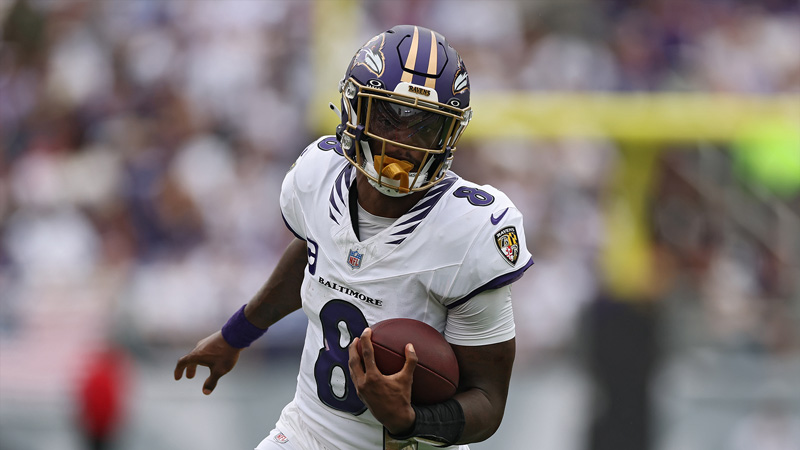
Lamar Jackson’s absence from the Baltimore Ravens’ lineup has settled into something heavier than a one-week inconvenience. On Friday, the team confirmed what many fans had already begun to fear: the reigning MVP-caliber quarterback would not be under center when the Ravens travel to Cleveland to face the Browns on Sunday afternoon. The news came from coach Jesse Minter, who delivered the update with the kind of calm, matter-of-fact tone that coaches often use when trying to keep a locker room steady. But for the Ravens and their faithful, there is no way to soften the reality. Jackson’s ankle, injured on a sack near the end of the first half in Week 4 against the Tennessee Titans, remains too compromised for him to play. It will be the second consecutive game he has missed, and it means the team must once again place its hopes in Tyler Huntley, the backup who has become something of a folk hero in Baltimore for his ability to step into impossible situations and somehow keep the ship afloat. The matchup against the Browns, set for 1 p.m. ET on FOX, carries real weight in the AFC North, and the stakes are impossible to ignore. But beyond the playoff implications, there is a human story here—a quarterback who hates watching more than anything, a backup who has been asked to carry the torch again, and a team that is learning just how deep its resilience runs.
The injury itself was the kind of moment that makes every Ravens fan hold their breath. With the first half winding down against the Titans, Jackson found himself trapped in the pocket, the pressure collapsing around him like a closing door. He took a sack, and when he stayed down on the turf, the stadium fell quiet. He was helped off the field, and despite the Ravens’ ability to hold on for a victory that day, the concern never fully subsided. Jackson missed four games last season with a similar type of ailment, and the pattern is all too familiar to those who have watched him carry the franchise on his shoulders. He is a player who redefines the position with his explosive speed, his uncanny vision, and his ability to make defenders miss in spaces that shouldn’t allow for escape. But that style of play, as thrilling as it is, comes with a toll. The same athleticism that makes him singular also exposes him to hits that would sideline most mortals for months. For now, the team is choosing patience over heroics. The medical staff, the coaching staff, and Jackson himself seem to understand that a few more weeks of caution now are better than a lost season later. Still, one can imagine the frustration simmering beneath the surface—Jackson is not built to sit quietly on the sideline, and watching his teammates battle without him is perhaps the most difficult assignment of his career.
Enter Tyler Huntley, the unassuming backup who has somehow become Baltimore’s safety net in moments of crisis. Huntley has been here before, and that experience matters more than any stat sheet. He stepped in for an injured Jackson last season, starting two games and winning both, endearing himself to the locker room with his poise, his mobility, and his knack for making just enough plays to keep the offense moving. Last weekend, after Jackson was ruled out for the first time this season, Huntley led the Ravens into Atlanta and came away with an overtime victory that felt less like a stopgap triumph and more like a statement. He didn’t try to be Lamar Jackson—no one can be Lamar Jackson—but he ran the offense efficiently, managed the clock, and gave his playmakers chances to make plays. That is exactly what a backup is supposed to do, and Huntley has made an art form of it. His teammates trust him, and that trust is visible in the huddle, in the way they respond to his cadence, in the extra bounce in their step when they see him take the field. He may not have the highlight reels or the MVP trophies, but he has something that resonates just as deeply in a sport built on collective effort: the certainty that he will not flinch when the moment is biggest.
The Ravens’ record without Jackson is a testament to their ability to adapt, but it is also a reminder of how fragile success can be in the NFL. Last season, when Jackson was sidelined for four games, Baltimore went 2–2—a result that now looks remarkable given the circumstances. What is less remembered is the strange path of those losses, both of which were started by Cooper Rush, who was filling in while Huntley was working his way back for another stint with the team. That brief turbulence underlined how much a franchise can depend on a single individual, even with a roster built to be versatile. This season, the Ravens have started 4–1, and that record is buoyed by a defense that has looked increasingly formidable and a running game that can control the tempo. But the passing attack, so often the engine of Baltimore’s offense, is a different animal without Jackson. Huntley’s style is more measured, more reliant on anticipation than improvisation. The playbook opens up a little less, and the margin for error tightens. What has kept the team grounded is the belief shared by coaches and players alike that every game is a collective mission. They are not asking Huntley to be a magician; they are asking him to be a steward, and he has answered the call with a calm authority that has steadied the locker room.
For Jackson, this latest setback arrives at a critical juncture in both his season and his career. He has already proven that he can be the most dynamic player in football, but durability has been the persistent shadow over his brilliance. Every injury invites a new round of questions about how long his style can sustain him, whether he needs to change his approach, and whether the team needs to do more to protect him. The truth is that no one has clear answers. Football is a violent sport, and quarterbacks who create magic with their legs are always one awkward tackle away from the sideline. What the Ravens have tried to do is build a system that allows Jackson to be himself while also giving him enough support to reduce unnecessary risks. The offensive line, the running backs, the quick-passing concepts—all of it is designed to make life easier for him. But when a play breaks down and the pocket collapses, instinct takes over, and Jackson’s instinct is to escape, to turn nothing into something, to defy the geometry of the field. That is what makes him special, and it is also what makes these moments of helplessness so difficult to watch. He is not just a quarterback missing games; he is a competitor whose identity is tied to being on the field, to feeling the grass beneath his cleats, to hearing the roar of the crowd as he takes off down the sideline.
As Sunday approaches, the Ravens find themselves in a strange emotional place—cautious, hopeful, and deeply aware of what is at stake. A win in Cleveland would strengthen their grip on the division and prove that they are more than just a one-man show. A loss would intensify the noise and raise the pressure for everyone involved. But beyond the scoreboard, there is a quieter narrative unfolding. This is a team learning how to endure, a backup proving his worth, and a star quarterback confronting a test of patience that will shape how the rest of his season unfolds. The fans will pour into their living rooms and bars, wearing their purple jerseys, holding their breath on every play, hoping that Huntley can summon another afternoon of steady competence. And somewhere in the Ravens’ facility, Lamar Jackson will be watching, cursing the limits of his own body, celebrating every good throw and wincing at every missed opportunity. He will be the best teammate he can be, offering advice, encouraging Huntley, and preparing for the moment when he returns. But for now, the game belongs to others. The stakes are high, the opponent is bitter, and the road ahead is long. Yet if there is one thing Baltimore has learned over the years, it is that this team is never quite as fragile as it appears. They have weathered storms before, and they will weather this one too—one snap, one drive, one victory at a time.