


There are moments in life when a person decides that the path they have been walking no longer leads where they want to go, and so they stop, turn around, and begin again. For Abigail Seymour, that moment came more than once. In her twenties, she was seized by a restless hunger for meaning, a sense that her life was meant to be something more than a predictable line from childhood to career to quiet acceptance. In 1994, she made the bold and somewhat romantic decision to leave everything familiar behind and move to Spain for three years, treating the adventure as a kind of pilgrimage. She packed her bags with the unshakable optimism of someone who believes the universe will deliver clarity in a matter of weeks, not decades. She wanted to be a documentary filmmaker, drawn to storytelling and art, and she carried within her the quiet insecurity of being the youngest of five brilliantly accomplished siblings. They had gone out into the world and done impressive things, but Abigail never quite saw herself as the sort of person who belonged in a glass tower or a courtroom. Law, in her young mind, was the opposite of everything she loved—it was rigid, corporate, and soulless, while she was drawn to music, theater, photography, and the raw honesty of human expression. She attended NYU’s Tisch School of the Arts and graduated in 1989 with a degree in fine art photography, then spent years piecing together a living through restaurant work, writing, and teaching English before finally finding her footing as a wedding photographer. For ten years, she ran her own small photography business, employing only two others, and she found genuine joy in being invited into the most tender and transformative moments of people’s lives. But even that beautiful work began to feel too small, and the quiet voice inside her grew louder with each passing year. She was burning out, not the way people burn out from overwork, but the way people burn out from living a life that no longer fits. She felt certain there was more for her in the world, and she needed to discover what that was, even if she had no idea where to begin looking.
The search for purpose did not follow a straight line, and Abigail learned that the detours often become the story itself. In 2013, after winding down her photography business, she became an AmeriCorps member at a local nonprofit serving immigrants, and that experience cracked something open inside her. She discovered a deep and unexpected desire to advocate for people, to stand beside them in moments of vulnerability and help them navigate systems that often felt cold and overwhelming. It also changed the way she saw lawyers, the profession she had dismissed so casually in her youth. Over the years, she had encountered attorneys from all kinds of backgrounds, and she realized that not all of them were soulless corporate drones. Some of them were compassionate, creative, and genuinely invested in the lives of others. She began to wonder if she had been too quick to judge, too narrow in her vision of what a legal career could be. By her mid-forties, with two young children at home, she felt the pressure to settle down and choose stability, but she also felt an undeniable pull toward something larger. So she made the terrifying and exhilarating decision to enroll at Elon University School of Law in 2014, at the age of forty-seven. What followed was both the most driven and the most painful season of her life. She was no longer a twenty-something exploring the world with nothing to lose; she was a mother, a woman with responsibilities, and a student surrounded by people young enough to be her children. She struggled with the constant question of whether she had made a terrible mistake, feeling depressed, overwhelmed, and exhausted. Yet halfway through her first year, something far more devastating arrived. Her sister, Mary, died by suicide, leaving a hole in Abigail’s heart that seemed impossible to fill. She nearly dropped out, unable to see the point of anything, unable to remember who she was doing it for. But in time, she realized that law school had become her refuge. It gave her a place to disappear into, a mission to hold onto, and a way to honor the sister she had lost. It was a beautiful and painful irony that Mary had also written her own essay for Newsweek in 2002, and Abigail would later think of this as a sentimental full-circle moment, as if their stories were woven together in ways neither of them could have predicted.
By the time Abigail graduated in 2017, she should have been proud, but instead she was consumed by a deep and embarrassing shame. She was fifty years old, and she felt like an oddball, someone who had started too late and finished too late, as if the universe had stalled while everyone else moved ahead. She did not want anyone to attend her graduation ceremony, convinced that people were either feeling sorry for her or quietly mocking her. But she pushed forward, determined to take the bar exam, knowing that this would be the next great hurdle. She studied relentlessly, burying herself in books, doing everything she could to prepare for the test that would determine whether she could officially practice law. While waiting for her results, in August 2017, she noticed a suspicious lump in her breast. She had recently had a clear mammogram, so she dismissed it as a cyst, certain there was nothing to worry about. Her doctor recommended a biopsy anyway, and she went through the uncomfortable procedure without much concern, more focused on the pending bar results than on the small irregularity in her body. Then the bar results arrived, and the letter opened with the devastating words, “We regret to inform you.” She failed. The next day, her doctor’s office called to share the biopsy results, and this time she walked into a room with soft lighting and a tissue box, recognizing the signs of bad news before a word was spoken. A radiologist entered carrying a tote bag decorated with a pink ribbon, and the only sentence Abigail remembered hearing was, “You have breast cancer.” It was stage 2, but the cancer had not spread to her lymph nodes, and she was offered a choice between a lumpectomy with radiation or a unilateral mastectomy. She chose the mastectomy, hoping to avoid radiation, and her surgery took place in October 2017. The next bar exam was in February 2018, but she knew she was not ready. She was too depressed, too raw, too drained to face another test, and her heart simply was not in it. So she set her sights on July 2018, taking the exam a second time with a strange sense of fatalism, almost expecting to fail before she even opened the letter. And she did fail again. But this time, she noticed something important: she had missed passing by only two points, and her score had improved dramatically. Instead of crushing her, the near miss gave her a surge of energy. It was proof that she was close, that her efforts were working, and that perhaps she could actually do this.
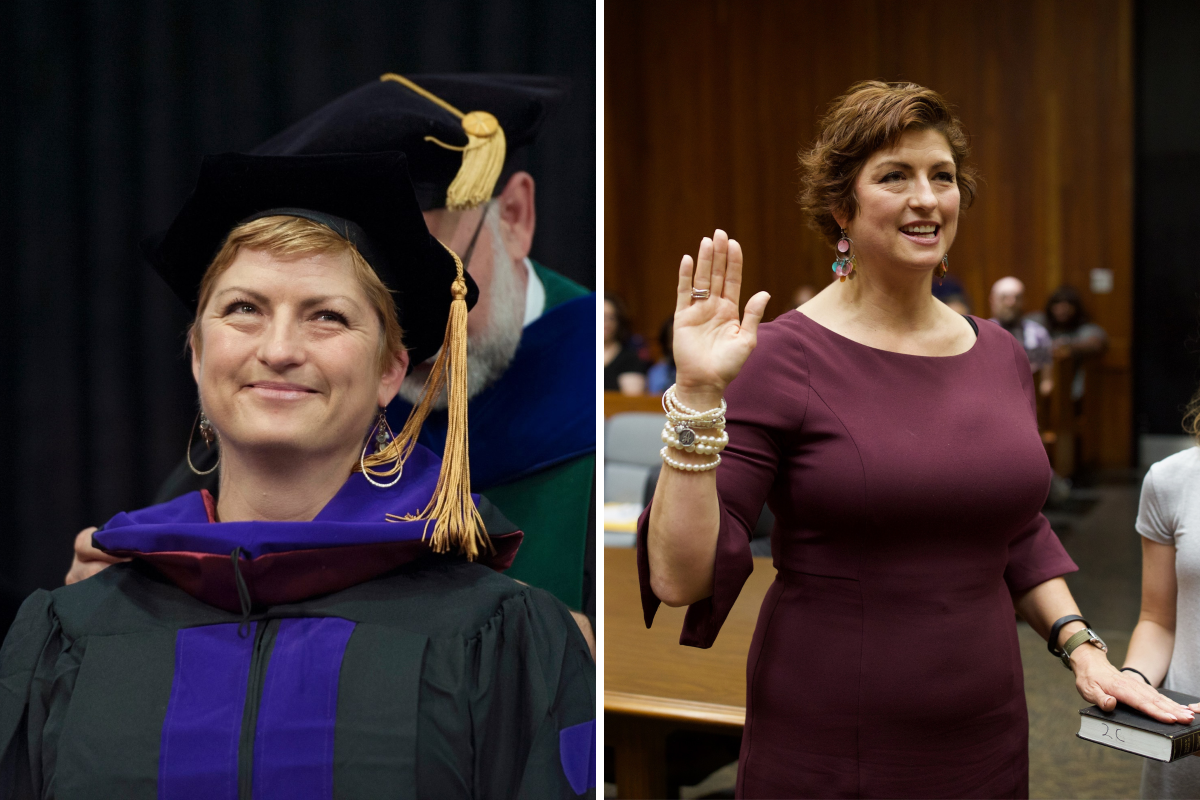
That small flicker of possibility ignited an unbreakable determination. Abigail signed up for the February 2019 bar exam with the mindset that it did not matter how many times she had to take it, because she was going to pass or die trying. She changed everything about her approach. She began meditating, working out daily, adjusting her study habits, and shifting her mental state from fear to self-belief. She worked part-time to keep herself grounded, but she gave the exam everything she had, fully accepting that she might have to try again. On the day of the test, she dressed in a sleek suit, not out of vanity but as a message to the universe and to herself: from that day forward, she would be an officer of the court. She wanted to embody the identity before she earned it, knowing that confidence had to be practiced before it could be real. When the letter finally arrived, it began with the word “Congratulations,” and she felt a mountaintop moment, the kind of overwhelming joy that comes not just from achieving something difficult, but from doing so after loss, illness, and failure had tried to convince her she could not. Passing the bar at fifty-one was not simply an academic accomplishment. It was a triumph over every doubt she had ever carried, every moment she had felt too old, too afraid, or too scarred to belong. After that, she worked at a law firm as an immigration brief writer for about six months, but it did not take long for that familiar restlessness to return. She had always been an entrepreneur at heart, and she realized that she wanted to build something of her own, something that reflected her values and her vision. So on September 30, 2019, she filed the articles of incorporation for Camino Law, a name inspired by her pilgrimage in Spain and the winding paths that had led her home. Her first clients came with her from the firm she had worked at, and slowly the practice grew. Today, Camino Law has eight employees, and most of its cases involve family law, helping people navigate child custody disputes, separations, and the dismantling of marriages. The firm did not set out to be all-female, but the right people came together naturally, and they happened all to be women. They bring empathy and lived experience to their work, offering a warmer kind of legal service than people are used to, as if practicing law can also be an act of compassion.
Looking back, Abigail recognizes how much her understanding of the world has changed since she was a young woman walking the Camino de Santiago, searching for purpose with more hope than direction. She once believed that law was the opposite of creativity, that it belonged to people who were somehow smarter or more rigid than she was, and that her place in the world had been fixed by the stories she told herself in childhood. But life taught her that people are not meant to be frozen into a single identity. They are meant to evolve, to surprise themselves, to take detours and make mistakes and start over again. She learned that there really is no deadline for achievement and no limit to the number of times a person can change course. In her twenties, she thought finding her purpose would take thirty days; it actually took thirty years, and she would not trade a single one of those years for a shorter journey. The waiting, the doubt, the frustration, and the heartbreak were all part of what made the eventual arrival meaningful. The pressure to commit to a single life trajectory is immense, especially for women, especially for mothers, especially for people who feel they have already missed their chance. But Abigail’s story is proof that the future cannot be planned, that the best map is often no map at all, and that searching, curiosity, and willingness are what bring true fulfillment. She still laughs at the thought that she might one day become a documentary filmmaker, because she has learned never to say never. But for now, she has something even more valuable than a film. She has her own story, one that she never expected to live, and she tells it openly, hoping it might give someone else permission to begin again.
There is a particular tenderness in the way Abigail talks about her journey now, as if she has finally made peace with the detours and the darkness. She lives in Greensboro, North Carolina, where she founded Camino Law, and she regularly shares her story on social media, connecting with people who are standing where she once stood, terrified and unsure and still hopeful. She is also working on a memoir, gathering the scattered pieces of her life into a book that will likely help many people feel less alone. In some ways, she is still the same woman who left for Spain in her twenties, chasing meaning with an open heart and a belief that life could be more beautiful than it seemed. She has simply learned to be patient with the process, to trust that the answers unfold slowly, and that every ending is really just the beginning of something else. The path from the Camino de Santiago to Camino Law winds through loss and love, through art and advocacy, through failure and victory, everything connected by the thread of a woman who refused to stop searching for herself. She used to think she was not smart enough to be a lawyer, not capable enough to make a difference, not young enough to start again. But she discovered that the only limits that truly matter are the ones we accept, and that the courage to begin again is available to every person at every age. Her story is not just about a career change or a late-in-life law degree. It is about the human need to keep growing, to keep asking questions, to keep reaching for meaning even when the answers are slow to arrive. Abigail’s journey was never really about finding a destination. It was about proving to herself, and to anyone who listens, that the very best parts of life often come from the willingness to let your story remain unwritten.