


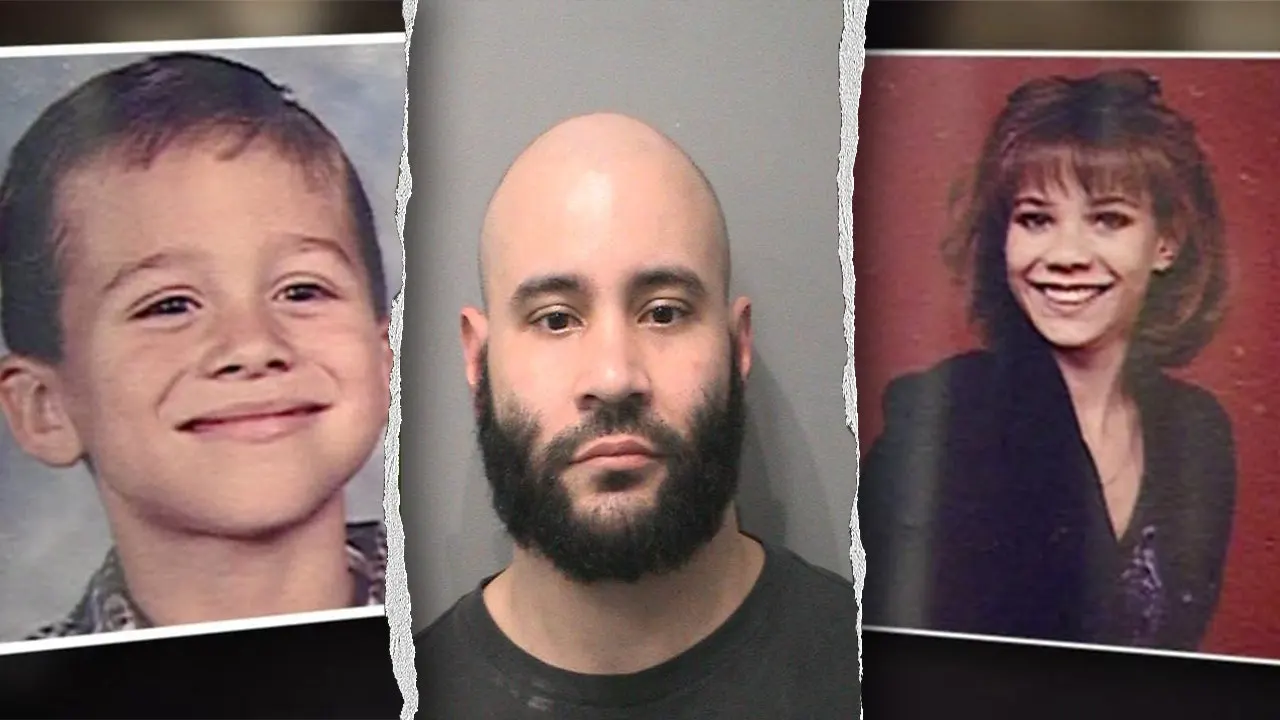
On a warm summer morning in July 2006, the quiet suburban community of Franklin, Indiana, was shattered by a horror that would echo for nearly two decades. In a tidy home on Aberdeen Drive, inside the peaceful Branigin Woods subdivision, two lives were violently extinguished: 10-year-old Blake Dickus, a boy with a lifetime of promise ahead of him, and his 26-year-old stepmother, Chynna Dickus, a young woman who had become a motherly presence in his life. The crime scene was devastating—both victims had suffered multiple stab wounds, and young Blake had also endured blunt-force injuries and signs of smothering. His father, Sean Dickus, returned home that day to discover the bodies, a moment that would haunt him forever. Blake’s biological mother, Christina Smith, had been planning to pick up her son, but instead she arrived to find police tape and a neighborhood frozen in shock. In the years that followed, the case would go cold, with no arrests and no answers. Families and investigators alike were left to wonder who could have committed such an atrocity, and why. It would take eighteen years, a change in the law, and a prosecutor’s determination to finally bring charges—and even now, the road to justice remains uncertain.
The man eventually charged is Michael Jerome James, now 35 years old. He was just 14 at the time of the murders, a fact that created a strange and formidable legal barrier for the prosecution. Johnson County Prosecutor Lance Hamner explained to Fox News Digital that authorities actually identified James as a suspect years before they could charge him. The problem was not a lack of evidence or will, but an unusual gap in Indiana law. Historically, the state’s juvenile courts held jurisdiction over crimes committed by minors. That made sense in ordinary cases, but it created a dilemma when authorities identified an alleged juvenile offender only after that person had aged out of the juvenile system. Because James had not been charged in juvenile court while he was still a minor, and because he was now an adult, the law as written left no clear path for an adult court to try him for crimes committed at age 14. “That leaves a gap,” Hamner said. “This person is alleged to have committed a crime when he was 14, was not charged in juvenile court, and now that he’s over the age of 18 could not be charged in adult court because of the way that law was written.” For years, prosecutors worked to find a way forward, but their efforts were repeatedly frustrated. In 2023, the state legislature passed a law that created a new pathway for adult courts to handle certain cases involving serious crimes committed by juveniles. The law, however, was not universal, and it depended on whether prosecutors could have sought adult prosecution at the time of the offense. The first test came in a child molestation case, and the Indiana Court of Appeals rejected the law’s application. The Indiana Supreme Court soon reached the same conclusion. “That means that we couldn’t use it either,” Hamner said. Rather than give up, he and his team went back to the legislature, using the courts’ guidance to draft a new statute that would satisfy their concerns. In 2025, lawmakers passed the revised law, and it finally gave prosecutors the legal mechanism they needed to charge James. “Then we were back in business to be able to charge this individual,” Hamner said. He expressed greater confidence in the new statute, though he acknowledged that nothing is ever certain. Still, the legal fight may not be over. Criminal defense lawyer Mike Cunningham told Fox 59 News that he believes the law should not be applied retroactively to crimes committed before 2023, arguing that people had no notice that they could later be prosecuted in adult court. If James’s eventual defense attorney challenges the court’s jurisdiction, the entire case could hang in the balance.
The investigation itself was a marathon of dogged detective work and heartbreaking dead ends. After the murders, investigators combed the crime scene and the neighborhood, looking for any thread that might connect the killings to other crimes. They noted that a string of break-ins had occurred within a half-mile of the Dickus residence around the same time, raising the possibility that the murders had occurred during a burglary gone horribly wrong. They also questioned construction workers who had been active in the area, hoping someone had seen something suspicious. But tip after tip led nowhere. “They did a very extensive and thorough investigation, but they weren’t able to identify any suspects,” Hamner recalled. “They were getting a lot of tips, but nothing was coming from it.” The crime scene itself told a harrowing story of struggle. Blake and Chynna had both been stabbed multiple times, and Blake’s injuries suggested a desperate fight for survival. His hands were severely injured, with wounds so deep that his mother later described them as almost sliced through. “His poor little hands were so bad, like, he tried to grab the knife and like, his thumb was almost sliced off,” Christina Smith told WTHR. “The knife went through his hands… I don’t know how that guy could live with himself.” The image of a child trying to fend off an attacker with his bare hands was almost too much to bear, and it fueled the community’s demand for justice. For years, the case sat in the cold-case files, occasionally revisited, but essentially unsolved. Then, in 2021, investigators believed they had caught a break. Hamner declined to reveal what first led authorities to James, but he acknowledged that the development was significant. Franklin Police Capt. Jeff Dawe later confirmed that James represented the first lead in the nearly 20-year investigation that was supported by forensic evidence, though the specific nature of that evidence has not been publicly disclosed. That forensic link, whatever it is, appears to be the cornerstone of the case against James, who now faces four counts of murder in connection with the deaths.
For Hamner, this case is not just another prosecution—it is a deeply personal mission that spans decades of his own career. He was first elected Johnson County prosecutor in 1991 and was in office when the murders occurred in 2006. He left the prosecutor’s office in 2009 to become a judge, but the Dickus case stayed with him, unresolved and gnawing at his conscience. By 2021, he was considering leaving the bench and running for prosecutor again. Then he learned that investigators believed they had finally caught a break in the case. That news helped solidify his decision. “When I found out about this, this was a huge part of my making that decision to come back and work on this case that had sadly just been languishing all those years,” Hamner said. He returned to the prosecutor’s office determined to see the case through, even if it meant navigating the thorny legal landscape that had delayed charges for so long. His perseverance paid off when a grand jury handed up an indictment against James, and Hamner stood before the court on October 8 to begin the process of seeking justice. During the court appearance, James told Johnson Circuit Court Judge Andrew Roesener that he did not yet have an attorney but planned to hire one. The judge gave him until November 2 to secure representation and scheduled a status hearing for the same day. Hamner’s confidence in the revised statute is palpable, but he is also realistic about the challenges ahead. “Nothing’s ever certain, but I’m a lot more confident about this statute than we were with the other one,” he said. His determination reflects not just a prosecutor’s professional duty, but a genuine investment in a community that waited too long for closure.
The human cost of the delay is impossible to measure. For nearly two decades, the Dickus family lived in a strange and painful limbo. They mourned two beloved people while also facing lingering suspicion—especially Sean Dickus, who had discovered the bodies and was cleared by investigators, yet found himself the subject of public doubt. “My family went through torture, so I can’t go through anything worse than that,” he told WTHR. The weight of being suspected, even whispered about, on top of the violent loss of his son and wife, was almost unbearable. Blake’s mother, Christina Smith, spent those years reliving the horror of losing her son and imagining the fear he must have felt in his final moments. She spoke publicly about the details of his defensive wounds, hoping that someone would come forward with information. The family repeatedly appealed to the public, reminding people that a child had been taken far too soon and that a young woman had lost her life in what should have been a safe home. They held onto hope that science and persistence would eventually yield answers, even as the years stretched on and the case grew cold. When news finally came that an arrest had been made, it was both a relief and a reopening of old wounds. Justice was coming, but it had taken nearly two decades—a lifetime for a boy who would now be an adult. The family’s journey has been filled with pain, frustration, and moments when they feared the case might never be solved. But the indictment has brought a sense of validation and a renewed belief that the truth will finally be told.
Now, Michael Jerome James sits in the Johnson County Jail in Franklin, held without bond as the legal process begins to unfold. His next scheduled court appearance is a pretrial conference on December 10, and the months ahead will likely involve intense legal wrangling over whether the new law can be applied retroactively. If the court upholds the jurisdiction, prosecutors will proceed with four counts of murder, hoping to hold James accountable for crimes he allegedly committed as a teenager. If the defense successfully challenges the statute, the case could collapse, and a family that has already endured so much would be left shattered once again. Hamner, however, remains resolute. He believes the 2025 law was carefully crafted to withstand scrutiny, and he is prepared to defend it. For the community, the arrest is a reminder that justice, however delayed, is still possible. For the Dickus family, it is a chance to see the person accused of tearing their world apart face a courtroom, to hear the evidence, and to finally move toward some measure of peace. The road ahead is uncertain, and the case will likely be tested in appeals, but one thing is clear: the hearts of those who loved Blake and Chynna Dickus have never stopped fighting for them. In the end, this is not just a story about legal statutes and forensic breakthroughs—it is a story about a family’s relentless hope, a prosecutor’s unwillingness to forget, and a community’s quiet insistence that some crimes are too grievous to go unanswered. The boy who loved and was loved is gone, but his memory now lives in a pursuit of justice that, after eighteen long years, has finally begun.