


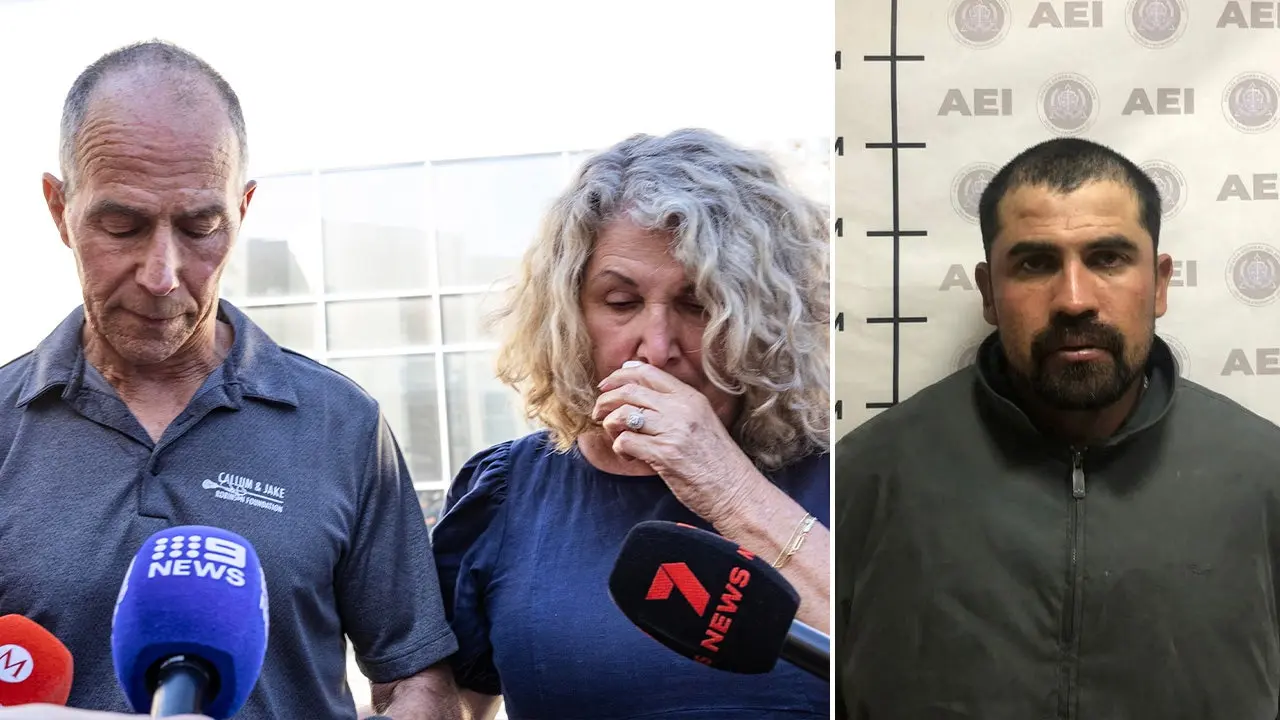
In a sunlit courtroom in Ensenada, Baja California, on a Friday that had been marked on calendars for months, the families of three murdered young men finally heard the words they had been waiting for: guilty, followed by a sentence that stretched far beyond a single lifetime. Jesús Gerardo García, Irineo Francisco and Ángel Jesús were each sentenced to 158 years and nine months in prison for the killings of Australian surfers Callum and Jake Robinson and their American friend Carter Redd Rhoad. The three friends had traveled to the remote Pacific coast in April 2024 for a surfing trip, chasing waves and the kind of golden afternoon that turns into a cherished memory. Instead, they disappeared. Their bodies were found in a well in May, and the subsequent investigation revealed a motive so mundane and so cruel that it seemed almost impossible to comprehend: the men were killed for the tires on their truck. As the judge pronounced the sentence, Martin and Debra Robinson, parents of the brothers, sat together in the courtroom, their presence a quiet testament to their two-year fight for justice. The verdict did not resurrect their sons, but it did something rare in a grief-stricken journey: it offered an official, incontrovertible answer to the question that had haunted them — that the men who took their sons’ lives would be held accountable. For the families, and for the international community that had followed the case, the moment felt like both an ending and the beginning of a different kind of pain: the long, difficult process of remembering the lives rather than the deaths.
The sentencing was the culmination of a prosecution that implicated not only the three men who carried out the killings, but also an accomplice who played a different role. In November, Ary Gisell Silva Raya, described as an accomplice of García, was convicted of aggravated robbery with violence and vehicle theft with violence and sentenced to 20 years after agreeing to an abbreviated trial. She was not charged with murder, but her conviction underscored the breadth of the investigation and the network of people involved in the deadly encounter. García, Francisco and Jesús, for their part, had been found guilty a week before the sentencing on charges that included murder, robbery with violence, and vehicle theft with violence. The court in Ensenada handed down a combined penalty, stacking the sentences for each crime into a term that, in practical terms, means the men will spend the rest of their lives behind bars. For the families, the legal process was a labyrinth of motions, delays, and painful testimony, but they never stopped showing up. The parents traveled from Australia to Mexico, not just to attend the sentencing, but to ensure that the court understood who Callum and Jake were — two adventurous brothers with a passion for the sea, a tight bond with each other, and a wide circle of friends who refused to let their memory fade. Carter Redd Rhoad, the American companion, was equally loved, his own family carrying the same burden of loss even as much of the public attention centered on the Australian brothers. The fact that the three men were sentenced together, for the same crimes, seemed to acknowledge the equal weight of all three lives.
The investigation painted a chilling picture of what happened in the final hours of the victims’ lives. According to Baja California prosecutor María Elena Andrade, the attack began as a robbery. The three friends had driven to Punta San José, a remote stretch of coast about 50 miles from where their bodies were eventually found, for a surfing trip. The remote location, chosen for its beauty and solitude, became a trap. Andrade said that when the group was confronted, one of the men resisted the robbery, and the attackers pulled out a gun and killed him on the spot. Then, in a cold, methodical fashion, they turned the weapon on the other two. The motive, authorities said, was to steal the tires from the victims’ truck — a small, replaceable object compared to the immense loss left behind. The bodies were dumped in a well in the Baja California countryside, a final insult that turned the search for the missing men into a grim recovery effort. For weeks, their families clung to hope, but the discovery in May 2024 shattered any possibility of a happy ending. The prosecutors’ account of the crime, delivered in court with exacting detail, made the cruelty of the act impossible to ignore. It was not a crime of passion, not a gangland execution, not an act of war; it was a robbery gone wrong, carried out with a casual violence that left an entire community stunned. The case also highlighted the vulnerability of travelers in isolated areas, where a chance encounter with the wrong people can turn a dream vacation into a nightmare.
Behind the crime statistics and legal verdicts, the true story was always about the men who died. Callum and Jake Robinson grew up in Australia with a shared love of the outdoors, and surfing was more than a hobby; it was a way of connecting with the world and with each other. Carter Redd Rhoad, an American, had become part of their traveling circle, and the three men set out together on a trip that was supposed to be filled with sun, salt, and adventure. Instead, their names became part of an international headline, and their faces were shown on news screens from Sydney to San Diego. The Robinson parents have spent two years navigating a grief that no parent should have to know. In a statement after the sentencing, Martin Robinson said: “Today’s guilty verdict is a significant moment in our long and painful journey to seek justice for our beautiful sons, Callum and Jake, and their friend Carter Rhoad, whose lives were so cruelly taken from them in 2024.” The words were measured, but they carried the weight of months of sleepless nights, unanswered phone calls, and the terrible realization that their sons were not coming home. The presence of the parents at the sentencing was not just about seeing justice done; it was also a way of honoring the memory of their boys, of showing the court and the world that these were not anonymous victims, but beloved members of a family. Their quiet dignity in the face of such overwhelming loss became a part of the story itself.
The murders reverberated far beyond the families. The remote surf town of Punta San José and the surrounding region had long relied on tourism, drawing visitors from around the world who came for the waves, the vistas, and the sense of freedom that the Baja coast offered. The brutal killings, and the discovery of the bodies in a well, sent a shockwave through that community. Antonio Otañez, president of the Baja California surfers association, said he was happy to see justice served but acknowledged the incident caused a “major drop” in tourism. The fear was understandable: if a group of surfers could be killed just for their truck tires, what was safe anymore? Local businesses, guides, and families who depended on the influx of visitors felt the pain in their livelihoods as well as their hearts. For a time, the empty lineups and deserted streets were a daily reminder of the tragedy. The broader travel community also took notice. The case became a cautionary tale about the risks that can accompany even the most picturesque destinations, and it prompted discussions about safety, security, and the need for travelers to remain vigilant. In the months since, officials and local leaders have worked to rebuild trust, emphasizing that the violence was an aberration carried out by individuals who have now been convicted. But the damage to the region’s reputation was real, and the road back to normalcy has been slow. For Otañez and others, the sentencing was not just a legal victory; it was a chance to begin healing the community’s wounds and to reassure visitors that the beauty of Baja California could coexist with safety.
Friday’s sentencing did not claim to bring closure in the absolute sense — there is no such thing when a life has been stolen. But it did complete a critical chapter in the search for justice. The three men convicted of murder will spend the rest of their lives behind bars, a fact that carries its own bittersweet significance. The family members who traveled to Mexico, who sat through every hearing, who looked into the faces of the men who killed their sons, have now completed the hardest task they could have imagined. They did it for love, and they did it so that Callum, Jake, and Carter would not be forgotten. In the days ahead, there will be quieter moments of remembrance: a wave surfed in their honor, a photograph on a mantel, a story told by a friend who still cannot quite believe they are gone. The legal process has ended, but the human story continues. The sentence of 158 years is a number too large for the mind to fully grasp, yet it will always be smaller than the loss it seeks to punish. The three young men who came to Mexico for adventure were not statistics; they were sons, brothers, friends, and dreamers. And in a courtroom in Ensenada, their families finally won the only victory the law could offer. Justice, imperfect and incomplete as it always is, had been done.