


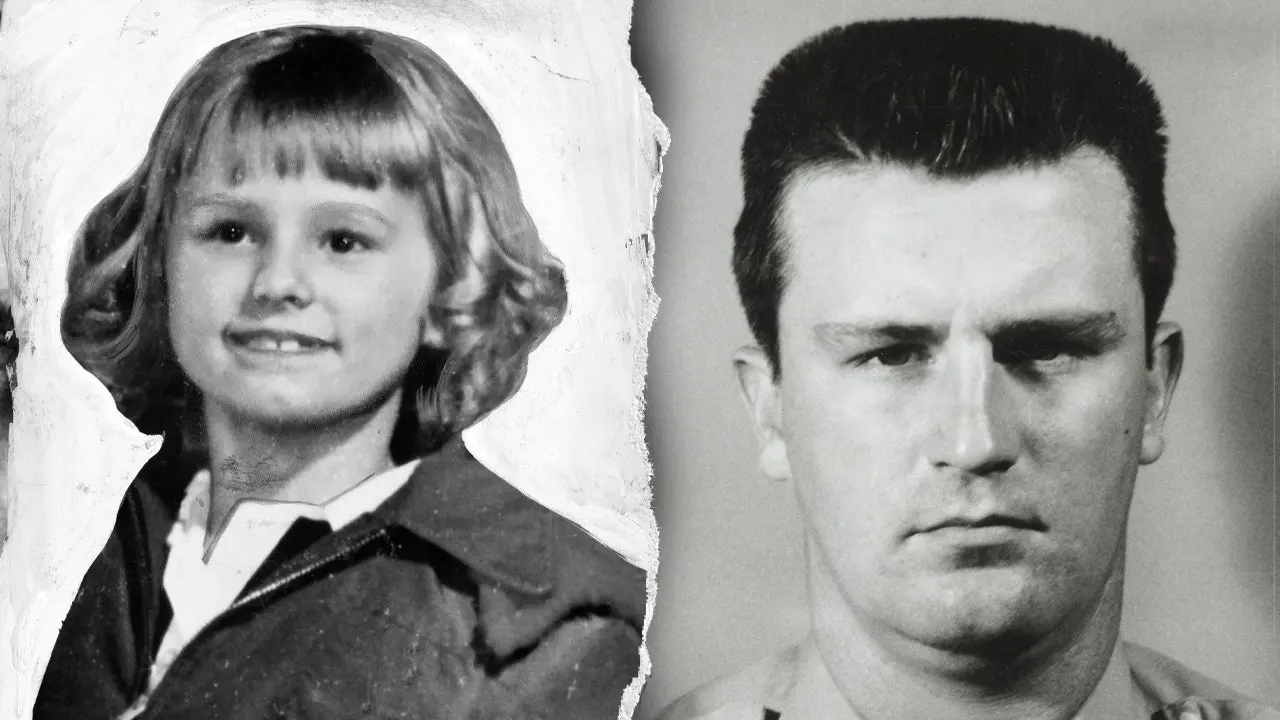
For more than sixty-five years, the murder of eight-year-old Gloria Kowalewicz remained one of Chicago’s most haunting mysteries, a case that seemed destined to never be solved. On the morning of November 12, 1960, Gloria left her home just before eight o’clock and began the short walk to St. Mary of Mt. Carmel Church, a few blocks away. She was carrying a little white communion purse that held her prayer book, likely dressed for a day of quiet devotion, her small life unfolding in the ordinary rhythm of childhood and faith. She never arrived at the church. Four hours later, her body was discovered in a ditch in a forest preserve southwest of Chicago, a place no child should ever have been. The horror of that discovery shook the community, and the pain of her loss stayed with her family for generations. Now, after decades of false starts and vanishing clues, the Chicago Police Department has finally put a name to the monster responsible: Thomas F. McInerney Jr., a violent crimes detective who was then a recent addition to the force. The person who abducted and killed Gloria was not a stranger lurking in the shadows, but a man entrusted with protecting the public, a cop wearing the same badge as the officers who would spend years hunting him.
The crime scene painted a grim picture of a little girl’s final moments. Investigators found a bullet, Gloria’s coat, her shoes, and that small white communion purse, abandoned or scattered along the route back toward the city. The evidence was preserved, carefully cataloged and stored, even as the case grew cold. In the aftermath of her death, Chicago police threw themselves into an exhaustive investigation. They formed a task force, knocked on hundreds of doors, and interviewed more than 1,300 people in the hope that someone had seen something, heard something, or knew something. More than a dozen individuals were questioned under polygraph, each one cleared, while the true killer remained hidden in plain sight. The idea that a member of the police department could be responsible was so unthinkable that investigators never seemed to see him. He was a colleague, a fellow detective, part of the machinery of justice. It was not that the investigators of that era were foolish or lazy; they simply did not have the advanced forensic tools that modern detectives rely upon. DNA profiling was decades away, computerized databases did not exist, and fingerprint matching was still a painstaking manual process. The killer moved through the investigation, perhaps even observing it, while the city mourned and the case settled into a long, sorrowful silence.
What finally broke the case open was not a confession or a sudden memory, but science. Over the years, Chicago police detectives never truly stopped looking. They worked alongside Illinois State Police and the FBI, returning to the files, reexamining the physical evidence, and waiting for technology to catch up with the horror of the crime. At last, it did. Advances in fingerprint analysis and DNA testing allowed investigators to revisit the old evidence with new eyes. It was a fingerprint lifted from the strap of Gloria’s purse that ultimately identified McInerney as her killer, more than six decades after the crime. The evidence had been preserved all those years, held in storage by law enforcement who refused to let the case die. According to Michael Gould, a founding member of the New York Police Department’s K-9 unit, such long-term preservation is rare, and it was essential in solving this case. Gould also reflected on the limits of the original investigation, noting that scent-tracking dogs could have been used to follow the killer’s trail, but police K-9 units were not widely adopted until the mid-1980s. “Dogs could have tracked where the person lived and what direction he fled,” he said. They offer what he calls “X-ray vision,” allowing officers to see evidence that is invisible to the naked eye. The lack of those tools in 1960 was an unfortunate loss, but in the end, patience and scientific progress triumphed where older methods could not.
The identification of McInerney has opened a window into a deeply disturbing aspect of the case. Gould has no doubt that this was not a spontaneous act of violence, but something planned, deliberate, and likely part of a larger pattern. “My prediction is there are going to be other victims,” he said. “I don’t think this was a sole act. This, in my view, would have been a planned and intentional act. It’s rare that this happens once in a serial murderer’s life,” he said. “They don’t do it one time. In fact, it usually escalates when they’re successful.” What makes it even more chilling, Gould noted, is the way McInerney may have used his badge to gain Gloria’s trust. Children are taught to respect law enforcement officers, to see them as protectors rather than threats. When a police officer leverages that trust to harm an innocent child, it is a betrayal that cuts deeper than the violence itself. “We teach our children that you should trust law enforcement, and when they leverage that against innocent people, particularly children, it’s horrendous,” Gould said. The thought of little Gloria being lured into a car by a man in uniform, believing she was safe, is almost unbearable to contemplate. It transforms the story from a random tragedy into a violation of everything a community holds sacred.
For Thomas F. McInerney Jr., the truth arrived far too late to face justice in this world. After spending twenty-eight years on the Chicago Police Department, he retired and moved to Las Vegas, where he lived out the remainder of his life as a free man. He died in 2006 at the age of seventy, more than a decade before his fingerprint would finally be matched to the strap of Gloria Kowalewicz’s purse. In a prepared statement, the Chicago Police Department expressed the anger and sadness that still surrounds the case. “His abhorrent actions not only took the life of an 8-year-old child, but left her parents and all who knew and loved her shattered as they searched for answers,” the statement read. “McInerney should never have worn the CPD star, and it is devastating to accept that he was never identified and held accountable while he was alive. Though her parents have since passed away and were not able to receive justice in their daughter’s murder, we hope that this news brings a measure of closure to all who knew Gloria and her story.” The Kowalewicz family’s attorney, who has served as their spokesperson, did not respond to requests for comment. It is likely that for Gloria’s surviving relatives, the news brings not joy, but a complicated mixture of validation, grief, and the sorrowful knowledge that justice came too late for the people who loved her most.
In the end, this is a story about memory and the lengths some people will go to honor it. Gloria Kowalewicz was not famous, not powerful, not old enough to have fully shaped her own life. She was simply a little girl walking to church on a November morning, someone’s daughter, someone’s friend, someone with a whole future ahead of her. The city of Chicago never let her vanish completely. Evidence was kept, files were preserved, and detectives returned to her story again and again, generation after generation. The answer, when it finally came, was not satisfying in the usual sense. It did not bring a trial, a sentencing, or a moment of accountability in a courtroom. It only revealed the truth: that a man trusted to protect children had instead stolen a young life and then hidden behind his badge for decades. Yet there is a kind of justice in the truth itself. Gloria’s name is remembered, her story is told, and the man who killed her is finally known. For a family that waited so long, for a city that refused to forget, that knowledge matters. It cannot bring Gloria back, and it cannot ease the pain of her parents, who died before they could hear the news. But it closes the case in the only way left possible, and it ensures that the little girl in the white communion purse will never be lost to the silence of an unsolved mystery again.