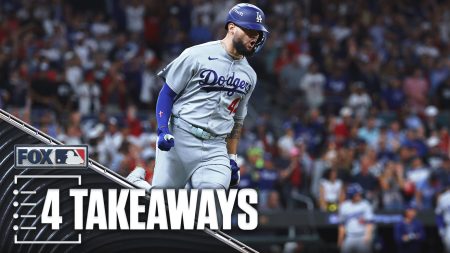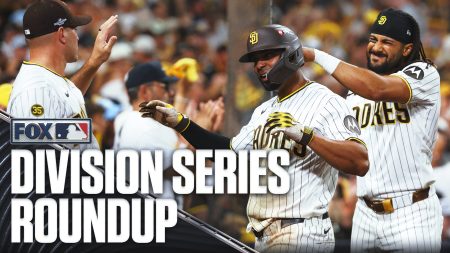


For the fourth time in nine seasons, the Los Angeles Dodgers and Milwaukee Brewers are meeting again in the National League playoffs, and this time, the stakes feel even heavier. The top-seeded Brewers, who finished with an outstanding 103-59 record, clawed their way through the San Diego Padres in the NL Division Series, while the second-seeded Dodgers, at 100-62, handled the Atlanta Braves. The two teams are now set to battle in the NLCS, and there’s no shortage of history between them. The Dodgers have won every single postseason meeting between these two clubs—the 2018 NLCS, the 2020 wild-card round, and the 2025 NLCS, where they swept Milwaukee in four straight games. That sweep, in particular, still lingers in the minds of Brewers players and fans alike. It was a series where Milwaukee simply couldn’t find any traction, scoring just four runs in four games despite having one of the best offenses in baseball that season. So as the 2026 NLCS approaches, the Brewers are not just trying to reach the World Series—they’re trying to exorcise a demon, rewrite history, and prove that they can finally get past a team that has had their number when it matters most. The quote from Buzz Lightyear, “So, we meet again, Buzz Lightyear … for the last time!” captures the dramatic, almost cinematic nature of this rivalry: two titans colliding, with the Brewers hoping this is the moment they turn the tables and make their own destiny.
How exactly do the Brewers flip the script? According to former MLB player and FOX Sports analyst Eric Karros, it comes down to discipline and patience at the plate. Karros, who knows a thing or two about playing in big moments, emphasized that Milwaukee can’t afford to get caught up in the power game against a pitching staff as deep as Los Angeles’s. Instead, they need to grind every single at-bat, take their walks, and refuse to chase pitches outside the strike zone. “They come to play every single day. They grind; they don’t give away anything. Offensively, I don’t know if it’s necessarily the hitting part as much as it’s controlling the strike zone,” he said. “That means don’t expand, don’t chase pitches out of the zone, take your walks, be patient and just kind of wear down this Dodgers’ pitching staff. That’s really the MO that they’re going to have to create offensively.” This is a team that clearly has the talent, but the mental approach could be the deciding factor. In the NLDS against San Diego, the Brewers only mustered 13 runs across four games, and in last year’s NLCS, they scored just four runs against the Dodgers—a shocking collapse for a team that was third in both runs and hits during the regular season. But the 2026 regular season told a completely different story: Milwaukee was first in hits with 1,422, first in on-base percentage at .341, tied for first in batting average at .258, and second in runs with 832. Yet, they hit only 154 home runs, tied for 28th in baseball. The Brewers aren’t a team that relies on the long ball—they’re a team that thrives on small ball, situational hitting, and relentless pressure. If they can be true to that identity against the Dodgers, they have a real shot.
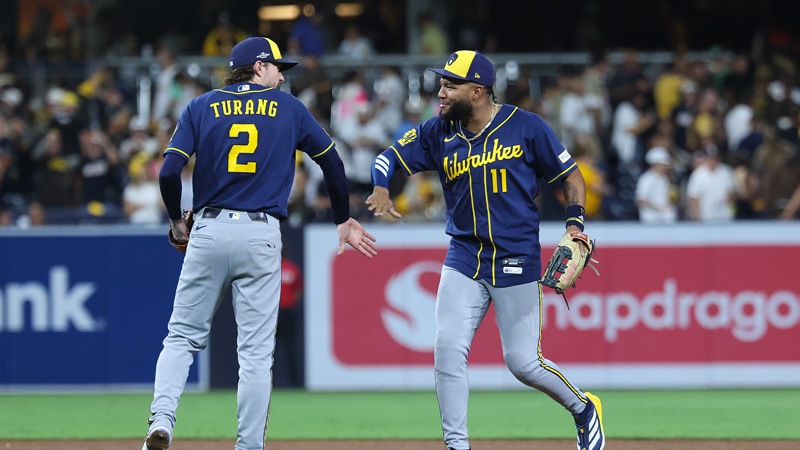
Milwaukee’s offense is led by a mix of young stars and gritty veterans who have stepped up in big moments. Second baseman Brice Turang has been the heartbeat of the team all season, posting 23 defensive runs saved at the middle infield position—a stunning number that showcases his elite glove work—while also driving in a team-high 100 runs and accumulating 7.3 wins above replacement, which ranked third among all MLB position players. Turang isn’t the flashiest name in the league, but he does a little bit of everything: he gets on base, he plays spectacular defense, and he finds ways to drive in runs, often in clutch situations. First baseman Jake Bauers provided the power punch with a team-high 26 home runs, 86 RBIs, and a .484 slugging percentage, proving to be a reliable run producer in the middle of the order. Then there’s Jackson Chourio, the electric young left fielder who has become a fan favorite with his combination of speed, power, and infectious energy. Chourio hit 25 home runs, drove in 75 runs, stole 23 bases, and posted a .291/.351/.487 slash line across 127 games. But his most memorable moment came in Game 2 of the NLDS, when he delivered a walk-off, two-run single with a full count and two outs, sending the Milwaukee crowd into a frenzy. That single moment captured the spirit of this team: they never give up, and they always believe they can find a way to win. Behind the plate, William Contreras has been rock solid, driving in 94 runs in the regular season, which led all MLB catchers, and adding two home runs in the NLDS. Together, these hitters form a lineup that doesn’t necessarily intimidate with raw power but with sheer consistency and a refusal to make easy outs.
As productive as the Brewers’ bats have been, pitching remains the true backbone of their operation. Their starting rotation has been one of the best in the National League, posting an opponent batting average of .220 (second in MLB), 907 strikeouts (third), a 1.14 WHIP (tied for third), and a 3.61 ERA (fifth). Ace Jacob Misiorowski has been simply phenomenal, putting up a 1.80 ERA, a 0.80 WHIP, a 232 ERA+, and 252 strikeouts—all NL bests—over 30 starts. Misiorowski is a fearsome presence on the mound, with a fastball that can reach triple digits and a breaking ball that leaves hitters guessing. But what makes him even more dangerous in this matchup is his ability to neutralize left-handed hitters, holding them to a microscopic .114 opponent batting average compared to .209 against righties. That could be a huge factor against a Dodgers lineup that leans heavily on left-handed stars. Behind him, Logan Henderson has emerged as a reliable second option, posting a 2.47 ERA, a 0.84 WHIP, and 110 strikeouts in just 18 starts. The bullpen also deserves recognition, ranking third in ERA at 3.40, third in opponent batting average at .223, and tied for fifth in WHIP at 1.23. In a short series, the bullpen can make or break a team, and Milwaukee’s relief corps has shown the ability to shut down high-powered offenses. Karros highlighted this exact strength: “From a pitching standpoint, they’ve got Misiorowski, who’s as good as anybody and actually dominates left-handers. The Dodgers are top-heavy on the left side. That could help Milwaukee. They also have Logan Henderson. At the end of the day, this series is going to come down to the Brewers’ bullpen and matchup against the Dodgers’ depth position player-wise and what Dave Roberts creates.”
But of course, the Brewers are facing a juggernaut. The Dodgers are not just another good team—they are deep, experienced, and loaded with talent at every position. Offensively, Los Angeles features a murderer’s row of hitters: Shohei Ohtani, the two-way sensation who continues to redefine what’s possible in baseball; Freddie Freeman, the consummate professional with a knack for coming through in the clutch; Mookie Betts, a former MVP with an all-around game; Andy Pages, a young outfielder making his name on the biggest stage; and Kyle Tucker, a trade deadline acquisition who added even more pop to an already fearsome lineup. This group finished second in the regular season in slugging percentage at .424, third in batting average at .257 and on-base percentage at .338, fourth in runs with 801, and tied for fourth in hits with 1,399. They also had the fourth-fewest strikeouts in the sport at 1,267, meaning they don’t swing and miss often—they make contact, put pressure on opposing pitchers, and capitalize on mistakes. On the pitching side, the Dodgers were second in ERA at 3.43, second in opponent batting average at .220, tied for third in WHIP at 1.14, and fourth in strikeouts with 904. And as if that wasn’t enough, they already boasted 2025 World Series MVP Yoshinobu Yamamoto, two-time Cy Young Award winner Blake Snell, and right-hander Tyler Glasnow. Then, at the trade deadline, they went out and acquired Tarik Skubal, the back-to-back American League Cy Young Award winner from the Detroit Tigers. That kind of rotation is almost unfair, and the Dodgers have the ability to throw elite arms at opponents from game one all the way through the series. Ohtani hasn’t pitched since July 3 due to knee inflammation, but he’s remained the team’s primary designated hitter, causing chaos with his bat alone. With this kind of roster, it’s easy to see why the Dodgers are favorites—but they are not invincible, and Milwaukee has already proven they can beat them.
The regular-season series between these two teams was split 4-3, with both sides winning a series on the other team’s home turf, which suggests this NLCS could be incredibly tight. The Brewers have gone 4-3 against the Dodgers this year, and that confidence, paired with their mental and emotional growth, makes them a dangerous opponent. Karros, for his part, is excited to see what unfolds. “I’m looking forward to the series as a fan. I think it’s going to be a great series,” he said. And he’s right—there’s something special about this matchup. On one side, you have a Brewers team that plays with a chip on its shoulder, a group of hungry, hard-nosed players who don’t have the superstar names but have the heart and grit to compete with anyone. On the other side, you have the Dodgers, a superteam built to win championships, with a lineup of future Hall of Famers and a pitching staff that looks like an All-Star roster. The series will come down to the details: whether Milwaukee can maintain their plate discipline and force walks, whether their bullpen can hold up against deep Dodger lineups, and whether Misiorowski’s left-handed dominance can neutralize the heart of Los Angeles’s order. It’s a battle of approach versus talent, of gritty teamwork versus overwhelming star power. Game 1 is set for Sunday night, with the entire series airing on FOX networks, and every baseball fan should be glued to their screens. After years of playoff heartbreak, this might finally be the moment the Brewers find a way to flip the script, to slay the dragon, and to prove that, no matter how many times you meet the same opponent, history doesn’t dictate the future—just ask Buzz Lightyear, who thought this would be the last meeting, only to find out that this rivalry still has plenty of magic left.