



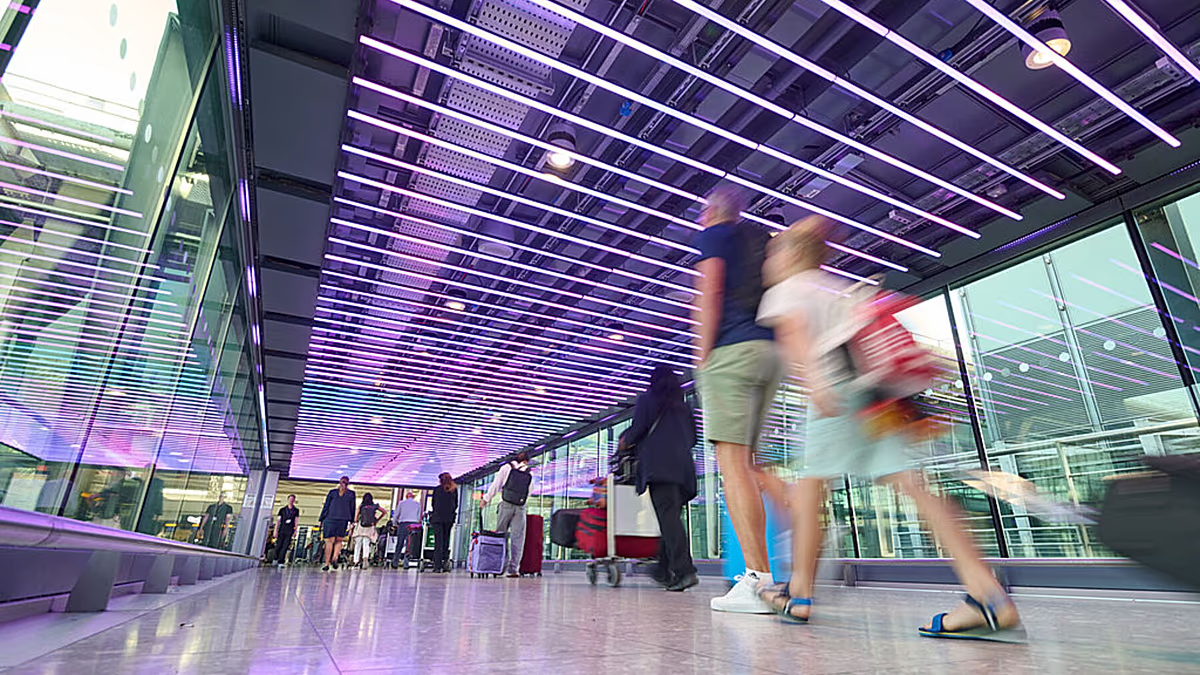
Imagine stepping off a long-haul flight, your body still humming with the rhythm of the plane, your mind already racing ahead to the taxi queue or the welcome-home hug waiting just beyond the arrivals hall. For decades, that moment of arrival has always been interrupted by the same ritual: fumbling for your passport, checking that you still have the right page ready, and waiting in line to prove who you are. In the United Kingdom, that ritual is beginning to change. The country has started rolling out a new contactless border system across its airports, and the first travellers to experience it have already done so at East Midlands Airport. Eligible passengers arriving in the UK will soon be able to pass through airport e-gates without presenting their passports at all. Instead, a quick glance at a camera will be enough to confirm their identity and let them through. Initially, the service is only available to British citizens, but the government has made it clear that this is just the beginning. In an official statement, it announced plans to upgrade all of the country’s e-gates by early 2027 and to extend access to other eligible nationalities in due course. For anyone who has ever stood in a long border queue after an overnight flight, the thought of simply walking up to a gate, looking at a screen, and watching the barrier slide open feels almost futuristic. But it is happening now, and it promises to make the final stage of international travel feel a little less like an obstacle course and a little more like the welcome home it should be.
The new contactless system has been tested thoroughly, and the results are impressive. According to the government, it is up to 25 percent faster than the traditional method of presenting a physical passport. That might not sound like a dramatic difference at first, but in a busy airport, with hundreds of passengers arriving at once, a 25 percent speed increase can mean the difference between a short, manageable queue and a long, stressful wait. Steve Griffiths, the Managing Director of East Midlands Airport, said he was delighted to be the first UK airport to have the contactless e-gates introduced by Border Force. He added that any technological innovation that can make customers’ journeys smoother, swifter and simpler is always welcome. That sentiment will surely be shared by families, especially those travelling with young children. Phil Douglas, the Director General of the UK’s Border Force, explained that the digital push builds on work done over the summer to extend e-gates to children aged eight and older. For parents juggling luggage, sleepy kids and the general chaos of arrival, not having to dig out multiple passports and coax a child into standing still for a photograph is a small but significant blessing. The system effectively removes one more friction point from the travel experience. It also gives Border Force officers more time to focus on the travellers who genuinely need extra attention, rather than spending most of their day watching the same routine scanning process repeat itself over and over. The result, in theory, is a border that is both faster and more secure, a rare combination in the world of modern travel.
So how does the contactless system actually work? At its heart is facial comparison technology, a type of biometric recognition that has become increasingly common in airports around the world. When a passenger arrives at an e-gate, they simply approach the barrier and pause for a moment while a camera takes a photograph of their face. The system then compares that live image against verified immigration, travel and passport information already held on record. If everything matches up and the passenger is clear to enter, the barrier opens automatically and the checks are complete. There is no need to scan a passport, no need to place a finger on a sensor, no need to do anything except look at the camera. For most eligible travellers, the entire process takes just a few seconds. However, the system is not infallible, and there are times when further checks may be needed. If the facial comparison is unable to produce a confident match, or if there is any reason to look more closely at a traveller’s records, the e-gate will prompt the passenger to place their passport on the reader. In some cases, the traveller may be directed to speak with a Border Force officer. This human oversight is important. It means that the technology is not simply replacing people; it is supporting them, handling the straightforward cases quickly and efficiently while flagging anything unusual for a more personal review. Despite the automated nature of the system, officials strongly advise travellers to keep their passports with them at all times, both while moving through the airport and after they have entered the country. The passport remains the ultimate proof of identity, and there may be moments when it is still required.
For travellers, the arrival of contactless e-gates brings with it a few practical considerations. The most important piece of advice is to carry your passport even though you may not need to scan it. This is especially relevant for dual British nationals, who have been given a specific warning by the UK government. If you hold British nationality alongside another nationality, you should return to the UK using a valid British passport or hold a Certificate of Entitlement. This will help avoid potential delays at the border. The reason for this is straightforward: the contactless system relies on being able to verify your identity against existing records, and those records are linked to your British citizenship status. Without the correct documentation, even the most advanced facial recognition system in the world cannot do its job properly. For most people, though, the process will feel wonderfully simple. You walk up to the gate, look at the camera, and the gate opens. No paper, no fingerprints, no awkward fumbling for documents while holding a suitcase under one arm. Border Force officers will be present at all times, monitoring the e-gates and offering assistance to anyone who needs it. That means there is no need to feel anxious about using the new technology. If something goes wrong, or if you simply have a question, there will still be a person nearby to help. The system is designed to be user-friendly, but it is also designed with enough flexibility to handle the unpredictable nature of real life at an airport.
Which UK airports can travellers expect to find these new contactless e-gates? For now, the technology is available at East Midlands Airport, where the initial rollout has begun. But this is only the starting point. As part of a phased introduction, the contactless e-gates will also be rolled out across a wide range of major airports, including Birmingham, Bristol, Cardiff, Edinburgh, Gatwick, Glasgow, Heathrow, London City, Luton, Manchester, Newcastle and Stansted. That list covers almost every significant international gateway in the country, which means that within the next few years, contactless arrival could become the standard experience for most visitors to the UK. The country already has more than 290 standard e-gates in place at 15 air and rail ports, and those existing gates are being gradually upgraded to support the new facial recognition technology. At the moment, the e-gates are available to UK and Irish citizens, as well as to travellers who are eligible to obtain an Electronic Travel Authorisation, or ETA, to travel to the UK. The ETA system was introduced in February as a way of identifying potential security risks before a person even sets foot on a plane. By requiring certain travellers to apply for authorisation in advance, officials can review their information and make decisions before they arrive at the border. This adds an extra layer of security, but it also makes the arrival process smoother for travellers, because much of the checking has already been done before landing. The combination of ETA pre-screening and contactless e-gates means that the border experience is becoming less about interrogation and more about verification.
Looking ahead, the introduction of contactless e-gates feels like a genuine turning point in the way we travel. It is part of a broader global trend toward biometric borders, where technology takes on the repetitive work of checking identities and leaves human officers free to deal with the things that require judgement, empathy and experience. The UK is clearly aiming to be at the forefront of that shift. By upgrading all of its e-gates by early 2027 and expanding access to more nationalities, the government is sending a message that it wants to make travel to Britain easier, faster and more welcoming. For business travellers, this means less time spent in queues and more time doing what they came to do. For tourists, it means a smoother start to a holiday or a visit to friends and family. And for everyone, it means that the anxiety of arriving in a foreign country, that little flutter of uncertainty as you approach the border, becomes just a little bit lighter. Of course, this does not mean the end of the passport. You will still need one to travel, and you should still carry it with you. But at the border itself, the passport may no longer be the star of the show. Instead, your face becomes the key. It is a strange and slightly wonderful thought: after a long journey, the last thing you have to do before entering the country is simply be yourself. With the right technology in place, the future of travel looks faster, kinder and far less bureaucratic. The next time you land in the UK, don’t be surprised if the gate opens for you with nothing more than a smile at the camera.