

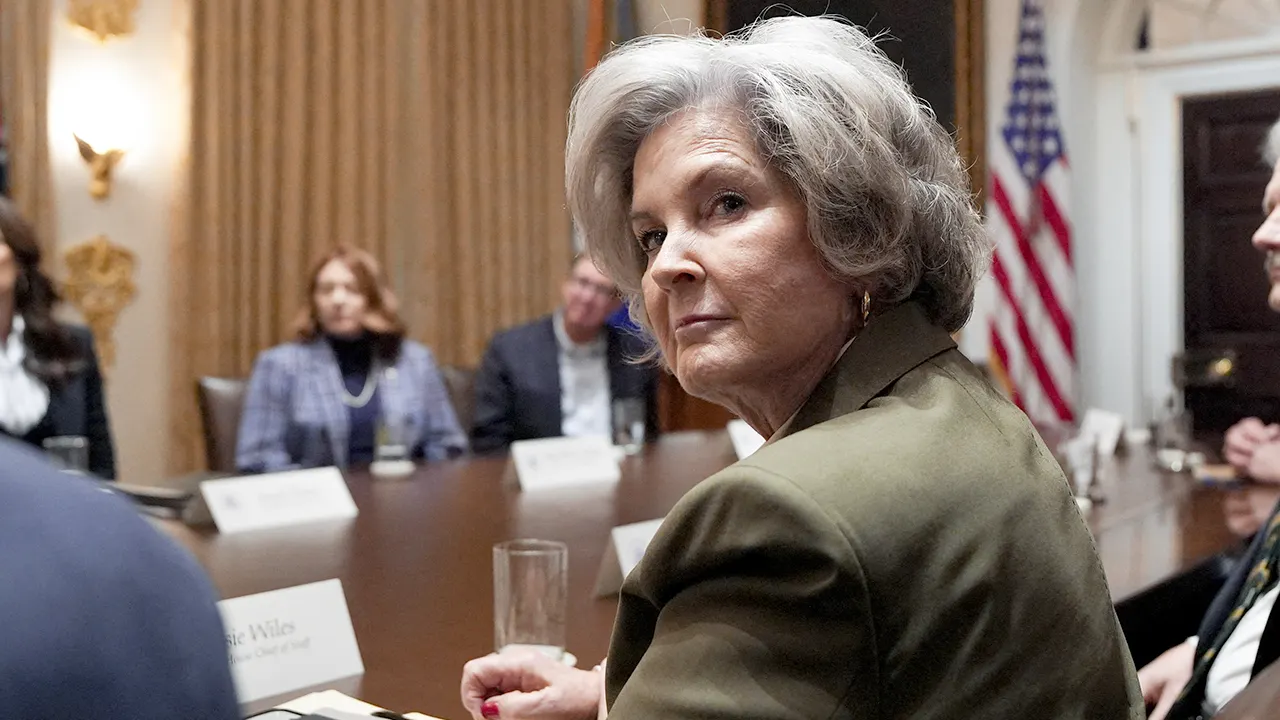
For months, the FBI was quietly assembling a portrait of Susie Wiles’ life through the digital footprint of her phone. The newly declassified records, released Monday by the White House, show that federal investigators tracked her calls in remarkable detail during the classified documents investigation into President Donald Trump—long before Wiles became his chief of staff. These were not wiretaps recording her conversations; they were metadata logs, cataloguing every incoming and outgoing call: who reached her, whom she called, when the calls happened and how long they lasted. But to anyone who has ever lived a life of work and relationships, those little details are intimate. A call to a lawyer at 11 p.m., a brief conversation with a Secret Service agent, a check-in with a journalist, a quick word with a campaign aide—all of it laid out in government spreadsheets and timelines. The records, part of the FBI investigation code-named “Plasmic Echo,” reveal the breadth of the bureau’s monitoring of Wiles from at least February through May 2023. At the time, Wiles was running Trump’s political operation and serving as one of his most trusted campaign advisers. The documents do not tell us what the FBI was looking for or why her contacts mattered. But they show that the bureau was determined to map her network, and that determination extended into every corner of her life.
What is most striking about the new documents is how expansive that network turned out to be. The FBI’s logs show Wiles was in contact with at least 21 different attorneys, along with campaign personnel, Trump Organization contacts, Secret Service officials and journalists from major outlets including CNN, The Washington Post and POLITICO. Some entries identify people by name; many others are reduced to labels: “Lawyer,” “Campaign,” “USSS.” The monitoring even swept in two separate Secret Service officials, identified only as “USSS 1” and “USSS 2,” pulling Wiles’ phone activity into the protective orbit around Trump. A single entry from March 24 of that year illustrates how investigators were not just capturing random calls. They logged a 41-second call from “Lawyer 7” to Wiles, then went back and examined earlier calls between the same two people. That is not passive collection; that is active pattern-mapping. Similarly, a March 9 log shows investigators cataloguing a series of calls between Wiles and at least six campaign contacts, recording the timing and duration of each communication. The records do not reveal what was said, what investigators hoped to establish, or whether any of these contacts had anything to do with classified documents. But the image is clear: the FBI was building a detailed chart of Wiles’ relationships, habits and daily rhythms. For anyone in public life, that is unsettling. For a campaign professional doing her job, it is a reminder that the state can reduce your entire world to a list of metadata points.
The investigation behind these records began long before those phone logs were assembled. In March 2022, the FBI and Justice Department launched a probe into Trump’s handling of classified documents and other presidential records, with then-FBI Director Christopher Wray seeking authorization and Attorney General Merrick Garland approving the full investigation. That probe eventually became known as “Plasmic Echo,” and it led to the FBI’s dramatic search of Mar-a-Lago on August 8, 2022. Months later, in November 2022, Garland appointed Jack Smith as special counsel to oversee the ongoing investigation, which also examined possible obstruction. Wiles was not the target of the investigation, at least as far as the public knows. She was, however, a central figure in Trump’s political world—the person managing campaigns, coordinating strategy, and interacting with the lawyers, staff, reporters and security personnel who surrounded the former president. Her phone records were swept up in the same operation that reached into Trump’s circle, and the newly released documents show that the FBI was still monitoring her communications as late as spring 2023, more than a year after the investigation began. It is worth remembering that these were not records of government officials acting in an official capacity. Wiles was a private citizen at the time, advising a candidate and running a political operation. The fact that her personal calls and professional contacts were treated as evidence in a sprawling federal investigation raises serious questions about how far prosecutors were willing to go.
Reaction to the documents was swift and blunt. White House spokesperson Lauren Bis called the surveillance operation “a disgraceful abuse of government power,” adding that “spying on political opponents is weaponization of law enforcement, plain and simple.” Victoria Coates, a foreign policy expert at the Heritage Foundation, went further, describing the tracking of Wiles as “unprecedented, dangerous, and should be illegal.” Coates drew a direct line between the Biden-era FBI and what she characterized as the Obama-era FBI’s surveillance of Trump’s 2016 campaign, warning that the same authorities used against political figures are now being normalized. She also pointed to what she sees as a glaring double standard: the Justice Department’s handling of President Joe Biden’s own classified documents case, which she argued involved violations far more serious than anything found at Mar-a-Lago, yet did not produce the same kind of aggressive investigative tactics. Whether or not one agrees with that comparison, the underlying concern is legitimate. When the FBI monitors the phone contacts of a campaign manager—including calls to lawyers and journalists—it creates the appearance, at least, that the power of the state is being used against political opponents. The documents do not prove that anyone acted with corrupt intent, but they show how easily intelligence-gathering tools can be aimed at the people closest to a candidate.
The broader implications of this monitoring extend far beyond Susie Wiles or even Donald Trump. In a digital age, our phones are extensions of our minds, our calendars, our relationships and our work. When the government obtains phone metadata, it does not need to know what a conversation was about to draw conclusions from the fact that it happened. A call to a lawyer can look like guilt. A call to a journalist can look like coordination. A call to a Secret Service agent can look like access. None of that is illegal, none of it is nefarious, and all of it is protected by the First Amendment in a healthy democracy. Yet in a surveillance file, these ordinary interactions are transformed into suspicious patterns. Coates warned that this kind of tracking “raises the grim specter of future campaigns where an incumbent can weaponize the private communications of not only a candidate and his family, but also his staff.” That is not an abstract fear. Every presidential campaign is filled with late-night calls between anxious advisors, hurried conversations with lawyers about legal threats, and quick exchanges with reporters trying to confirm stories. If those metadata trails can be quietly collected and held against the people involved, the chilling effect on political participation and honest counsel is enormous. Campaigns depend on candor. Lawyers depend on privilege. Journalists depend on confidential sources. When the government can see the outline of all those relationships, the foundation of political life begins to crack.
The newly released documents also revealed that the FBI’s planning for the Mar-a-Lago search was not limited to Trump’s own movements. Operationally, agents were gathering details about the travel of Melania Trump and her son, Barron, as part of the planning process. Pre-raid checklists instructed agents to “finalize FBI understanding of FPOTUS/FLOTUS/minor son’s travel,” including the type of aircraft they were using and their specific travel timeline, so investigators could determine the best moment to execute the warrant. That level of preparation might be expected in any sensitive operation, but the inclusion of a former first lady and a minor child in the surveillance calculus is deeply troubling to critics. The raid itself ultimately unfolded on the morning of August 8, 2022. Agents arrived at Mar-a-Lago shortly before 9 a.m. and began searching around 10:30 a.m., according to earlier reports. By the time the search was over, the political landscape in Washington had shifted again, and the investigation would continue for months under Jack Smith. But the documents released Monday are a reminder that grand investigations are built from small, human details—phone calls, travel plans, appointments, relationships. For Susie Wiles, those details now belong to history. For the public, they are a reason to ask hard questions about what happened, why it happened, and whether the people responsible will ever be held to account. The records may not provide full answers, but they offer a rare, troubling glimpse into the machinery of federal power and the lives it touches along the way.