


# Bitcoin Drops Below $84,000 as Iran Tanker Attacks Rock Markets, Oil Surges Past $101
Bitcoin slid beneath $84,000 just after midnight UTC, as an escalation in Iranian attacks on oil tankers in the strategic Strait of Hormuz triggered a violent shift in risk sentiment across global markets. The price move, which took the world’s largest cryptocurrency into the red after a period of fragile stability, came as Brent crude surged past $101 a barrel, while U.S. Treasury yields and the dollar pushed higher — a combination that historically creates a difficult backdrop for speculative assets. For a market already struggling to find a clear directional catalyst, the geopolitical shock was enough to knock bitcoin off its narrow trading range and send investors scrambling to de-risk their portfolios. The immediate reaction was not hard to read: oil’s jump reignited concerns about imported inflation, and the prospect of a more aggressive Federal Reserve prompted traders to trim exposure to assets with longer duration and higher perceived risk. Bitcoin, which has often traded like a high-beta technology stock rather than a reliable inflation hedge in times of acute stress, was caught in the same wave of selling that weighed on equities. The speed of the move underscored how sensitive digital assets remain to global liquidity conditions, macroeconomic data, and headlines from the world’s most important energy chokepoint. For the broader cryptocurrency market, the message was clear: in a climate defined by geopolitical uncertainty, no asset class is insulated from the ripple effects of a spike in oil and a firmer dollar.
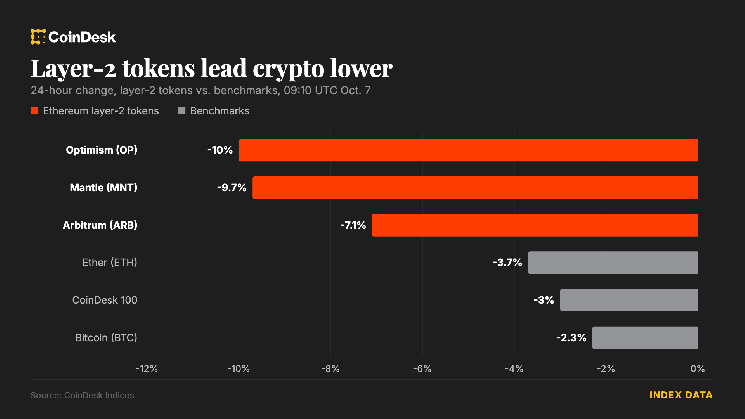
Bitcoin’s slide, however, was only the beginning of the damage. Further down the market, the pain was considerably more severe, as high-beta tokens bore the brunt of the sell-off in a classic risk-off cascade. The CoinDesk 80, an index that tracks a broad basket of smaller cryptocurrencies, lost nearly 4 percent over the past 24 hours, while the more concentrated CoinDesk 5 — which measures the five largest digital assets — fell roughly 2.5 percent during the same period. That divergence tells an important story: when institutional investors and large traders become defensive, they tend to rotate out of riskier, more speculative names first, and the latest session was no exception. Decentralized finance tokens were hit especially hard, dropping almost 6 percent, while the Memecoin Index, a benchmark for the sector that had led the market’s earlier rally, tumbled by around 5 percent. These categories have become shorthand for speculative appetite in the crypto ecosystem, and their sharp decline signaled that traders were closing positions across the risk spectrum rather than merely rotating from one digital asset into another. What made the sell-off even more striking was its breadth. Only a handful of tokens, including SAND, PUMP, and STX, managed to post gains since midnight UTC, and even those moves appeared to be idiosyncratic rather than a sign of broader market strength. In a market as interconnected as crypto, the inability of even a small group of tokens to hold their ground spoke volumes about the prevailing mood of fear.
Beneath the surface, the selling pressure triggered a violent deleveraging event that left few corners of the market untouched. According to data from CoinGlass, liquidations — the forced closing of leveraged positions by exchanges — climbed by a staggering 235 percent to $547 million over the past 24 hours. That surge in forced selling suggests a large number of traders had been positioned long and leveraged heading into the session, betting that the market would continue to grind higher after a period of consolidation. When the geopolitical news broke and prices began to slide, stop-losses were triggered in rapid succession, creating a feedback loop that amplified the decline. Ether, the second-largest cryptocurrency, was at the epicenter of the liquidation cascade. Ethereum positions accounted for $174 million of the total, more than any other asset, as ETH traded at $2,600, down 3.5 percent on the day. The scale of those liquidations highlights a recurring theme in the digital asset market: leverage is a double-edged sword. In quiet times, it can fuel outsized gains and push prices to levels that the underlying fundamentals do not justify. But when sentiment shifts, that same leverage accelerates the decline, forcing traders out of positions and adding to the selling pressure. Liquidity conditions in crypto are often thinner than in traditional markets, especially during off-peak hours, which means outsized moves in either direction can be exacerbated by a lack of bids. Thursday’s price action was a textbook example of how quickly a market can change when leverage unwinds and liquidity dries up.
Yet for all the red candles and forced liquidations, one corner of the market was flashing a quiet signal of strength. U.S. spot bitcoin exchange-traded funds took in $119 million on Tuesday, according to data from SoSoValue, marking the fourth day of inflows in the last five sessions. That resilience in demand is notable, especially given the weakness in the broader market. It suggests that institutional investors are using the dip to build long-term exposure, even as short-term traders and speculators rush for the exits. But the divergence between spot ETF inflows and the price action in the underlying market also complicates the picture. If professional allocators are buying, why is bitcoin still falling? The answer may lie in the composition of the market. ETF buyers represent a different kind of capital — patient, often macro-driven money that is less sensitive to intraday headlines and more focused on long-term structural trends. Meanwhile, leveraged traders and momentum players in the perpetual futures market react to volatility far more quickly, and their selling can overwhelm the steady accumulation of spot buyers in the short term. This tug-of-war between institutional accumulation and speculative deleveraging is a recurring theme in the current cycle, and it often produces a period of churning, range-bound trading before the next directional move becomes clear. For now, the resilience of ETF demand is a welcome sign for a market that could easily have seen a much deeper drawdown if institutional investors had joined the selling en masse.
At the center of the storm is geopolitics. Iran’s stepped-up attacks on tankers in the Strait of Hormuz — a narrow waterway that carries roughly one-fifth of global oil supply — have reignited fears of a supply disruption at a time when the world’s spare production capacity is already limited. Oil’s move above $101 a barrel is significant not just for energy markets, but for the broader macro economy. It introduces another potential source of inflation into an economy that has been cooling but remains above the Federal Reserve’s target. That is why Treasury yields and the dollar rose alongside oil despite the risk-off tone in equities and crypto. For most assets, a flight to safety would normally lift Treasuries and push yields lower, as investors seek refuge in the world’s most liquid instruments. But an oil-driven inflation shock is a different beast entirely. It raises the expected path of interest rates, which in turn weighs on high-duration, high-valuation assets like technology stocks and cryptocurrencies. This dynamic is a reminder that bitcoin’s relationship with the broader macro environment is not static. While some investors have long argued that crypto should act as a hedge against inflation and currency debasement, episodes like this one show that, in practice, digital assets tend to trade like growth equities during periods of market stress. The question of whether bitcoin is a risk asset or a safe haven is answered differently depending on the shock, and the market’s behavior over the past 24 hours suggests that, for now, the risk asset narrative is winning.
Looking ahead, the key question for traders is whether bitcoin can defend the $84,000 level. A close below that mark could open the door to a deeper slide toward the psychological $80,000 zone, where a number of buy orders are said to be stacked. On the upside, resistance sits near $86,000 and then $88,000, and reclaiming those levels would signal that the selling pressure has finally been exhausted. The next few sessions are likely to be dictated by headlines from the Gulf, the trajectory of oil, and the performance of the dollar. If tensions ease and crude pulls back, risk assets could stage a relief rally, with bitcoin leading the rebound as traders who closed long positions rush to reposition. If the situation escalates, however, the sell-off could deepen as the market prices in a longer period of high energy prices and tighter monetary policy. For investors, the situation calls for patience and discipline. The volatility of the past day is a reminder that crypto remains one of the most dynamic and unpredictable asset classes in the world, and that no amount of institutional adoption can fully insulate it from geopolitical shocks. The fundamentals — such as growing ETF demand, long-term holder accumulation, and the continued development of digital asset infrastructure — remain broadly intact. But in the near term, the market’s direction may hinge on events unfolding thousands of miles away from the trading floor, in the waters of the Strait of Hormuz. For now, the only certainty is uncertainty, and the only safe assumption is that the intersection of geopolitics, macroeconomics, and digital assets will continue to produce surprises.