


Taxes Have Outpaced Seattle’s People and Jobs. Here’s What That Means.
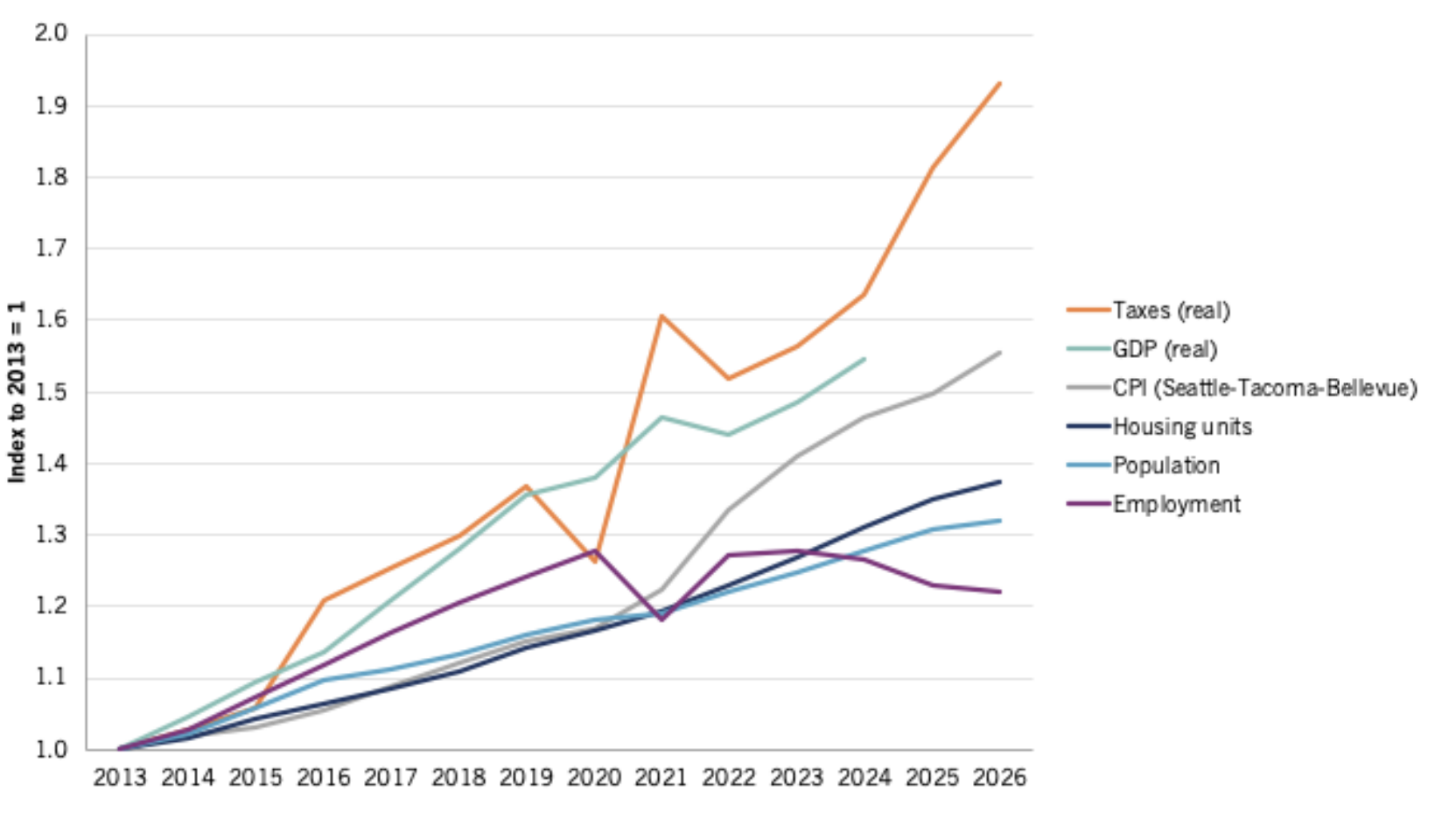
There is a moment in every city’s life when the numbers stop being abstract and start telling a story about who lives there, who works there, and who is expected to pay for the shared services everyone relies on. Seattle has reached that moment. A decade ago, the city collected about $900 million in taxes. Today, that figure is projected to hit $2.8 billion by 2026. On paper, this sounds like a triumph—the kind of growth most cities would envy. But a new report from ECOnorthwest, commissioned jointly by the Downtown Seattle Association and the Seattle Metropolitan Chamber of Commerce, reveals a more complicated and uncomfortable truth. Seattle’s tax system has been quietly rewritten. The money pouring into city coffers is no longer coming evenly from a broad community of residents, shoppers, and businesses. Instead, it is increasingly flowing from a surprisingly small cluster of large corporate employers, mostly in the technology sector. That shift has happened quickly, and it has happened without most Seattleites fully noticing. While the city was debating homelessness, transit, safety, and the future of downtown, the underlying structure of its revenue system was changing in ways that will shape the city for years to come. The report’s central finding is stark: city tax revenue grew by 172% between 2013 and 2025, while the city’s population grew by only 31%, jobs by 23%, and local inflation by 50%. In other words, the tax base expanded more than five times faster than the population it serves, and more than seven times faster than the number of people actually working in Seattle. This is not normal. It is not the steady, organic growth of a healthy local economy. It is something else entirely—a revenue system that has become deeply dependent on a handful of companies and increasingly disconnected from the everyday life of the city. And it raises a question that no spreadsheet can answer: if Seattle’s prosperity is built on the presence of a few giant employers, what happens to the city if those employers decide their future lies somewhere else?
To understand what happened, it helps to look at the old Seattle tax system, the one that existed in 2013. Back then, more than eight out of every ten tax dollars Seattle collected came from broad-based core taxes: property taxes on homes, offices, and apartment buildings; sales taxes on everyday purchases; utility taxes on electricity and water; and the general Business & Occupation tax that applies to nearly every company doing business in the city. These taxes are not glamorous, and no one loves paying them, but they have a valuable quality: they are spread across millions of transactions and thousands of businesses. When one industry stumbles, the others keep the system standing. That broad foundation meant the city could plan budgets with reasonable confidence, even in uncertain times. It also meant the burden of running Seattle was shared widely—not always equally, not always fairly, but at least widely. By 2026, however, that familiar structure is expected to be turned on its head. The report projects that broad-based core taxes will account for just 52% of Seattle’s total revenue. Nearly half of all city tax dollars will come from newer, narrower levies aimed at specific companies and particular payrolls. The change did not happen by accident. It happened because Seattle’s political leaders, facing urgent needs and frustrated voters, decided to go where the money is. In a city dominated by a handful of massive tech companies, the path of least resistance for raising revenue is to tax those companies directly. The result is a system that increasingly resembles a toll booth placed on a busy highway: efficient, lucrative, and dangerously dependent on traffic staying high. For a while, that toll booth generated enormous sums with little visible friction. But the drivers have begun to change their routes. The same companies that make Seattle’s tax system work are the ones whose workers no longer go into the office every day, and whose expansion plans increasingly point to Bellevue, the Eastside, or entirely different regions of the country.
The two most important examples of this shift are the JumpStart Payroll Expense Tax and the Social Housing Tax. JumpStart, created in 2021, was designed to fund affordable housing, equitable development, and pandemic recovery, but it is paid by fewer than 500 businesses. That sounds like a long list until you learn that the top 10 taxpayers alone are responsible for 73% of the total revenue the tax generates. The Social Housing Tax, approved in 2025 to fund the development of social housing, is even more concentrated: roughly 220 entities pay it, and the top 10 cover 66% of the collection. Together, these two taxes did not even exist five years ago, and now they account for nearly a third of all business tax dollars the city collects. More striking still, because many of the same big companies appear on both lists, fewer than 20 businesses are responsible for approximately $356 million in annual Seattle tax revenue. That is not a diversified tax base. It is a handful of giant employers underwriting a meaningful share of the city budget. For the companies involved, including some of the most recognizable names in technology, this creates an awkward relationship: they are simultaneously the engine of the city’s prosperity and the target of its revenue needs. For everyone else, it creates a strange kind of dependency. The city’s finances are now tied to the fortunes of a small group of firms, any one of which could restructure, relocate, or reduce its workforce and immediately blow a hole in Seattle’s budget. This is not a hypothetical worry. It is already happening. Large employers have shed thousands of jobs, embraced remote work, and shifted operations to the Eastside. The tax dollars they still send to Seattle are a reminder of their power, but also of the city’s vulnerability. When a tax system becomes so concentrated, every corporate decision becomes a public event. A quarterly earnings call in Silicon Valley can feel like a budget hearing in Seattle. That is not a healthy way to run a city.
The employment data in the report makes the risk vivid. Between March 2020 and March 2025, Seattle lost about 24,000 jobs. During that same period, the rest of King County added 21,000 jobs. The geographic pattern is unmistakable: work is moving out of Seattle, often to Bellevue and other Eastside suburbs. In the single year ending March 2025, the city lost 18,000 jobs, a figure that predates many of the most aggressive remote work mandates and the latest wave of technology layoffs announced across the region. Seattle is not facing a temporary slump. It is facing a structural realignment of where work happens, and because its tax system is now so dependent on employers, that realignment threatens the city’s ability to maintain services. The irony is painful. Seattle built a progressive revenue system on the backs of big employers, but those employers are exactly the ones whose footprint is shrinking. The workers who once filled downtown offices are now logging in from homes in Shoreline, Redmond, or Tacoma. They still contribute to the regional economy, but they are not buying lunch in Seattle, parking in Seattle, or riding the bus in Seattle. Every one of those absent workers is a small cut to the vitality of downtown and the tax revenue that depends on it. The report arrives on the heels of ongoing coverage of these regional tech dynamics, including the shift of high-paying jobs from Seattle to Bellevue, and the broader political shifts in how West Coast hubs are responding to tech sector backlash and the rise of artificial intelligence. No one knows the stakes better than Joe Nguyen, president and CEO of the Seattle Metropolitan Chamber of Commerce. “Seattle’s tax collections are growing far faster than its population, jobs or inflation. Employers are carrying more of that burden. That trajectory is not sustainable,” Nguyen said. “The question cannot always be how to collect more money. It must be how to deliver better results with the money we already have and build a tax structure that helps our economy grow.” His words carry the tone of someone who has watched the numbers for years and sees a cliff approaching. The city, he suggests, cannot simply keep raising taxes on a smaller and smaller group and expect the goose to keep laying golden eggs.
The political response is beginning to catch up to the reality. Mayor Katie Wilson, in a sign that city leaders are paying close attention, has proposed a $9.1 billion budget for 2027 that would erase a $175 million general fund deficit. To close the gap, she is proposing nearly $50 million in spending cuts and a freeze on the JumpStart tax rates. It is a delicate balancing act: she is trying to preserve essential services while sending a signal to the business community that Seattle is not going to keep turning the dial ever higher on the companies that anchor its economy. The freeze alone will not reverse the broader concentration problem, but it is an acknowledgment that the current trajectory is untenable. Wilson’s budget recognizes the uncomfortable relationship between the city’s ambitious spending commitments and its increasingly fragile revenue base. It is not enough to layer new taxes on the same handful of companies and assume they will absorb the costs forever. The report comes at a time of broader political reckoning on the West Coast, where tech hubs are wrestling with how to respond to a public that is both grateful for the industry’s wealth and resentful of its power. Seattle has become the face of that tension. It is a city that loves to boast about its progressive values, but it is also a city that has come to rely, more than most, on the very corporate giants it sometimes likes to criticize. There is also the fast-changing landscape of artificial intelligence, which could either create a new wave of prosperity or make the current disruptions look small. In that uncertain environment, the worst thing a city can do is make itself structurally fragile. Yet Seattle, according to this report, has done exactly that. The question is whether its leaders can find the will to create a tax structure that works for everyone, not just for a moment, but for the long run.
What does this mean for the people who actually live in Seattle? It means the morning coffee shop, the bus route, the library branch, the police patrol, and the tiny apartment that may or may not be affordable are all now tied, to an uncomfortable degree, to the decisions of a few distant corporate boards. It means the next time a major tech company announces layoffs or a shift to remote work, Seattle’s budget—not just its mood—will feel the shock. The report is not an argument against taxing corporations. Progressive taxes on large employers have helped fund housing and services in a city that has struggled with inequality and displacement. But there is a difference between a tax system that asks big business to pay its fair share and one that quietly abdicates responsibility for everyone else. The honest takeaway is that Seattle needs a broader conversation about how it funds itself. It needs to ask why job growth is fleeing the city limits, what can be done to make Seattle a more attractive place to work, and whether the services residents demand can be funded by a tax base that is not dependent on a twenty-company oligopoly. The answer may involve new taxes, but it must also involve better management of the money already collected, a point Nguyen made explicitly. Above all, the report is a reminder that tax policy is not an abstract accounting exercise. It is a statement of values. For most of the past decade, Seattle’s values have been expressed through a system that puts a few giant employers on the hook for the city’s ambitions. That system has produced money, but it has also produced fragility. It has created winners and losers, and it has made the city’s future dependent on forces that are largely outside its control. The challenge now is to build something more sustainable, more equitable, and more connected to the real lives and real work of the people who call Seattle home. The numbers are clear. The question is whether the city’s leaders have the courage to act before the tax base, and the city itself, shrinks any further.