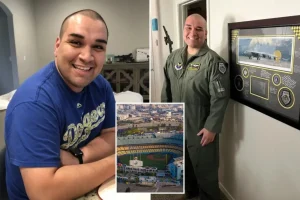



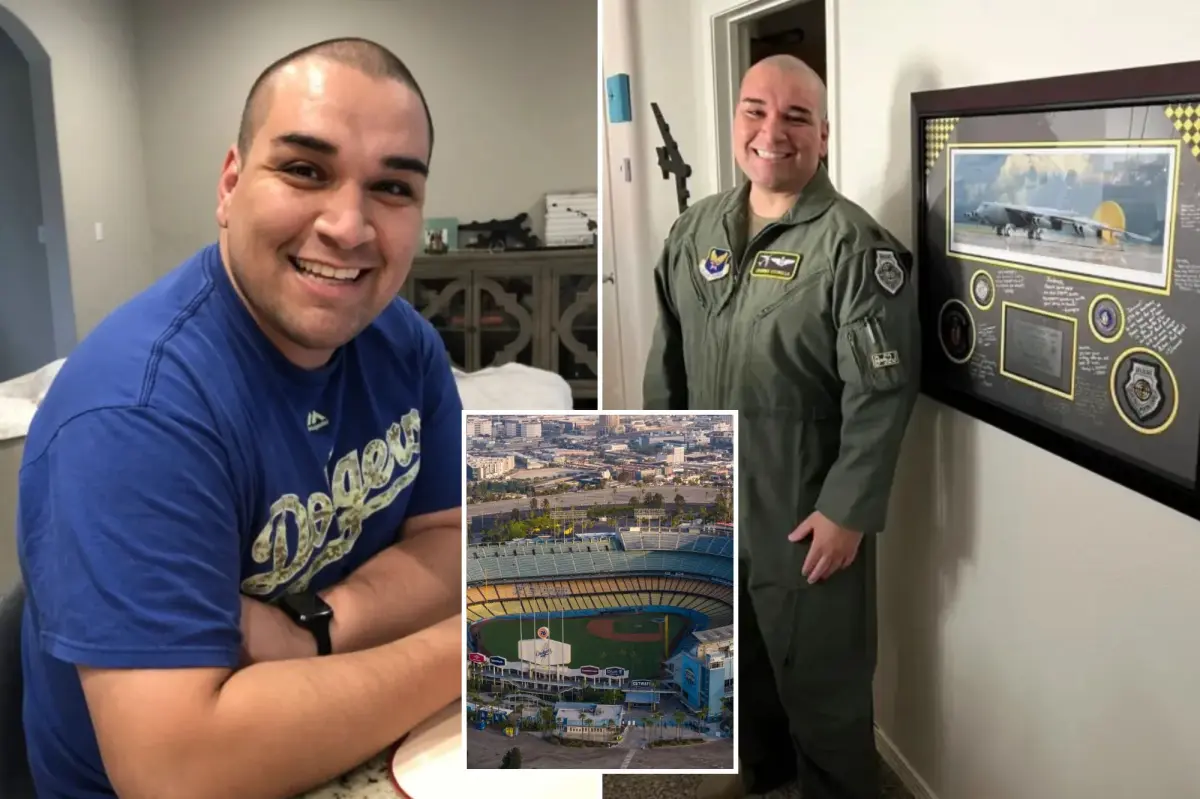
On a Saturday evening destined to be loud and electric, Dodger Stadium will pause for something that has nothing to do with wins or losses. The Los Angeles Dodgers will face the Atlanta Braves in the first game of the National League Division Series, but before the first pitch, before the crowd settles into the familiar rhythms of baseball, three B-52 Stratofortresses will thunder across the sky during the national anthem. It will be a spectacle, yes, but also a salute. Major League Baseball announced that the flight crew will honor fallen airman and Military Hero of the Game, U.S. Air Force Lt. Col. Gabriel Estrella. Estrella, a Los Angeles native, was one of eight people killed in June when an $85 million, nuclear-capable B-52 Stratofortress crashed shortly after takeoff at Edwards Air Force Base, an explosion so enormous that it left a black scar across the Mojave and a wound in the American military community. For Estrella’s family, particularly his wife Brianna, the tribute means more than any banner or flyover can express. “I am so grateful that they are honoring him,” she told NBC Los Angeles. “He truly was one of their biggest fans, and with him being an LA native, it means that much more.” To understand why this moment is so powerful, you have to know the man, the crash, and the quiet way baseball became his joy.
Sometimes a tragedy becomes a statistic, but Estrella’s story refuses to let that happen. The crash occurred on a routine test mission, the kind of flight that military crews had completed dozens of times. The B-52 Stratofortress lifted off and then, within moments, fell from the sky in Kern County. Video captured a great cloud of black smoke rising over the desert as the enormous jet hit the ground. Later images revealed only smoldering wreckage and a vast burn scar, evidence that eight lives had been extinguished in an instant. Col. James Hayes described the crash as “tragic and unsurvivable,” words that left no room for hope. Those on board represented the full fabric of the base: uniformed airmen, government civilians, and contractors, all of them essential to the mission. The official cause remains unknown, an unanswered question that multiplies the grief. For the families who received that dreaded knock on the door, the world stopped. For base officials, the loss was not just a mission failure but a family tragedy. Edwards Air Force Base has long been a place where legends fly, where the next generation of aerospace technology is tested. On that June day, it became a place of mourning. The pain was not private either. Because the crash was so visible, because the smoke could be seen for miles, the public grieved too. And when the Dodgers announced they would honor Estrella, it gave the country a way to say thank you, not with a flag folded and handed over, but with America’s pastime.
For Gabriel Estrella, the Dodgers were never just a team. Born and raised in Los Angeles, he grew up hearing the crack of the bat and the roar of the crowd, and he carried that love into adulthood. He was a husband, a father, and a warrior in the sky. But on his off days, he was a fan. His obituary remembered a man who “loved sharing his passion for baseball with his family, especially taking his daughter to games and creating memories they would cherish forever.” Those words are not sentimental decoration; they describe the exact moments that make a life. He attended World Series games at Dodger Stadium in 2024 and 2025, and according to his obituary, he was looking forward to a “three-peat” this year. That hopeful phrase, so ordinary for a fan and so heartbreaking in hindsight, is a reminder of how sports intersect with our deepest dreams. We plan our schedules around games, we buy jerseys for our children, we imagine the next season and the one after that. Estrella did not know he was attending his last games. He just knew he was happy, sitting in a stadium he loved, with the people he loved. His wife Brianna’s gratitude toward the Dodgers is really an acknowledgment of something profound: in the middle of a national stage, a family’s grief was seen and honored. The team did not simply put a logo on a display; they gave Estrella back to his hometown. The little boy who grew up dreaming of Dodger Stadium will now be remembered there, not as a stranger in a uniform but as one of the faithful.
Estrella’s life was defined by service long before the flyover. At 39 years old, he had spent 17 years in the United States Air Force. As a weapon systems officer on the B-52, he was responsible for some of the most complex and demanding tasks in aviation—navigating a massive, nuclear-capable bomber, operating its defensive and offensive systems, and doing it all in coordination with a crew that had to trust one another completely. It is a role that requires coolness under pressure, meticulous attention to detail, and an ability to make split-second decisions. He was not just a passenger on that B-52; he was a key part of an elite team. But service is not only what happens in the air. It is the missed birthdays, the late-night phone calls, the children who learn to wave goodbye instead of asking Daddy to stay. Estrella shared three children with his wife Brianna. He knew the weight of their love and the cost of duty. And still, he chose to serve. That dual devotion, to country and to family, is so often invisible, tucked away inside a flight suit or a routine deployment. The Dodgers’ tribute helps make it visible. For 17 years, Estrella helped keep the nation safe. On Saturday, a stadium full of people will stand and honor him. His rank, his job, and his title matter, but so does his identity as a father who taught his daughter to love baseball. The flyover is not just for an officer; it is for the man who threw a ball in the backyard, who bought a hat too big for his kid’s head, who looked at a World Series ticket and felt that thrill we all know.
The choice to honor Estrella with a B-52 flyover is both breathtaking and heartbreaking. Three B-52s from Edwards Air Force Base will break through the sky above Dodger Stadium during the national anthem. For many fans, the flyover will be a fleeting moment of awe, the classic sound and sight of American power. For Estrella’s family, it will carry a different meaning. These are the same type of warplane he flew in, and the crews in those cockpits are colleagues, perhaps friends. When they fly over the stadium, they are carrying him with them in a way words cannot. The phrase “Military Hero of the Game” is often read quickly in stadium announcements, but Saturday it will land with rare force. It acknowledges that this man, this fan, this father, did something heroic not only in uniform but in how he lived. Baseball, with all its ritual and memory, is the perfect setting for such an honor. The Atlanta Braves, the visiting team, will stand respectfully during the anthem, rivals for a moment but fellow human beings in the greater game of life. The three B-52s will pass overhead, and the rumble will vibrate through the stands, through the chests of fans, reminding everyone that the men and women who protect this country are real, with favorite teams, favorite seats, and families waiting for them. The flyover will be gone in seconds, but the image of those planes—heavy, purposeful, unmistakably connected to the tragedy—will linger long after the national anthem ends.
On Saturday, the Los Angeles Dodgers will not just play a baseball game. They will honor a man who lived and died in the service of something larger than himself. Gabriel Estrella was a weapon systems officer, a 17-year Air Force veteran, a husband, a father of three, and a boy from Los Angeles who loved the Dodgers with his whole heart. He attended World Series games in 2024 and 2025 and dreamed of a three-peat in the year to come. That dream will remain unfulfilled, but his memory now has a place in the stadium he prized. The official cause of the crash is still unknown, and for his family and the families of the other seven victims, the wait for answers is part of the burden. But Saturday offers a different kind of answer: that their loss is not forgotten. When the national anthem begins and the three B-52s approach the stadium, the sound will be louder than any cheer. It will be a roar of remembrance. It will say, We remember you. We honor you. We will never stop showing up for the people who showed up for us. And for Brianna Estrella and her children, for the mother, father, siblings, and friends who never expected to see their loved one’s name in the spotlight, it will be a moment to cry, to hold each other tight, and to feel proud. Baseball is a game of seasons and cycles, of wins and losses. But sometimes it becomes something better: a sanctuary. On Saturday, Dodger Stadium will be that sanctuary, and Lt. Col. Gabriel Estrella, a fan forever, will be home.