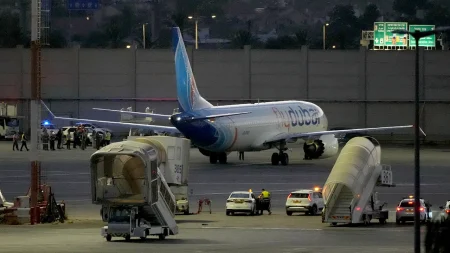



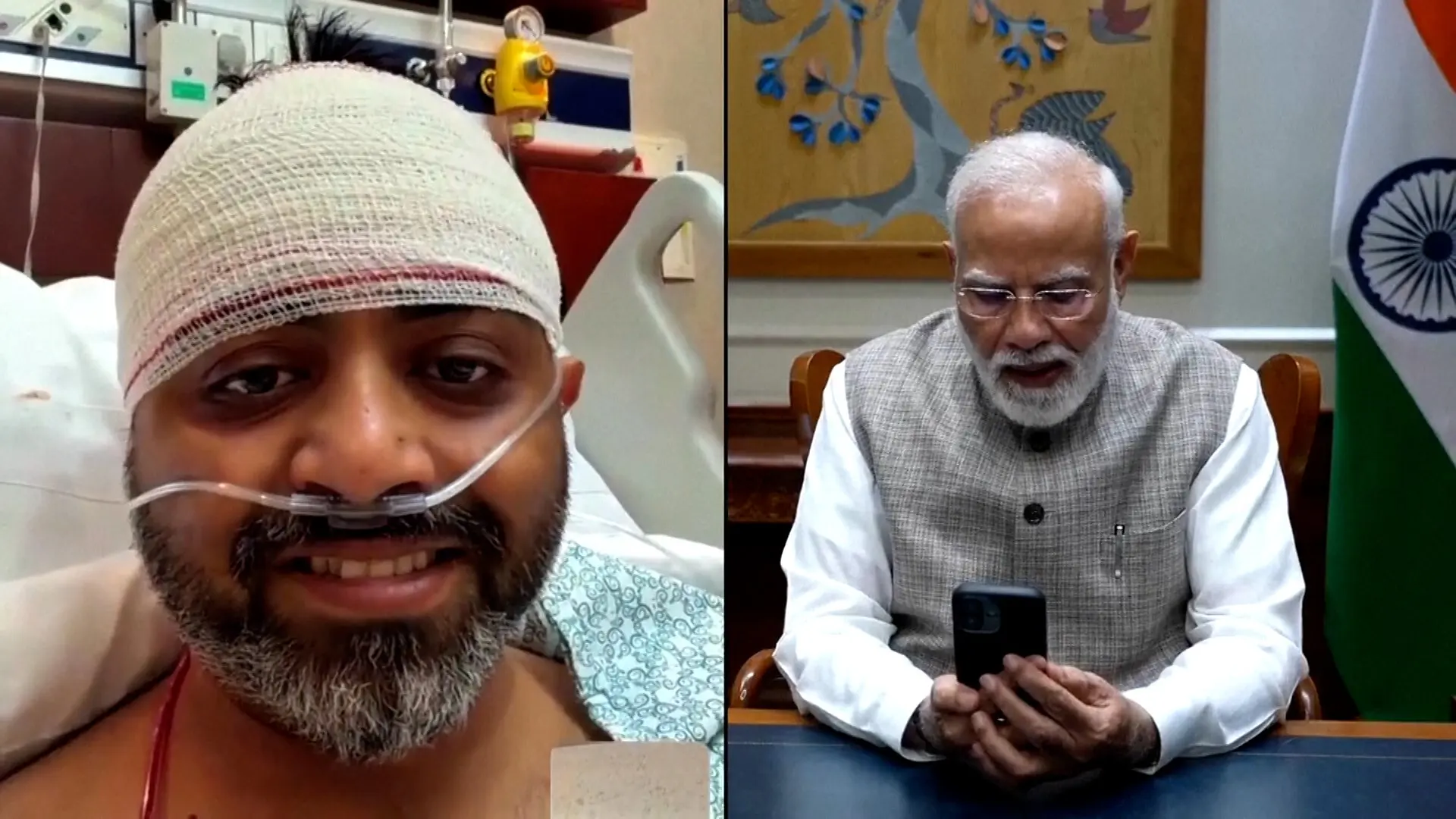
On a routine FlyDubai flight, the sky turned from a place of quiet order into a nightmare of violence and terror. Capt. Smit Machchhar, a veteran pilot with seventeen years of flying experience and eleven years as a captain, was suddenly attacked by his own copilot in the cockpit, a place that should have been the safest and most controlled environment on the aircraft. The attack came without warning, and in the cramped space of the flight deck, Machchhar was stabbed repeatedly, suffering a deep wound to his head and an arm that was later described by Israeli Prime Minister Benjamin Netanyahu as being “basically split in two.” As blood filled the cockpit and the copilot continued his assault, the aircraft began to plunge, dropping more than 14,000 feet in just thirty seconds. Passengers screamed, oxygen masks may have deployed, and the plane was in mortal danger. Yet in that chaos, Machchhar did not surrender to his injuries. He later described lying on the floor, wounded and beaten, but somehow aware that the plane was falling. His decades of experience told him exactly what was happening even with his eyes shut. He knew that if he did not get up, everyone on board would die. With a final, desperate push, he forced himself to open the cockpit door, allowing passengers—many of them Israeli citizens—to rush in, subdue the copilot, and take control of the situation. That single act of courage transformed a potential catastrophe into a story of survival, and it would soon make Machchhar a global hero, celebrated by prime ministers and prayed for by millions.
The world learned the depth of Machchhar’s bravery when he spoke by phone with Indian Prime Minister Narendra Modi, a call that revealed both the pilot’s humility and the profound emotional weight of what he had endured. During that conversation, Machchhar told Modi, “You are my biggest idol, and I am feeling very proud that you called me and encouraged me. I was fighting for my life in that moment.” It was a striking statement from a man who had just saved dozens of lives, yet it showed how grounded he remained even in the aftermath of trauma. Modi, in turn, offered not just praise but a deep sense of national gratitude. He told the wounded pilot that all of India was praying for him, that prayers and chants had been offered in temples and holy places, and that the entire country was eager to welcome him home. “Your courage, patience, and presence of mind. You took a decision in a fraction of a second and saved the lives of so many people and today, the whole country can say this with pride—we Indians are not killers, we are lifesavers,” Modi said. The prime minister’s words were not just political rhetoric; they reflected the raw emotion of a nation that had watched the story unfold with horror and pride. For Machchhar, the call was clearly a deeply personal moment. He had been fighting for his life, and now the leader of his country was telling him that his sacrifice had meaning, that his wounds had become a symbol of courage, and that his actions had enhanced the honor of 1.4 billion Indians. It was a moment of connection between a man who had faced death and a nation that had found a new hero.
Machchhar’s own recollection of the attack is harrowing and deeply human. He described the moment he fell to the floor, wounded and unable to defend himself, and the terrifying realization that the aircraft was plunging toward the earth. “At that moment, I thought if I don’t get up, I’ve been flying for the last 17 years and I have been a captain for the last 11 years, and even if I shut my eyes, I can tell what is happening inside a plane. When I was lying on the floor, I could feel that the aircraft was plunging, and I said to myself while I was getting beaten, ‘This is the last push Smit, do it, the door is right there,’” he recalled. There is something almost poetic about his words—the idea that muscle memory, training, and instinct could guide a man even while he was bleeding and under attack. He did not think of himself as a hero in that moment; he thought of the door, the door that stood between the passengers and certain death. Somehow, he reached it. He opened it, and in doing so, he changed the course of the flight. “Somehow, I opened the door and everyone came in and everyone else had an equal role (in the rescue). I was trying to save myself, but I also knew that I can’t let anyone die,” he said. That final sentence captures the essence of his character: even in the most desperate moment of his life, he was thinking not just of his own survival, but of the people whose lives depended on him. It is the kind of selflessness that cannot be taught, only revealed in moments of crisis.
The rescue was not a one-man act, and Machchhar was quick to acknowledge that. Once the cockpit door was open, Israeli passengers on board rushed into the flight deck, incapacitated the copilot, and worked to stabilize the rapidly descending aircraft. Their actions were swift and decisive, and without them, the plane might never have recovered from its terrifying plunge. Netanyahu later praised the passengers and the pilot, saying that their bravery had prevented what could have been “another 9/11.” That phrase is chilling, but it underscores how close the flight came to becoming an unimaginable tragedy. The copilot’s motives remain unclear, and the attack itself is still being investigated, but in the immediate aftermath, the focus was on the extraordinary teamwork that saved the flight. Machchhar himself insisted that everyone had an equal role in the rescue, a humility that made him even more admired. He was not interested in taking all the credit; he wanted the world to know that the passengers were heroes too. After the plane was stabilized, it landed safely in Saudi Arabia, where a second flight crew on board took over and brought the aircraft down. Machchhar was then taken to a hospital in the United Arab Emirates, where he began the long process of recovery. The physical wounds were severe, and the psychological scars would likely take even longer to heal, but the pilot’s spirit remained unbroken.
In the days since the attack, Machchhar has spoken openly about the role of faith in his survival. “Whenever I’m in pain, I know only one thing, I chant the Hanuman Chalisa. I know that God saved me,” he said. The Hanuman Chalisa, a sacred hymn dedicated to Lord Hanuman, is a source of strength for millions of Hindus, and for Machchhar, it was a lifeline in his darkest moments. He did not simply rely on his training and experience; he relied on something deeper, a spiritual conviction that he was not alone. That faith was echoed by Modi, who told him that people across India were chanting mantras for his recovery. “Yesterday, prayers and chants were offered in all the temples and holy places, wishing for your long life, and we all are praying for your good health. You are going to be in good health very soon and India is very eager to welcome you,” Modi said. Machchhar’s response to his injuries was equally inspiring. “I am not thinking about my wounds like typical wounds because that will hinder my recovery. I am taking these wounds like a journey which will progress slowly, and it will take time, but I am very confident that this recovery will happen, and I will be absolutely healthy,” he told Modi. There is a quiet determination in those words, a refusal to be defined by pain or victimhood. He saw his recovery as a path forward, not a punishment. He told Modi, “I am fine and everything is all right,” a simple statement that carried enormous weight given what he had been through. His optimism, grounded in faith and resilience, became another layer of his heroism.
Ultimately, the story of Capt. Smit Machchhar is more than a tale of a mid-flight attack and a miraculous landing. It is a story about the best of humanity emerging in the worst of circumstances. It is about a man who, while bleeding and beaten, found the strength to save others. It is about passengers who did not hesitate to rush into danger. It is about a nation that saw one of its own rise to the occasion and felt a surge of collective pride. Modi captured this sentiment when he said, “You endured so many wounds on your body and you are fighting a battle of life and death. In that moment as well, you did not think of your life, rather thought about the lives of the passengers. And the biggest thing is you enhanced the honor of 1.4 billion Indians and that is why I am feeling proud from my heart.” Those words resonate far beyond India. In a world often filled with division and fear, Machchhar’s courage is a reminder that ordinary people are capable of extraordinary things. He did not set out to be a hero; he simply did what needed to be done. He fought for his life, and in doing so, he fought for the lives of everyone on board. His story has been praised by leaders like Netanyahu and Modi, but more importantly, it has touched the hearts of people around the world. As he recovers in a hospital in the UAE, surrounded by medical care and the prayers of millions, Machchhar stands as a living testament to the power of courage, faith, and the unbreakable human spirit. His journey is not over, but his legacy is already secure: he is a lifesaver, a hero, and an inspiration to us all.