



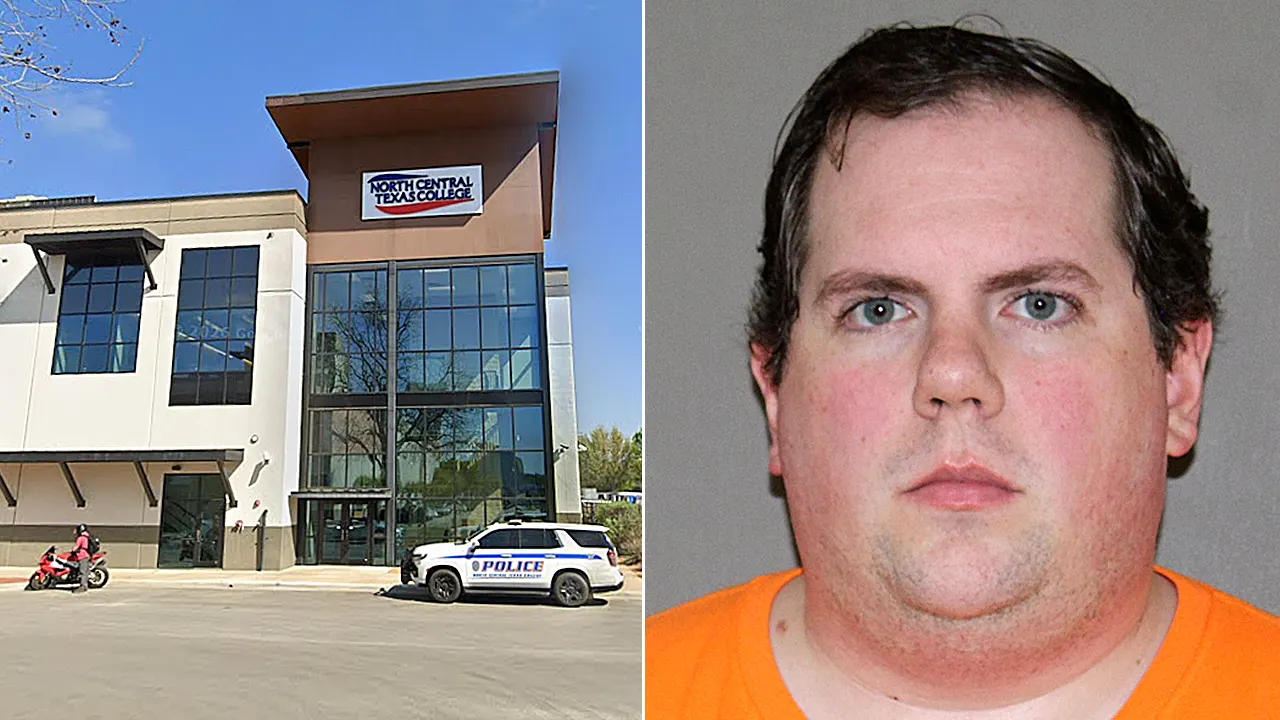
In a case that has unsettled both the small college town and the wider community, Texas authorities last week arrested a 34-year-old drama professor from North Central Texas College (NCTC) after he allegedly sent sexually explicit photographs and messages to someone he believed was a 14-year-old boy. The educator, identified as Aaron Wood, had been teaching drama at the Denton-area college for two years. According to county records, the Denton County Sheriff’s Office arrested Wood on Friday and charged him with solicitation of a minor via computer. The arrest came after an undercover agent from the Orange County Sheriff’s Office in Florida initiated what appeared to be a routine online safety operation, a method law enforcement increasingly uses to identify and intercept adults who seek out minors for sexual purposes. The alleged exchange took place on Snapchat, a platform popular among teenagers but also notoriously difficult for law enforcement to trace due to its disappearing messages. Yet, in this instance, the digital trail was sufficient to lead investigators across state lines and into the quiet, unassuming life of a community college instructor. For students, faculty, and parents, the news is a jarring reminder that danger can sometimes hide in plain sight, behind a familiar face and a title associated with mentorship and education. The college moved quickly to sever ties with Wood, confirming in a statement that he was no longer employed as of Monday and emphasizing that, to their knowledge, the alleged offense did not involve any NCTC student or staff member. Still, the emotional aftershock lingers, as the same classroom where Wood once taught drama now becomes part of a larger narrative of trust betrayed.
The details of the alleged conversation, as outlined in an arrest affidavit, paint a troubling picture of calculated grooming behavior. Wood reportedly engaged in an online conversation on Snapchat with an undercover officer from the Orange County Sheriff’s Office in Florida on May 22. During that interaction, he allegedly told the officer that he taught students around the same age as the person he believed he was speaking with—a 14-year-old boy. According to the affidavit, when asked about his students, Wood allegedly admitted, “I’ve been into a few over the years,” a statement that suggests a pattern of attraction and boundary-crossing that investigators found deeply concerning. Despite expressing nervousness, Wood continued the conversation, showing a persistent interest in pursuing the chat. The affidavit further states that Wood sent a picture of male genitalia along with other sexually explicit messages and asked the undercover officer to share photos in return. The behavior described is not merely criminal in a technical sense; it represents a deliberate attempt to engage a child in sexual activity, using anonymity and digital distance to lower both his own inhibitions and the perceived defenses of his target. For parents, reading such details is agonizing, a reminder of the vulnerability of adolescence and the ways social media can become a hunting ground. For educators, it is a stain on the profession, a painful example of how one individual’s alleged actions can cast suspicion on countless dedicated teachers who devote their lives to nurturing young minds. It also raises difficult questions about how someone entrusted with young adults could allegedly turn that knowledge of youth into a tool for exploitation.
The investigative process that led to Wood’s arrest is a testament to the persistence and coordination of law enforcement agencies working across jurisdictional lines. The conversation occurred on Snapchat, a platform where messages are designed to vanish, but investigators with the Orange County Sheriff’s Office in Florida were able to trace the account through its IP address. That digital breadcrumb led them directly to an apartment in Denton, Texas, where Wood lived. Once the location was established, authorities in Denton County took over the physical side of the investigation, culminating in Friday’s arrest. The affidavit noted that the Orange County Sheriff’s Office had probable cause to charge Wood with transmission of harmful material to minors and unlawful use of a two-way communication device, charges that reflect the severity of the alleged communications. In addition, the Denton County charge of solicitation of a minor via computer carries significant legal consequences, underscoring how seriously prosecutors treat online predatory behavior. For law enforcement, cases like this are both a victory and a cautionary tale: a victory because a potential threat was removed from the streets, and a warning because countless more offenders remain hidden behind screens and fake profiles. The undercover officer who posed as the 14-year-old boy likely spent hours or days navigating a difficult and emotionally taxing role, balancing the need to gather evidence with the grim awareness that the person on the other end of the conversation genuinely believed they were talking to a child. The arrest itself, occurring on a quiet Friday, probably unfolded without drama—a knock on a door, a pair of handcuffs, a moment when an entire life changed forever.
North Central Texas College responded to the arrest with a formal statement aimed at reassuring the public while also making it clear that the institution had no role in the alleged behavior. “To our knowledge, the alleged offense does not involve NCTC, its students or staff,” the college said. “We can verify that he has had no contact with NCTC students, faculty or staff since his arrest on September 25, 2026.” The school also emphasized that “the safety of our students and staff are of the utmost importance and concern.” By terminating Wood’s employment as of Monday, NCTC took swift administrative action, but the emotional and reputational damage is not so easily undone. Students who once looked up to him as a drama instructor may now grapple with feelings of confusion, betrayal, and anger. Colleagues who worked alongside him may wonder how well they truly knew someone they saw every day. The statement, while carefully worded to protect the college legally, also reflects an institution scrambling to distance itself from a scandal that could tarnish its image and shake public confidence. In small college towns, news like this travels quickly, and the sense of security that many parents and students take for granted is often the first casualty. The fact that the alleged conversations were with an undercover agent, not an actual minor, means that no real child was directly harmed in this instance—but that is cold comfort. The intent, as described in court records, was real, and it is that intent that will likely shape the legal proceedings ahead. For now, the college is left to do damage control, to support its community, and to reassure everyone that it is taking every step to ensure safety and transparency.
This case also shines a light on the broader, deeply troubling issue of online exploitation and the prevalence of adults who use social media to target minors. Platforms like Snapchat, with their ephemeral messaging and perceived privacy, have become fertile ground for predators who believe they can operate without consequences. Undercover operations such as the one that led to Wood’s arrest are essential tools in this digital arms race, allowing law enforcement to step into the role of vulnerable children and intercept would-be offenders before they can harm a real victim. But these operations are also a reminder of the vast scale of the problem. In recent years, numerous teachers, coaches, clergy members, and other authority figures have been arrested in similar sting operations, revealing a pattern that is both disturbing and all too familiar. The human dimension is often lost in the recitation of charges and affidavits, but consider the real people behind the headline: the undercover officer who spends his or her days pretending to be a child, absorbing graphic language and images in order to build a case; the family of a real child who learns that an adult they trusted spoke about being “into” kids; the students who must process that their professor may have committed the very kinds of crimes they have been taught to recognize and report. And beneath it all is the quiet, persistent fear felt by parents every time they hand their child a phone. The internet has revolutionized education, communication, and entertainment, but it has also created new vectors of danger, and cases like Aaron Wood’s underscore the need for vigilance, education, and open dialogue between parents and children about online safety.
As the legal process moves forward, Aaron Wood is presumed innocent until proven guilty, a foundational principle of the American justice system that must not be forgotten amid the outrage. Yet the allegations against him are serious enough that his career, reputation, and personal life have already been indelibly altered, regardless of the eventual outcome in court. He will have his day before a judge, where evidence will be examined, witnesses will be heard, and the full scope of his alleged actions will be laid bare. Meanwhile, the community around North Central Texas College is left to heal, to ask hard questions, and to re-examine the systems that allowed such a person to remain in a position of trust for two years. Some will call for stronger background checks, more rigorous reporting mechanisms, and more training for faculty on recognizing signs of inappropriate behavior. Others will simply struggle with the uncomfortable reality that evil does not always look monstrous; sometimes it wears a friendly smile, sits in the faculty lounge, and teaches drama to teenagers. For the students who once walked into his classroom, the coming semester will feel different. The lessons will be quieter, the trust less automatic. But if there is any hope to be found in this grim story, it is that law enforcement acted decisively, that no real child was harmed in this particular instance, and that the collective vigilance of communities and investigators can, at least sometimes, catch a predator before the worst happens. In the end, the story of Aaron Wood is not just about one man’s alleged crimes; it is about all the children who are vulnerable, all the parents who worry, and all the good teachers who carry themselves with integrity and honor. Their names, not his, deserve to define the profession, and their work, not his, should remind us why education remains one of the most meaningful callings in society. The road ahead will be difficult, but it is a road that must be walked with honesty, empathy, and an unwavering commitment to protecting the young people who depend on us all.