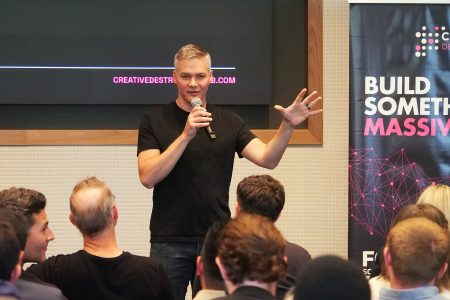



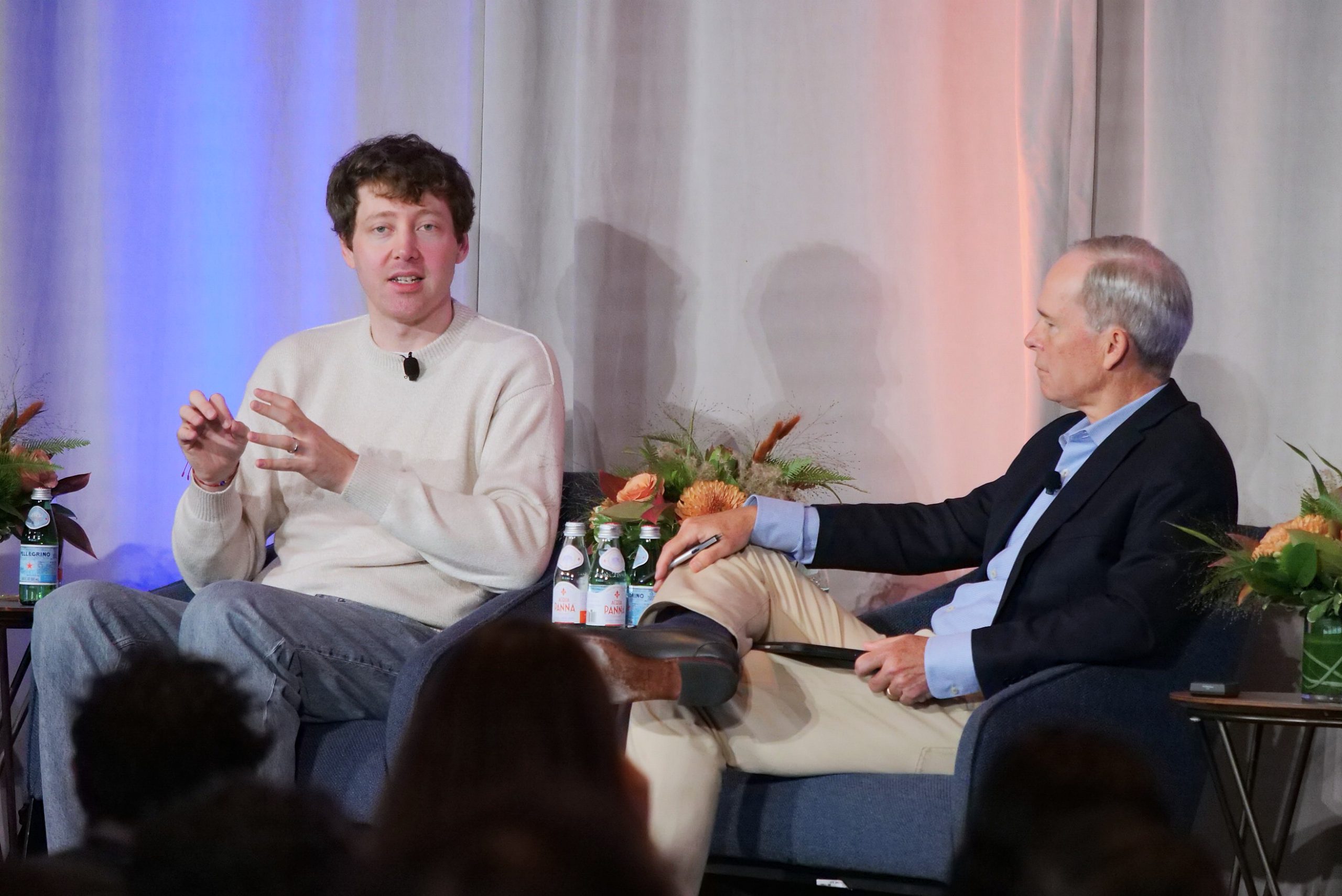
On a crisp September morning in Seattle, venture capitalists and startup founders packed into Madrona’s annual IA40 Summit, expecting big-picture talk about the latest AI breakthroughs. But Charles Lamanna, Microsoft’s executive vice president of Copilot, Agents and Platform, delivered something more like a warning. Sitting across from Madrona’s Matt McIlwain in the opening keynote, Lamanna painted a future where the familiar screens of business software fade into the background, replaced by invisible AI agents doing the work for us. And he made clear that for the vast majority of apps, this is not good news. “If my agent interacts with your app exclusively, the agent’s your customer, not the end user,” he said. “And agents are very harsh customers.” The line landed with the weight of a thesis statement. For decades, software companies built products to win over humans: get them hooked, keep them on the screen, make them feel loyal. Lamanna’s vision flips that entirely. In the new world, humans will no longer choose software. Agents will. And agents have no patience for branding, no nostalgia, no muscle memory. They care about one thing: results. The best agent will pick the service that is cheapest, fastest and most reliable — and the moment something better appears, it will switch without a second thought. No exit interview, no cancellation retention offer. That means apps that once enjoyed steady monthly subscriptions and sticky user bases will face brutal competition. Pricing power evaporates. Customer loyalty becomes meaningless. If your product can be replaced by a slightly better, slightly cheaper alternative, it will be, in seconds, by software that doesn’t even feel disloyal. Lamanna wasn’t just describing a trend; he was explaining the new Darwinism of enterprise technology. Survival belongs not to the strongest brand, but to the most efficient service. For the thousands of SaaS companies that built their existence on user engagement, it’s hard to imagine a more existentially threatening idea.
To make sense of this, Lamanna offered a simple mental model. He divides business software into two categories: thick and thin. “Thick” apps are the ones where people live professionally for hours at a time — a CAD engineer designing a jet engine in SolidWorks, a customer-service rep working inside a contact-center dashboard all day, a financial modeler who basically breathes Excel. These are serious, feature-rich tools with deep workflows and trained users who depend on every button, menu and keyboard shortcut. They won’t vanish, at least not soon. People need the fidelity and control of a full interface for complex creative and analytical work. But “thin” apps are a completely different story. These are the tools people drop into and then quickly leave: a CRM to check a contact, a project-management board to update a status, an HR portal to request time off, a procurement system to file an expense. The vast majority of business software falls into this second bucket. And Lamanna’s prediction is blunt: these thin apps will end up running “headless.” That means they won’t have a normal user interface front and center. Instead, AI assistants like Microsoft’s Copilot or OpenAI’s ChatGPT will do the work through the backend, driving the software invisibly on the user’s behalf. You won’t open the app, you won’t click through menus, you won’t even see it. You’ll just tell your agent what you need, and the agent will log into the service, navigate its screens, find the right information, complete the action, and then report back. The app will exist, but as a kind of ghost — functional, but unseen. For the companies making those apps, it’s a terrifying transformation. Their brand vanishes from the user’s experience. Their user interface, once considered their core product, becomes irrelevant. They are reduced to a commodity service behind an AI’s curtain. Lamanna compared this to a company that sells only on Amazon: you can still be in business, but you’re just one more seller of pencils on an endless shelf. Buyers don’t care about your story; they just select between “those pencils or your pencils,” and prices get squeezed accordingly. A brand like Nike has enough cultural power to charge a premium and inspire loyalty. But an unknown pencil maker? Not so much. And in the headless economy, most software becomes pencils.
Lamanna didn’t spare his own company. Microsoft’s flagship Office apps — Word, Excel, PowerPoint — probably won’t disappear, he acknowledged. But that doesn’t mean they’ll stay in their current form, front and center on millions of screens. Most people, he argued, will end up using those apps inside Copilot, the AI assistant that Microsoft has been weaving into everything from Windows to Outlook. Instead of opening a document and editing it directly, you’ll ask Copilot to prepare a memo, draft a slide deck, or analyze a spreadsheet. Copilot will call on Word and PowerPoint in the background, doing the heavy lifting while you direct the outcome. The applications become engines rather than destinations. In Lamanna’s vision of the standard office worker’s setup, the future is remarkably minimal: “Copilot for AI and Teams for communication, and that’s maybe it.” No need to flit between a dozen different software products during a typical day. The AI handles the interactions with all of them. Teams handles the human interaction. The rest happens behind the scenes. It’s a vision that aligns with the broader direction of Microsoft, which has rebranded itself as the “Copilot company” and put Lamanna at the center of that transformation. The company’s evolution into Microsoft 2.5 is turning the traditional productivity suite inside out: instead of software as a collection of separate containers for documents, messages and data, software becomes a single flow of intelligence and automation, with the agent as the interface. For users, it could mean fewer interruptions, less context-switching, more time for actual thinking. But for the rest of the software industry, the implications are chilling. If Microsoft can reach into every app through Copilot and Teams, then the role of a standalone SaaS tool becomes less meaningful. A company that spent years building a brilliantly designed interface and a loyal following could wake up one day to discover that its users no longer see the interface at all. They just see their AI assistant’s summary. In that world, the act of “using an app” becomes as obsolete as winding a wristwatch in an era of smartphones. The software still ticks, but no one touches it.
The real world is already catching up to Lamanna’s thesis, often in messy ways. The question of whether apps will agree to be “headless” is not theoretical; it’s being fought right now in the e-commerce aisles of Amazon. This week Amazon took the unusual step of blocking Meta’s new agent, called Muse, from shopping on its site. According to Amazon, Meta never asked permission. The agent didn’t identify itself as an AI, and it appeared to store customer credentials. Meta pushed back, insisting Muse can’t see users’ passwords or payment methods. But the conflict is about something deeper than security. Amazon doesn’t want its platform to become a “thin app” behind a more powerful agent. If Meta’s Muse becomes the way people shop online, then Amazon’s website becomes just a warehouse — and the customer relationship belongs to Meta. That’s a terrifying prospect for a company built on direct-to-consumer engagement, personalized recommendations, and endless browsing. Amazon is also locked in a legal battle with Perplexity over its Comet shopping agent, another AI that wants to act as a personal shopper across the web. Amazon’s message is clear: we’re happy to have agents, but only on our terms. So, days after blocking Muse, Amazon turned around and opened its seller tools to Anthropic’s Claude, a rival AI agent. That means merchants can manage inventory, update prices and adjust listings without ever logging into Seller Central. In that case, Amazon is willing to let an agent behind the curtain because it helps merchants and doesn’t threaten the actual shopping experience. Or perhaps because it prefers to cooperate with a company that asks nicely. The asymmetry is telling: Amazon wants to remain the destination for shoppers, but it sees the value in becoming the invisible machinery for sellers. Lamanna brought up Muse on stage, predicting it would reach far more people than work-focused agent tools like Copilot and Claude Cowork. Consumer agents will be enormous, he suggested, because everyone shops, while fewer people spend their days managing enterprise software. The battle for the future of software won’t be confined to the office. It will happen in every corner of daily life, starting with where and how we buy things.
Microsoft itself sits on a delicate edge of this transition. To make Copilot the universal interface for work, Microsoft needs other companies’ software to cooperate. The agent needs connectors, APIs, permissions and access to services like Salesforce and ServiceNow. Lamanna described in an August profile how Copilot pulls data from those services so people don’t have to leave the app. But that’s not just a technical challenge; it’s a business challenge. Why would Salesforce want to become a headless back-end service for Microsoft’s Copilot? Why would it hand over the customer relationship to an AI that lives inside a competitor’s ecosystem? These are the tough negotiations that will define the next decade of enterprise technology. The software industry is used to selling to human decision-makers who care about features, integrations and ease of use. But in the agent world, the “decision-maker” is the agent itself — and it cares only about performance, cost and reliability. That could be a race to the bottom for many companies, as agents ruthlessly compare prices and silently swap suppliers. But it could also be an opportunity for companies that become best-in-class in their domain. If your software is genuinely indispensable, if it does something no one else does, then agents will come back to it again and again — not out of loyalty, but out of necessity. In that sense, the rise of agents is a forcing function for quality. It strips away the comfortable moats of user habit and brand loyalty. It exposes hidden inefficiencies and mediocre products. And it rewards those who can offer real, measurable value in the most frictionless way possible. The paradox is that the more invisible software becomes, the more important its underlying quality becomes. The name on the box won’t matter, but the engine under the hood will matter enormously. That’s a frightening thought for incumbents with weak products and strong marketing. But for new startups with innovative technology and no legacy baggage, it’s an opening. The headless world is unforgiving, but it’s also meritocratic — at least in the cold, algorithmic sense of the term.
In the end, Lamanna’s keynote wasn’t just a tech forecast; it was a philosophical statement about the changing nature of the customer. For over a century, businesses have obsessed over the end user: the human with desires, frustrations, habits and preferences. Marketing departments built brand love. Product teams crafted delightful interfaces. Sales teams cultivated relationships. But if agents become our intermediaries, then the “end user” is no longer human. It’s an algorithm. And algorithms don’t love, don’t forgive, don’t get attached. They measure, compare and decide in milliseconds. That’s an unsettling idea, but also perhaps liberating. If software companies can no longer rely on dark patterns, addictive design and capture to keep users, they will have to actually serve them well. And for humans, the promise is real: fewer hours spent clicking through tedious forms, chasing data from one system to another, and wrestling with software that makes work harder. The AI agent becomes a kind of digital chief of staff, quietly operating the vast machinery of modern business on our behalf. But the transition will be rocky. There will be fights like the one between Amazon and Meta. There will be questions about privacy, consent, and who owns the customer relationship. There will be winners and losers, and the losers could include some of the most recognizable names in tech. Lamanna’s vision is not inevitable, exactly, but it is now plausible. The software industry is entering a new era where the deepest question isn’t what your app does — it’s whether an agent can do it for someone, without ever showing them your app at all. The future belongs to those who are comfortable with becoming invisible. And that’s a future that demands a kind of humility that the software world has never been particularly good at. But as Lamanna described it, standing on stage in Seattle, that future is already beginning to arrive. The only real choice is whether to become the agent, become the service behind it, or get out of the way.