


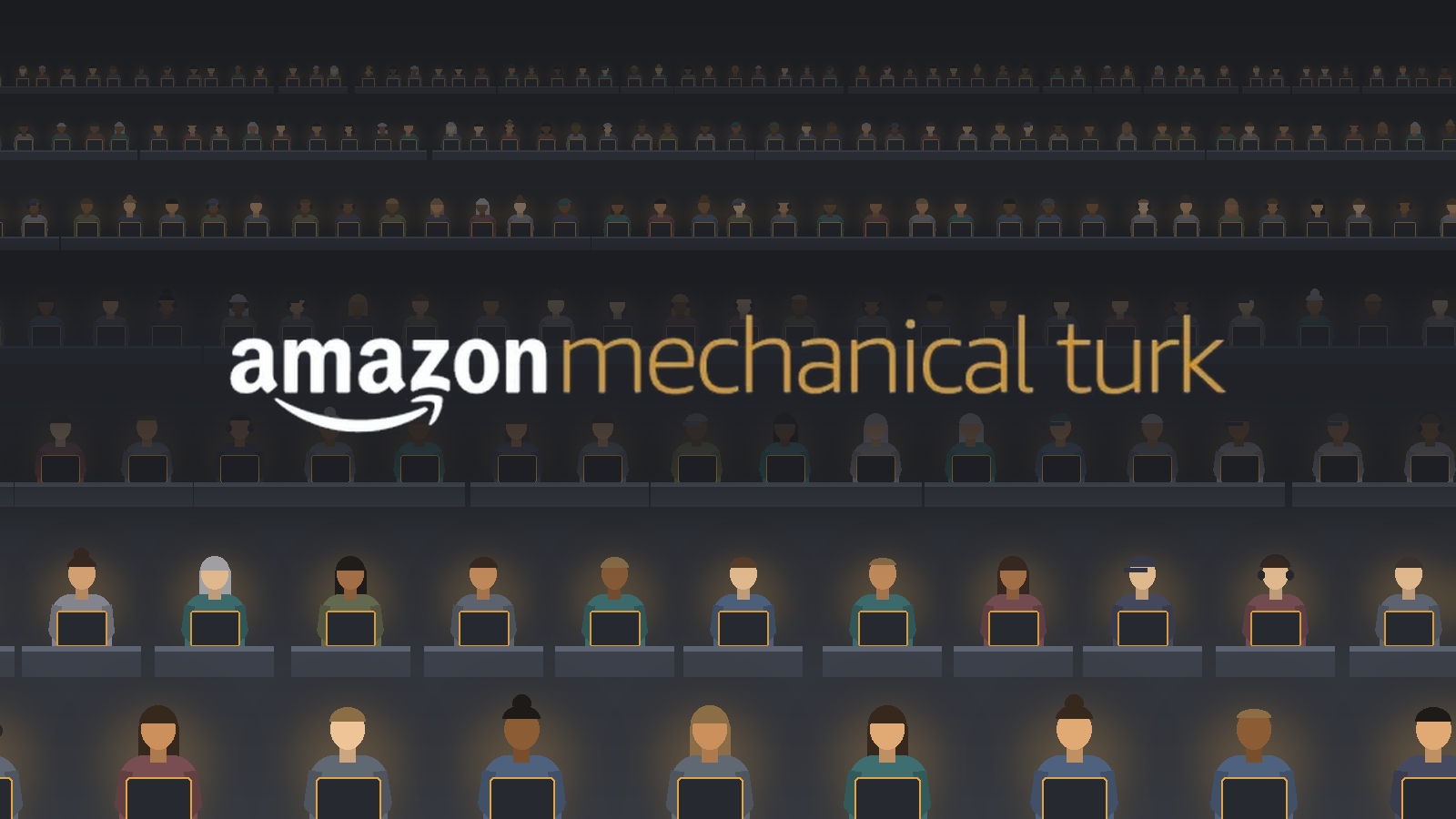
On Wednesday, after 21 years in operation, Amazon will permanently shut down Mechanical Turk, a platform that once felt like the internet’s strangest and most essential back room. For many people, the announcement arrived with the quiet shock of a familiar building in town suddenly scheduled for demolition. Launched in 2005, Mechanical Turk was one of the original pillars of the gig economy, a marketplace where humans could get paid for small digital chores that computers couldn’t yet handle. This was long before generative AI could describe images, transcribe audio, or write a passable email with a flick of a finger; these tasks required human judgment, human eyes, and human patience. They were called HITs, an acronym for Human Intelligence Tasks, and they ranged from taking a survey to identifying objects in a photograph, transcribing a receipt, recording a phrase, or listening to a voice and judging its emotional tone. They paid pennies or dollars, often at a pace that made traditional wage math laughable. But for an enormous global community of turkers, the platform was more than a crowdsourced labor queue. It was a lifeline, a daily ritual, a source of identity, and a strange, beloved home. Its closure is therefore not just a product shutdown. It is the closing of a chapter in the history of the internet, and an uncomfortable reminder of how the modern AI boom was built, largely invisibly, on the work of ordinary human beings.
The name Mechanical Turk, of course, was borrowed from an 18th-century chess-playing automaton that astonished Europe by defeating noblemen and statesmen. That original machine was a hoax: hidden inside the cabinet was a skilled human chess player operating the mechanism. Amazon’s version was, in a sense, the opposite. It was honest about its hidden humans. The interface exposed a vast list of micro-tasks to a distributed workforce, and requesters included academics running psychology studies, startups building databases, and eventually AI companies needing labeled data for machine learning models. For anyone who needed thousands of small judgments—is this image a stop sign, does this sentence sound natural, is this product review helpful, which of two search results is better—MTurk delivered. It became the original training school for artificial intelligence, even though its workers were paid only cents for their lessons. The platform thrived because it solved a problem that AI could not solve by itself: common sense, context, emotional nuance, and cultural knowledge. But for the workers on the other side of the screen, daily life on MTurk was something else. There were no guarantees, no benefits, no overtime, and no appeals process, but there was flexibility. A single mother could log on before sunrise. A disabled worker could find employment when no other employer would accommodate them. A student could sneak in a few hits between lectures. Some turkers made only a few dollars a day; a very few, through skill and luck and relentlessness, made enough to cover rent. The tasks themselves were often mindless, weird, or mind-numbingly repetitive, but the rhythm was addictive. The hit list refreshed, the green counters ticked up, approval rates mattered, and the community taught newcomers which requesters were fair and which were best avoided. There was a strange pride in learning to work efficiently, in recognizing a good batch before it disappeared, and in turning a few cents into a few dollars by sheer grinding discipline.
Now, as the final deadline approaches, the reaction from the long-time turker community has been surprisingly emotional. On Reddit’s r/mturk, where workers used to share earnings and warn each other about terrible batches, the shutdown announcement triggered a flood of bittersweet testimonials. One worker described MTurk as a huge part of their daily routine for years, not just extra cash but habit, community, and the reassurance that there was always work to be done. Another shared a wrenching story about leaving a job to care for twins in the NICU, with bills piling up and no clear path forward. They found Turk, scraped together enough money to pull themselves out of debt, and eventually used the platform to cover the mortgage and car payment. That same worker admitted they had not turked since 2021, when the platform began to slide, but they would always be thankful for the lifeline it gave them. Others told similar stories of rough patches, mental health crises, periods of grief, or the slow grind of recovery. One person found MTurk after losing a close loved one, used it to get through the worst months, and made $15,000 part-time whenever they had the energy. Another said it gave them time to recover from a difficult period and, in a way, became the gateway to working remotely for the last ten years. There were moments of absurd humor too. One turker remembered being paid $5 to listen to recordings of robots laughing and rating how realistic they sounded; every audio clip, they recalled, was the stuff of nightmares. Another bragged about making almost $700 in a single day rating clothes and shoes on different aspects, enough to buy a new laptop. A man trying to quit smoking set a rule for himself: if he wanted cigarettes, he first had to grind out the money for them on MTurk. After all that hard work, he could never bear to waste the money on cigs. A veteran turker mentioned total lifetime earnings of $19,600, and joked that they had been hoping to reach $20,000 before the platform ground to a halt. A $20 hit felt like Christmas. The overall tone across these stories is not exactly grief, but a kind of gratitude wrapped in farewell, because for so many people MTurk was not an app. It was a place with its own culture, its own etiquette, its own vocabulary, and losing a place like that can feel like losing a piece of a life.
Perhaps the most pointed reaction to the shutdown came from a tweet by a user named Wogan, who observed that if the most advanced AI still needs a human backup to book a haircut, then investors are paying trillions of dollars for something that is effectively just Mechanical Turk with a blue logo. The joke captures a painful irony at the heart of the AI era. For years, AI companies relied on Mechanical Turk workers to label their training data, judge model outputs, and fill in the gaps where algorithms failed. Those workers were, in effect, manual AI trainers. Yet the models they trained are now capable of performing large chunks of the very work that used to be posted on MTurk. Amazon’s decision to shut the platform down was probably driven by this reality: the tasks that made MTurk valuable in 2005 no longer require human eyes at the same scale, or at least not at the same price. But as the technologist and scholar Lilly Irani noted, the end of Mechanical Turk is less the end of an era than the end of an early prototype. AI still runs on data workers, human knowledge, and cultural skills. Culture is always changing, and models still need to be taught, tested, and corrected by people. The human in the loop has not disappeared; the loop has only become harder to see. It is now scattered across contract farms, ghost work platforms, offshore outsourcing, and invisible labor forces hidden behind glossy logos. Mechanical Turk may be the one with a public name, but it was never the only one, and it will not be the last.
Long before Wednesday’s official goodbye, MTurk had been dying a slow death. Forum posts are full of observations about how the platform gradually went downhill after 2021, with fewer well-paid batches, stricter approval rules, and a general sense that the economy of the platform had changed. Some workers, in turn, began using automated tools themselves to complete assignments, which accelerated the race to the bottom. Requesters who were once willing to pay a few cents for human judgment could now obtain the same output from a language model, or they could post their work to platforms that accepted AI-generated answers. Amazon, whose corporate identity has become increasingly native to AI, stopped onboarding new clients earlier in the summer. That was the quiet signal that the end was near. Then came the full announcement, with no plan to sell the platform and no handoff to another company that might have preserved the community. Some turkers admitted that the news hit them harder than it should have. They had barely turked in years, but knowing the option existed, knowing they could log on and grind out small tasks whenever they needed, was itself a source of comfort. One person said they were still waiting for the email that would reverse the decision, update the platform, and bring it back to life. That email will not come. There is something deeply human about this attachment to a service that paid little and promised nothing. MTurk was not glamorous. Its interface looked like an old classified ads page. Its workers were often underpaid, sometimes by requesters who disappeared after rejecting their work, and its entire economic model could fairly be criticized as exploitative. But for many people, it was also a rare door that stayed open. There were no interviews, no dress codes, no fixed schedules, and no minimum hourly requirement. It accepted anyone with a computer, a little patience, and a willingness to do strange work for small money. In a world where employment is often rigid, exclusionary, and unwelcoming, that alone was enough to create deep loyalty.
What is lost when Mechanical Turk shuts down is not just a website but a model of what work could look like on the internet. It was an early experiment in drawing meaningful income from micro-tasks, and it proved that human beings would do all sorts of delicate and peculiar jobs for just enough money to matter. It also taught thousands of workers the discipline of remote labor before remote work was normal, and for many it was a gateway to a broader freelancing career. The sadness of its closure is a reminder that the AI era is not a clean story of progress. It is a story of transfer: the judgment of human workers is being absorbed into machines, while the workers themselves are often left to find new ways to survive. The tasks may disappear, but the need for human intelligence in a world of automated systems will not. That need will simply become less visible, taking place in data centers, content moderation queues, annotator platforms, and private labeling contracts where there is no community, no shared forum, and no name that remembers the 18th-century trickster machine that fooled the world. The turkers who are mourning today are not just mourning a source of income. They are mourning a time when the internet seemed to have space for people like them, even if that space was cramped, underpaid, and mostly ignored. They will remember the strange hits, the nightmarish robot laughter, the Christmas-like excitement of a $20 task, the friends they made among a shifting crowd of strangers, and the way a tiny digital counter could provide small but genuine comfort on a difficult day. Mechanical Turk is finished, but the work of keeping AI human is not. It will simply be done by people who no longer have a shared place to call their own. And in that sense, the end of MTurk is not merely a product sunset; it is the disappearance of a digital home, and the beginning of an even quieter, more scattered chapter in the hidden labor that keeps the machine running.