



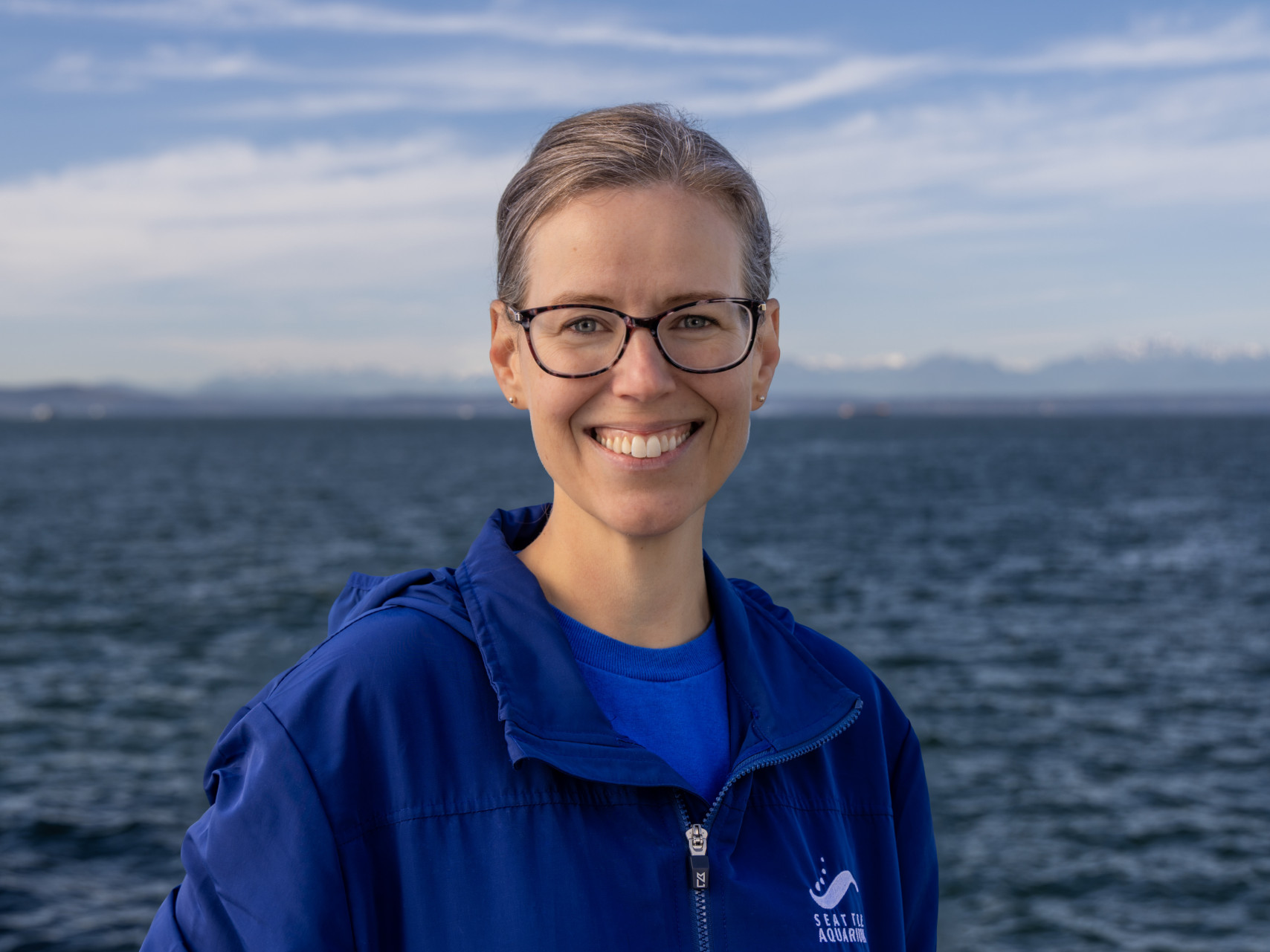
Meg McCann is not the person you might expect to be leading the Seattle Aquarium. She spent years as a trial lawyer, advocating in courtrooms and navigating the complexities of the legal system. She then ran an organization that helped survivors of sex trafficking rebuild their lives, and she held leadership roles in Washington State government, including the Department of Licensing and the Attorney General’s Office. None of that, on the surface, seems to point toward a career spent caring for sea creatures and championing ocean conservation. But McCann’s journey has never been about following a straight line. It has been about finding ways to create meaningful, systemic change, wherever that work needs to happen. Her love for the ocean began in childhood, growing up in Rhode Island, where the sea was not a distant vacation destination but a constant presence, woven into the fabric of daily life. That early connection stayed with her, and when she became president and CEO of the Seattle Aquarium in January, she brought with her a deep belief that the health of people and the health of the planet are inseparable. She often says that everything she has done has been in service of better outcomes for individuals, but the greatest outcome for everyone is a healthy planet. Now, from her office overlooking the waterfront, she leads an institution that welcomes a million visitors each year and supports critical marine research, yet she sees this role as about far more than attendance numbers. She envisions the aquarium as a global leader in conservation, rooted in a city that values environmental action and has the creativity and innovation to push boundaries.
The moment McCann realized that sustainability would be a central part of her life came early, during a school project in Rhode Island. She and a friend were tasked with creating a news report on the state of the bay, so they headed to the water with a camcorder borrowed from her friend’s mother. What they found was not a pristine shoreline but a beach littered with Styrofoam from McDonald’s, and they decided to make that the subject of their report. With the earnestness of young environmentalists, they picked up the foam and told their class that it would still be sitting there, unchanged, for the next seventy-five to one hundred years. It was a small, local project, but it was happening at a time when something much bigger was unfolding in Rhode Island: the fisheries were beginning to close because the water could no longer support healthy shellfish. That connection, between personal habits and the larger world, hit her hard. It was the realization that what we throw away, how we live, and the choices we make every day are not separate from the health of the ecosystem. They are all connected. That lesson stayed with her and shaped the way she thinks about the work she does now, from the energy used to run the aquarium to the waste produced by its visitors. She describes it as a direct line between our own interactions with the world and the broader consequences that ripple outward, sometimes invisibly, sometimes devastatingly. It was the kind of moment that does not fade, and for McCann it became the foundation of a career devoted to protecting the natural world.
When McCann is asked what gives her hope for the planet, she points first to the children who walk through the aquarium’s doors. She describes them as joyful, excited, empathetic, and endlessly creative, with a kind of unguarded wonder that adults often lose. These are the people who will come up with the next big innovation, she says, and the aquarium is relying on that generation to find solutions that protect the Earth. But she also finds hope in the scientists and partners working alongside her every day. The aquarium has been deeply involved in species recovery efforts in the Salish Sea, including kelp restoration research that helps scientists understand where kelp is most likely to grow and how that growth supports the broader underwater ecosystem. They are also working to recover the pinto abalone, a sea snail that plays an important role in the marine environment. McCann is surrounded by researchers using cutting-edge tools and new technologies to regenerate the ocean, and she finds that genuinely inspiring. She is careful not to brush off the enormity of the challenges we face, but she refuses to treat the situation as hopeless. As long as people remain curious and tenacious, she believes there is reason to keep pushing forward. The work is difficult, and the stakes are high, but the people committed to it are smart, dedicated, and constantly finding new approaches. For McCann, that combination of curiosity, creativity, and persistence is what gives her confidence that meaningful progress is possible, even in the face of such a daunting crisis.
If she could invent one sustainability solution overnight, McCann says without hesitation that it would be a way to remove microplastics from the water. Plastic is being dumped into the ocean and breaking down into pieces so small they are nearly impossible to see, but they are settling into every level of the sea. Marine animals are ingesting these particles, and the ecological disruption is widespread and still not fully understood. What worries her even more is that this plastic is making its way into the food system, which means humans are ingesting it too. The chemistry of our water is changing, and the long-term consequences are still unknown. McCann also talks about the changes she has made personally and institutionally since arriving at the aquarium. She has learned a great deal about how organizations can operate more sustainably, and she now thinks carefully about the downstream impacts of every big decision. One of the most significant shifts has been moving away from natural gas and reducing dependence on fossil fuels. When the aquarium thinks about renovating Pier 59 and Pier 60 and growing its operations, the conversation is framed around electrification and finding alternative fuel sources to support clean electricity. It is not always the easy path, but McCann sees it as necessary. She wants the aquarium to model what sustainable transformation looks like, not because it is trendy, but because it is essential. Her approach is practical and grounded, focused on the choices that are actually in front of her, and on making those choices in ways that align with the future she wants to see for the ocean and for the people who depend on it.
One of the most underrated solutions in the fight for sustainability, according to McCann, is building a broad coalition. The aquarium has a zero-waste goal, and by 2030 they want to divert ninety percent of their waste away from landfills. Reaching that goal is not something any single person or department can accomplish alone. It requires enlisting everyone, from the entire staff team to the million-plus visitors who pass through the aquarium each year. That kind of collective effort is the only way to make a real dent in waste. The Seattle Aquarium is in a unique position because it sits right next to a cruise ship stop in a global city that attracts visitors from all over the world. Seattle, McCann notes, can feel like a bubble of progressive values, and it is easy to assume that everyone shares the same environmental commitments. But many visitors arrive with different backgrounds, different beliefs, and different levels of awareness about sustainability. McCann has been thinking deeply about how to invite people in who do not already agree. How can the aquarium make them feel welcome? How can it help them feel a sense of agency and ownership rather than judgment? She believes that conservation cannot succeed if it only speaks to people who already think the same way. It has to be an open door, a place where people feel empowered to make changes in their own lives, no matter where they are starting from. That spirit of welcome and collaboration is, in her view, one of the most powerful tools the aquarium has, and it is one that deserves far more attention than it gets.
McCann watches several metrics closely as a sustainability leader, but energy usage is one of the most important. The aquarium is constantly looking for ways to make its systems more energy efficient, not only because it is better for the environment, but also because reducing energy use lowers operating costs, freeing up more money for animal health, educational programming, and outreach. She also tracks the aquarium’s sustainability engagement survey, with a goal of ninety percent participation. That means ninety percent of staff members should be able to say they know what the sustainability plan is, understand the goals, and see how their own work connects to them. Whether someone is on the custodial team, the guest services team, or the AV team, they should know exactly what the aquarium’s sustainability efforts mean for their role. Performance is evaluated based on that connection. When climate change feels overwhelming, McCann finds grounding in the everyday wonders happening beneath the surface. The aquarium recently put cameras on Pier 59 for research, and what they captured has amazed her. Humpback whales have swum past without ever surfacing, detected only through cameras, sonar, and hydrophones. A red octopus was caught on camera trying to steal bait from a research station. Sixgill sharks moved through the water just below where people walk every day. Seeing these animals thriving right under the city’s feet is a reminder of why this work matters. The big picture is hard, McCann admits, but these small, daily encounters show that life is still there, still fighting, still resilient. They also show that interventions work. They just need to happen on a much larger scale. There is a solution, and getting to see that marine life in action never fails to remind her what is at stake and how much is worth protecting.