



The regular season schedule absolutely did the Texas Rangers and Houston Astros a favor. The only two teams still vying for the American League West title entered the final weekend of the regular season needing to win three games against two non-playoff teams to finish the regular season with a winning record. On paper, this was a gift wrapped in a bow—a chance for two struggling rivals to stumble into October without having to prove they actually deserved it. The Minnesota Twins and the Oakland Athletics (now playing in Sacramento) were supposed to be speed bumps, not roadblocks. History was on their side, too. Since 1969, when the American and National Leagues first split into East and West divisions, no team has ever won a division with a .500 record or worse. For over half a century, the unwritten rule of baseball held firm: if you wanted to hoist a division banner, you had to at least break even. The Rangers and Astros looked poised to waltz through the weekend, collect their wins, and escape the embarrassment of a sub-.500 championship. But baseball, as it so often does, laughed at the script. What was supposed to be a coronation turned into a crisis, and the final days of the season have become a bizarre, agonizing race to the bottom where the trophy goes not to the best team, but to the one that simply loses the least.
That will change this year. The Minnesota Twins (76-84) handed the Rangers a painful 10-2 loss in Minneapolis on Friday, Sept. 25. It wasn’t just a loss; it was a dismantling, a brutal reminder that even a bad team can look like a juggernaut against a squad that has lost its swagger. The Rangers came in hoping to erase the memory of a shaky September, but instead they watched their hopes get battered around Target Field. Hours later, the Athletics (64-96) hung on to beat the Astros 6-5 in West Sacramento. That game was a gut-wrenching, edge-of-your-seat thriller that ultimately ended in heartbreak for Houston. The A’s, who have been playing out the string for weeks, suddenly found their competitive fire against a team that looked like it had forgotten how to close. The Astros mounted a furious late-game rally, clawing back from a 6-1 deficit with a run in the seventh and three more in the eighth, only to go silent in the ninth inning, their bats freezing up with the season on the line. The result was a twin catastrophe for the Lone Star State—two teams, two devastating losses, and a combined zero wins to show for their supposedly “easy” path to October. The magic that had carried both franchises through their respective dynasties and rebuilds had completely evaporated, leaving behind two exhausted, frustrated clubs staring at an unprecedented, ignominious finish.
The Astros and Rangers are tied in the standings at 79-81. With two games to play in the regular season, the best each team can hope for is an 81-81 record. That’s it. No 82-win miracle, no late surge to respectability. The math is final: whoever emerges from this wreckage will do so with a losing or .500 record, a distinction that has never occurred in the history of divisional play. The Astros hold the tiebreaker over the Rangers, so they will move on to the postseason if the two teams finish with the same record. It’s a cruel twist of fate for Texas, who could win out and still go home, watching their bitter rivals advance simply because of a scheduling quirk from months ago. For Houston, this is a strange lifeline—a chance to enter the playoffs as the laughingstock of the league, a team that is statistically mediocre but structurally positioned to steal a spot. The absurdity of the situation is not lost on the players or fans. In any other year, a 79-81 record would mean cleaning out lockers and booking early offseason vacations. But in 2025, it means you might be a division champion. The phrase “winning ugly” has never felt more literal, and the baseball world is collectively scratching its head as it watches two franchises stumble backward over the finish line, praying that the other trips first.
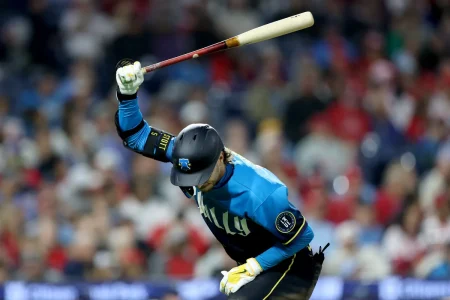
The Rangers will try to win twice without third baseman Josh Jung, who sustained a fracture in his right hand when he was hit by a pitch in the first inning Friday. The 28-year-old finishes his season with a .299 batting average and .827 OPS, a campaign that was quietly brilliant until it was violently cut short. The injury is a devastating blow to a lineup that has already struggled to find consistency, and it removes a key bat from the heart of the order at the worst possible time. Jung’s pain is symbolic of the Rangers’ entire season—a promising core repeatedly undermined by bad luck and untimely injuries. Texas will send veteran right-hander Nathan Eovaldi to the mound on Saturday with the season on the line. Left-hander MacKenzie Gore will follow on Sunday. These are the arms they have left, the men tasked with preventing the unthinkable. The Rangers’ best pitcher, Jacob deGrom, was of little help Friday, as the Rangers fell to 11-11 this month. deGrom, who was supposed to be the ace that carried them through October, looked mortal and vulnerable, a shell of the unhittable force he once was. The pressure now falls on Eovaldi and Gore to pitch the games of their lives, to summon greatness from a team that has shown none of it lately. For the Rangers, this is a final stand—a desperate gamble that two veterans can outduel their own team’s recent history of collapse.
The Astros rallied from a 6-1 deficit with a run in the seventh inning and three more in the eighth against the A’s on Friday, only to go quiet in the ninth inning. That late-game silence was deafening, the sound of a franchise that once struck fear into every opponent suddenly unable to buy a hit when it mattered most. Houston’s identity has always been built on clutch hitting and relentless pressure, but in that ninth inning, they looked like a team resigned to its fate. Hayden Wesneski will start for the Astros against the A’s in the rematch Saturday. Wesneski is an unlikely hero, a pitcher who was not on the roster during the Astros’ glory days but is now tasked with saving their season. The irony is thick: a team that has won multiple World Series titles is now leaning on a relative unknown to prevent a historic embarrassment. The Astros are no longer the powerhouse of the AL West; they are a fragile, aging group held together by hope and the tiebreaker rule. If they win both remaining games, they will celebrate a division title with a .500 record, popping champagne in a clubhouse that knows deep down they didn’t truly earn it. But as the old adage goes, you play the schedule in front of you, and Houston’s schedule has given them one last reprieve. They just have to take it.
On the line is one of two postseason spots that remains undecided headed into the final weekend of MLB’s regular season. Only the AL West champion and the final NL wild-card berth are up for grabs. The real winners might be the 2005 San Diego Padres. Their 82-80 season was enough to win the NL West that year. Until this weekend, that was the worst record ever held by a division winner. Now, the Padres’ long-held record for mediocrity is about to be shattered, not by a single team, but by whoever survives this catastrophic collapse. For the Rangers and Astros, this is not a moment of glory; it’s a moment of survival. They are not playing for a title—they are playing to avoid being the punchline of baseball history for decades to come. The fans watching from home feel the strange mix of dread and hope, knowing that their team might back into October. Yet, there is a strange beauty in this chaos. Baseball is a sport of attrition, where 162 games grind down even the best of teams. To see two rivals reduced to this level, to watch them scrape and claw for a .500 record, is to see the raw, unvarnished truth of the sport: sometimes, the season breaks you. But the prize remains. One of these teams will get a fresh start in the playoffs, a chance to erase the regular season’s failures with a magical October run. And as the 2005 Padres proved, you don’t need to be great to get in—you just need to get in. For the Rangers and the Astros, the final two games are not about pride, or even about winning. They are about surviving long enough to let the postseason rewrite their story, no matter how ugly the first chapter was. For more MLB news, visit Newsweek Sports.