



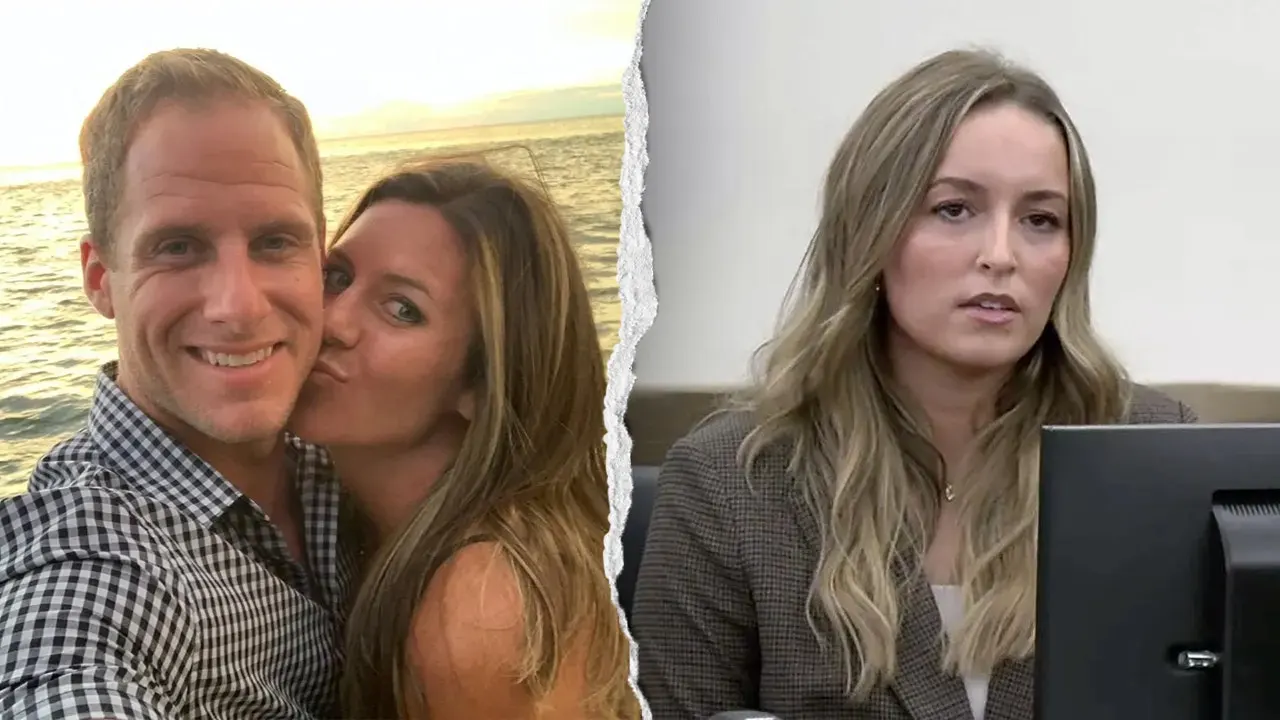
Inside a hushed Ohio courtroom, the sixth day of testimony in the murder trial of Caleb Flynn felt less like a routine legal proceeding and more like an autopsy of a love affair gone toxic, told through thousands of text messages and the raw, unsteady voice of the woman who had once been at its center. Flynn, a former American Idol contestant who once sang for millions of viewers, now sat accused of the shooting death of his wife, Ashley Flynn, a mother whose life ended behind the closed doors of their own home. For more than a week, prosecutors have been building a case that his secret relationship with a younger woman named Alleigha Botner supplied the motive for murder, amotive buried deep in a sprawling digital footprint that spanned months of deception. Over the course of their relationship, Flynn and Botner exchanged an astonishing volume of messages—more than one hundred thousand texts, by the prosecution’s accounting—and on Thursday, jurors were finally invited into the private world contained in those messages, a world of late-night confessions, promises, apologies, and, sometimes, dark fantasies that, in hindsight, seemed almost too on the nose. Botner, a young woman whose composure fractured at key moments, spent hours under oath, reading her own words back in a courtroom that seemed to hold its breath. Her voice broke, her eyes welled, but she kept going, methodically walking the jury through the emotional arc of their entanglement: the rush of falling for a man who was unavailable, the agony of sharing him with someone else, the desperate hope that he would finally choose her, and the creeping realization what she had helped unleash. Defense attorneys, however, asked the jury to see the exact same evidence in a radically different light: not as proof of a murder plot, but as the messy, hurt-filled, sometimes dramatic overflow of two people trapped in an impossible situation, trying to find a way out of a marriage that one of them no longer wanted. By the time the gavel brought the day to a close, the prosecution’s narrative had been met by a defense counter-narrative just as coherent, and the digital remains of the relationship—thousands of messages, deleted apps, AI-generated songs—had become the battlefield on which Flynn’s fate would be decided. The stakes were impossible to ignore: if the jury believed the messages were a roadmap to murder, Flynn could spend the rest of his life in prison; if they accepted the defense’s image of a flawed, paralyzed man who could not bring himself to leave his marriage, the same words would become tragic human weakness rather than criminal intent.
Perhaps no moment was more arresting than when Botner, her face flushed and her voice catching, testified about messages exchanged months before Ashley was killed, in which she had written that she wanted Caleb’s wife dead. “I just wish I didn’t say this,” she said, as tears threatened to stop her testimony cold. But she pressed on and read her own words aloud:”I want to kill her, Caleb.” Then she shared Flynn’s response:”That makes two of us.” The words hung in the stale courtroom air, and prosecutors let them linger, using them as an early bridge between the couple’s private venting and the violence that would eventually come. Botner’s testimony made clear that those dark statements did not exist in a vacuum; they were embedded in a relationship characterized by intense emotional highs and crushing lows, by promises made and deadlines missed, by a woman who say she had given everything—her heart, her loyalty, and, as she put it, her virginity—to a man who kept finding reasons not to leave his wife. She described an affair that consumed her, and she described waiting, hoping, demanding, always believing that Caleb was on the verge of choosing her permanently. But as prosecutors walked her through their messages, what emerged was a pattern of language that, if taken literally, painted a far more sinister picture: two people imagining the death of the woman standing inthe way of their happiness, and treating that possibility as almost casual shorthand for the freedom they craved. The defense would later insist this was metaphor, exaggerated venting, the kind of thing people say when they are hurting and don’t know how else to express it. But for the prosecution, this was motive, raw and premeditated. Botner’s own regret at having said the words, her visible shame as she read them back, only made the testimony more powerful, because it suggested she understood, perhaps too late, exactly how dangerous those words could sound when plucked from the privacy of an affair and placed before a jury. What made it even more haunting was her confession that she had not believed then that Flynn would ever act on such language—she had somehow separated the fantasy from the man she thought she knew, a distinction that would be tested again and again throughout the day.
Prosecutors then turned to the hours leading up to Ashley Flynn’s death, and the tone in the courtroom shifted from raw regret to an almost grim anticipation. The night before the killing, Botner testified, she and Flynn exchanged what would become their final messages, and those messages seemed to mark a threshold. She had been pressing him, as she had so many times before, asking whether he was truly ready to leave his wife. Her own words, read aloud in court, were full of vulnerability and doubt:”I said, ‘Caleb, I’ve never felt anything as deep as I felt with you. I trusted you with my heart. I’m terrified. But thank you for saying all that. We will see if your actions finally match your words.'” The reply that came back from Flynn, she said, was tender and resolute:”I’ve never felt anything like it either. It’s why I know it’s actually real … I’m terrified as well, but tomorrow it all starts.” When she asked whether he was more excited or scared, his answer was telling in its focus on the coming day:”Well, I got a pretty massive day tomorrow so I’m gonna head to sleep. Please be praying for me and I’ll update you the whole time.” Then, as the night wore on, she wrote what felt like a benediction:”You’re about to be free.” His reply:”I choose you … You’re more than enough. Good night.” Jurors heard these messages as the secret prelude to a murder; the phrase “tomorrow it all starts” seeming, in hindsight, chillingly specific. Botner testified she believed he was talking about finally telling Ashley he wanted a divorce, not about killing her. But prosecutors asked the jury to consider whether a man planning to leave his wife would have sounded so conspiratorial, so burdened, so much like someone preparing for a life-altering act that could not be undone. The messages were intimate, almost romantic, and that was exactly what made them unsettling: they showed a man comforting his mistress on the eve of his wife’s death, promising her he had chosen her, assuring er that freedom was hours away, and asking for her prayers as he headed into whatever version of “tomorrow” awaited him. There was, in the text thread, no mention of lawyers or separation papers, no practical discussion of how divorce would work, no concern about custody or property—only the language of destiny, choice, and release, language that the prosecution argued fit far more naturally with a plan to make Ashley disappear than with a plan to serve her legal papers.
When Botner described the aftermath of Ashley’s death, the courtroom seemed to grow even quieter. She told jurors that after the shooting, she went to Ashley’s parents’ home, where church staff had gathered to offer comfortand support. Flynn was there, and when he saw her, he pulled her into a hug. The first words out of his mouth, she testified, were not the frantic, grief-stricken words of a newly widowed husband, but a strange, almost puzzled observation:”It didn’t happen the way we thought it would, did it?” Botner said she immediately felt a chill of suspicion, and as he went on, describing how he heard a gunshot, found blood inside the home,and discovered Ashley, she began to question everything she thought she knew about the man she loved. She could not reconcile the tender, decisive man who had texted her good night with the person now standing in front of her, his story already forming in to the shape he would tell police. That moment became a hinge for the prosecution, a flash of possible revelation embedded in the chaos of loss. Defense attorney Emily Smith, however, worked methodically to soften the meaning of those words, asking Botner whether she now understood Flynn’s repeated references to being “free,” to taking action, to leaving Ashley, as his intention to divorce her rather than to kill her. Botner answered yes, she had understood those words as about divorce. Then Smith asked the sharper question: had she understood the same messages to mean Flynn was planning a murder? Botner’s answer was unequivocal:”I did not.” With that, the defense tried to pull the prosecution’s motive apart, urging jurors to see the entire affair through the lens of a man trying—badly, imperfectly—to end his marriage, not through a conspiracy to commit murder. The same evidence, the defense argued, could be read as the tragic incoherence of two people in love with an idea of freedom that neither of them knew how to actually reach. For Botner, the moment outside that home was not the fulfillment of a plan but the beginning of a nightmare, a sudden, brutal collision between the fantasy world she had inhabited and the blood-soaked reality that had shattered it forever. But under cross-examination, that very bewilderment became a shield for Flynn, because if even the woman at the center of the affair had not heard murder in his words, the defense asked, how could the jury be certain it was there?
Defense attorney Emily Smith spent much of her cross-examination trying to dismantle the prosecution’s portrait of Caleb Flynn as a man preparing to kill, and she did it by turning the spotlight back on Botner. The messages Smith walked her through painted a different kind of relationship: a woman who repeatedly pushed,, cajoled,, threatened, and issued ultimatums. “I’m so done with you,” Botner had written in one exchange, in a tone of exhausted fury. “You have murdered my heart.” In another, she wrote:”I hope you’re glad you took my virginity and also my heart and stomped all over it. Enjoy your marriage. I’m done.” Smith pressed Botner to acknowledge that she had given Flynn four or five separate deadlines to leave Ashley, deadlines that came and went with nothing happening, and that she had demanded constant reassurance that he hated his wife, questioned him every time he spent time with her, and threatened to end the relationship if he did not finally act. Botner agreed with much of it, though she often looked uncomfortable hearing her own words repeated back to her. She also acknowledgedthat in the weeks before Ashley’s death, she had looked up divorce proceedings online,that she had discussed with Flynn how to delete text messages and digital evidence,and that she had feared Ashley might discover the affair if Flynn actually went through with a divorce. Her explanation was straightforward: she had been trying to protect their secret, not to cover up a murder. She did not want to be exposed as the other woman; she did not want her family and friends to learnabout the affair; she wanted Flynn to leave his wife cleanly, without scorching her own life in the process. The defense seized on all of this as evidence that Botner was not an innocent dupe in a murder plot but an active, sometimes aggressive participant in an affair she desperately wanted to legitimize. And perhaps the most significant exchange of the afternoon came when Smith asked Botner directly whether she had ever believed Flynn meant his violent statements literally. “I did not believe that he meant it,” Botner said, her voice soft but clear. Asked why, she replied,”I don’t think he could ever be capable of doing something like that.” It was a momentthat cut both ways: it undercut the prosecution’s suggestion thatthe couple’s dark talk was a real plan, but it also underscored how completely Botner had trusted him—a trust that, whether naive or misplaced, had left her sitting in a courtroom trying to explain why the man she loved was now on trial for murder. Smith’s cross-examination did not erasethe dark texts, but it gave jurors a way to hear them differently: not as conspiracy, but as the ugly, overheated language of a love affair that had curdled into obsession and fear.
After Botner finally stepped down, the day pivoted from human testimony to the cold authority of digital forensics, as prosecutors began laying out the technological timeline they hope will seal their case. Acting as the prosecution’s guide through this phase was Special Agent Joseph Wilhelm,a digital forensics examiner with Ohio Bureau of Criminal Investigation, who spent hours walking jurors through what investigators found inside Flynn’s iPhone. Wilhelm testified that after earlier attempts failed, investigators eventually recovered a full copy of the device, allowing them to analyze browser history, location data, health information, application activity and other digital records in ways that reconstructed, minute by minute, what Flynn’s phone was doing during the final hours before Ashley’s death. Some of the findings seemed designed to suggest a man tidying evidence: ChatGPT, the AI chatbot that had apparently been part of his digital life, had been uninstalled from the phone on Feb. 15, and the messaging apps GroupMe and Instagram were removed shortly after 1 a.m. on Feb. 16, in the early hours of the day Ashley was killed. Investigators also found no text messages between Flynn and Ashley on the device itself, a gap the prosecution may argue speaks to the state of their marriage or to a deliberate cleaning. Wilhelm outlined location data that placed the phone in certain areas at certain times, along with data from Flynn’s Apple Watch, connections to AirPods,and an array of activity readings that together formed a timeline leading up to his 911 call. The forensic testimony was dense and technical, but its purpose was plain: to turn the mess of human emotion jurors had heard earlier into something measurable, observable, andominable. Then, in what felt like a strange collision of worlds, prosecutors played two AI-generated songs recovered from Flynn’s phone, files that Wilhelm testified were connected to his relationship with Botnerand that matched lyrics investigators had found saved in the phone’s notes app. The songs, born of the same impulses that had produced the texts—longing, fantasy, desire—became another set of artifacts for jurors to interpret, another way of asking whether the private world inside that phone was the world of a man planning to free himself, orthe world of a man who simply wanted out of his marriage. As the day ended, both sides were plainly preparing for the battles ahead, with prosecutors expected to return to the digital timeline in greater detail. Flynn’s attorney, L. Patrick Mulligan, declined to comment while the case is ongoing, and Botner, her testimony complete for now, could not immediately be reached. The trial will continue, but Thursday left everyone in the courtroom with an uncomfortable recognition: that between the two narratives now competing for the jury’s belief—a calculating killer or a flawed, tangled man whose affair ended in tragedy—lay thousands of messages, a dead woman,and a question no amount of technology can answer.