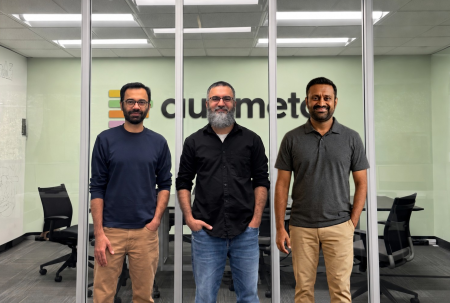





Every company has a story, but many businesses are telling it to themselves. Adam Kapel and Ryan Morel have spent years inside growing companies, and they’ve watched promising products stall not because of engineering or pricing, but because the story around them was messy, self-focused, and hard for customers to translate into value. The two worked together for a long time, including at Seattle logistics startup Flexe, where they got a front-row seat to what happens when a good product is sold through a weak narrative. This spring, they reunited to launch Kompeld, a Bainbridge Island startup built around a deceptively simple thesis: most go-to-market problems are actually messaging problems. Companies hire more salespeople, redesign their funnel, or rebrand, all while their fundamental narrative is undermining every conversion. Kompeld built a system to measure exactly how well a company explains what it does and why customers should care. They ran more than 150 technology companies through that system, and the results aren’t flattering: roughly half have messaging that ranks somewhere between average and weak. Not disastrously bad, but weak enough to quietly cap growth. It’s a hidden tax on revenue, because nobody sees the deals that didn’t happen or the trust that never formed. Kompeld itself is intentionally small—two people, bootstrapped, with no outside funding. That’s not a limitation; it’s a design choice. Morel and Kapel believe their experience can be turned into a repeatable framework rather than a giant agency retainer. They use AI to accelerate their diagnosis and keep their delivery fast and practical. Morel, the co-founder who handles much of the public thinking, sat down with GeekWire’s Startup Spotlight to explain why narrative is not just an art but a revenue discipline, and why the company is obsessed with getting companies out of their own heads. It’s early, and there is no guarantee it will succeed, but Kompeld is already making a compelling case that the way a company talks about itself deserves a seat at the revenue table.
Morel can summarize Kompeld in a single, tightly packed sentence: “Kompeld narrative systems turn subjective storytelling into an objective revenue driver. We continuously diagnose, architect, improve and align commercial messages across every revenue funnel stage. We replace gut-feel branding with the structural logic that creates demand, increases win rates and accelerates growth.” A phrase like “objective revenue driver” might sound like corporate-speak, but underneath it is a genuine obsession. The problem that keeps Morel up at night is what he calls “hidden revenue barriers caused by self-centered, product-first corporate messaging.” In practice, that looks like a company that spent years building a great product, then loses a sale because its materials are all about features the customer never asked for. Most B2B organizations, Morel says, plateau eventually. They assume it’s market saturation, poor pricing, or an underperforming sales team. But Kompeld’s research points to a deeper issue: the company is talking to itself. Its website says “we are the leading provider,” its slides are filled with architecture diagrams, and its sales emails are variations of “we wanted to show you our platform.” None of those messages begin with the buyer’s actual situation. Kompeld’s diagnostic examines every touchpoint—website, collateral, decks, follow-up emails—and measures whether the message centers on the buyer’s operational challenges or the seller’s own pride. The evidence from 150 tech companies is sobering: half struggle to articulate why anyone should care. Morel insists that’s not a cosmetic issue. It’s a structural flaw, one that suppresses demand at every stage of the funnel. The fix isn’t a better tagline. It’s a narrative architecture designed from the buyer backward, using the same rigor you’d apply to a financial model, and Kompeld has built itself around that discipline.
The thing that surprised Morel most was not that customers are confused; it’s that they already know their company is confused, and still don’t know how to change it. “How many B2B leaders passionately want to be customer-centric yet lack any concrete framework to actually be customer-centric?” he asks. “Everyone treats it as a core goal, but struggles to turn that into action across the organization.” That is the dirty secret behind all the “customer obsessed” posters on office walls. There is plenty of intention, but almost no process. Leaders talk about customers first, but their revenue meetings are filled with product timelines, internal milestones, and quarterly quotas. They don’t have a disciplined way to ask the most important questions: What are the buyer’s daily disruptions? What are their urgent challenges? What are the actual criteria they use to make a decision? Without a framework, customer-centricity is just a sentiment, and sentiments don’t scale. Morel and Kapel have seen what happens when the sentiment fades: sales teams default to pitching features, marketing teams default to broadcasting “we’re the best,” and everyone gets frustrated when the market doesn’t respond. But it isn’t because they’re bad people or incompetent professionals. It’s because they’ve never been given a system for translating customer awareness into day-to-day execution. Kompeld’s answer is to build exactly that. From the first click to the final contract, they help hardcode buyer perspectives, behaviors, and outcomes into the narrative. That turns customer-centricity from an aspiration into an institutionalized process. And that, Morel believes, is the only thing that separates companies that keep growing from ones that stagnate once they hit a certain size. This surprise discovery has shaped Kompeld’s entire playbook: give companies not just a message, but a mechanism for staying customer-centered as they scale.
Being a two-person company with no investors forces you to be resourceful, and Morel says AI is the reason Kompeld can do what it does. “AI allows us to turn our narrative expertise and best practices into repeatable, defendable diagnostic structures,” he explains. In other words, the wisdom that once lived only in the founders’ heads can now be embedded in a scoring system. That is huge for consistency: Kompeld is not another consultant’s gut feeling; it’s a methodology. The second benefit is speed. AI automates the routine parts of the work, so they can deliver in days instead of weeks. The third benefit is structural. Because AI makes their process so efficient, Kompeld doesn’t have to build a clunky software platform to sell. Instead, it gives clients purpose-built narrative protocols, custom frameworks built to solve the particular customer problem sitting in front of them. This doesn’t require a long integration or a training bootcamp; it’s more like a bespoke operating manual for talking about the company. For a two-person startup, that’s the difference between being a niche service and a scalable product. Morel’s own AI habits are surprisingly practical. His favorite tool isn’t a glamorous new chatbot; it’s a family calendar agent he built with Claude Code, a small program that keeps his household on schedule. Around the office, the vibe is equally no-nonsense. Morel drinks his coffee hot and black, reads The Tao of Pooh to keep perspective, listens to Dyaphonic, and says his entrepreneurial idol is the person who opens a laundromat or a small restaurant—someone who solves a real problem in the community. There’s no hyper-growth-at-all-costs energy here. There is, instead, a belief that a clear customer-first narrative is one of the most underrated growth levers in business, and that you don’t need a hundred employees to help companies find it.
One of the biggest obstacles Kompeld runs into is a misunderstanding about what narrative work really means. Morel is quick to correct it. “Executives misunderstand the difference between a creative brand story and a revenue narrative,” he says. “And as a result, they misunderstand the focus, approach and value of narrative. Brand stories serve a subjective purpose aimed at emotion, whereas narratives are structured, repeatable systems built strictly to drive revenue and growth.” A brand story might make people feel warm and fuzzy; a revenue narrative makes them sign a contract. The two are not enemies, but they are not the same thing. Morel argues that companies rely too heavily on brand stories when they should be engineering revenue narratives. That means aligning every sales and marketing message with the way a buyer actually decides. It means replacing gut instinct with a structure that can be tested, measured, and improved. It means taking the subjective art of communication and giving it the rigor of a sales methodology. Morel also has advice for other entrepreneurs, and it is exactly the same advice at the heart of Kompeld: “Recognize that it’s not about you. Founding a company requires deep personal passion for your idea, but winning requires turning that perspective entirely toward the buyer. Step away from the internal origin story and feature pitches and focus on the customer’s operational reality, their daily disruptions, their urgent challenges and their decision-making criteria.” That’s tough advice for any founder to hear. You spend years convincing investors, employees, and yourself that your vision deserves to exist. Then, just as you are ready to scale, the market tells you it doesn’t care about your vision—it cares about what you can do for the customer. The sooner founders make that transition, Morel says, the sooner they stop leaking revenue through messaging that only insiders can decipher. It’s a lesson that applies long after launch, and it’s one Kompeld was built to teach.
Morel doesn’t hesitate when asked about the hardest decision he’s made in the past year. It was telling Adam Kapel he had to come out of semi-retirement to help build Kompeld. There’s a warmth in that answer that cuts through the business-speak. Kapel had earned a slower life; he didn’t need another startup. But Morel had an idea that felt worth the risk, and he needed his friend and former collaborator to feel it too. Kapel said yes. The two have spent the last months turning that leap of faith into a company, quietly working from Bainbridge Island with no funding, no safety net, and no appetite for buzzwords. They are using their combined experience to help other businesses stop talking at customers and start talking to them. When Morel is asked what would tell him Kompeld has made it, he gives the most human answer imaginable: “Adam retires.” That one phrase captures what the company is really about. It’s not about exits, valuations, or awards. It’s about building something that works so well that the founder’s friend can finally leave, this time because the job is done. There is a quiet poetry to that. A company whose philosophy is “it’s not about you” is, for Morel, a vehicle for honoring a partnership and a promise. The risk is real, but so is the conviction. In the meantime, there is coffee, black, and a growing archive of diagnostics from 150 companies that are teaching them a lot about the state of B2B messaging. Kompeld’s ambition is modest and enormous at once: to turn storytelling from a bright idea into a reliable tool, and to prove that the way a company talks about itself can be as disciplined, as repeatable, and as consequential as the way it makes money.