



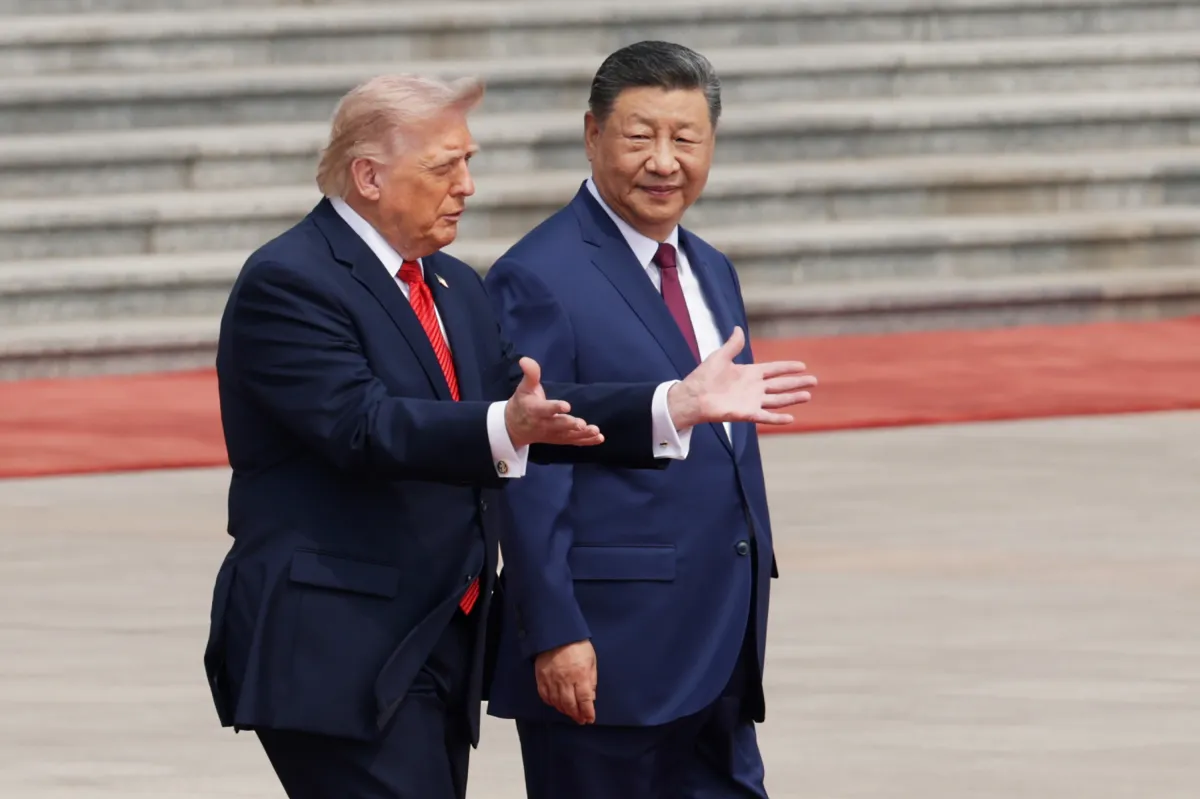
There is a moment in diplomacy when the choreography matters as much as the conversation—when the arrival of a foreign leader on an American tarmac becomes a stage for all the hopes, tensions, and unanswered questions that have built up over months. That moment arrives this week when President Donald Trump greets Chinese President Xi Jinping at Joint Base Andrews in Maryland, just outside Washington, D.C. It is a carefully arranged scene: the red carpet, the flags, the handshake, the forced warmth that may or may not carry over into the Oval Office. The formal talks are scheduled for Thursday, with trade, Taiwan, and tariffs dominating the agenda. But behind the protocol lies a more human story: Xi has not appeared in public since September 13, when he attended the BRICS summit in New Delhi. According to reports, he skipped the dinner hosted by Indian Prime Minister Narendra Modi, and that absence—small by normal standards—was enough to set off a storm of speculation. When a leader as controlled and controlled-by-protocol as Xi disappears from view, every silence becomes a sentence. The meeting with Trump, then, is not just another diplomatic stop; it is his return to the world stage, a chance to reassure allies and adversaries alike that he is still firmly in command. Yet the very fact that his health is a subject of conversation says something about the strange, opaque nature of power in China: we know less about the man at the top than we do about almost any other major world leader.
The rumors did not start out of nowhere. In the weeks before Xi’s scheduled arrival, social media accounts associated with exiled dissidents began circulating unverified claims that Xi, now 73, had fallen ill during the BRICS opening ceremony, required first aid, and was flown back to China before the summit had ended. These claims were amplified by Jun Xie, the chair of the outlawed China Democratic Party, who has become a familiar voice for those seeking to question the official narrative. There is no independent evidence to support any of this, and the Chinese government has not officially responded. But in a political system where censorship makes almost everything about the leader’s health a state secret, especially after a visible purge of military officials, silence itself becomes fuel for conjecture. Steve Tsang, the director of the China Institute at SOAS University of London, offers a more measured view: “Xi occasionally disappears for some days, so it’s not necessarily a sign of major problems. After several foreign trips, he may want a bit of downtime before the Washington visit.” He acknowledges that dissidents have speculated, but stresses, “so far this is not proven, though not impossible.” That is perhaps the most honest thing anyone can say about Xi’s condition: we do not know. We are left to read meaning into a cancelled dinner, a quiet September, a gap in the public schedule. It is a reminder that even the most powerful people in the world are still human, with bodies that tire, schedules that shift, and private moments that the public will never see. But it is also a reminder of how deeply our understanding of global politics depends on transparency—and how easily the lack of it turns ordinary absence into extraordinary intrigue.
What does each leader actually want from this summit? On the surface, the agenda is clear: trade, technology, fentanyl, Taiwan, and the vast, tangled web of disputes that has defined U.S.-China relations for the past several years. Trump returned to the presidency in 2025 determined to use tariffs as a blunt instrument, pressuring Beijing on everything from opioid trafficking to economic imbalances. China retaliated with its own tariffs, and after a period of escalating tension, a truce was reached—one that Trump’s state visit to China in May seemed to strengthen. But the balance of leverage has shifted, perhaps more than Trump’s team wants to admit. Allen Carlson, an associate professor of government at Cornell University and an expert on Chinese foreign policy, points out that “Trump and his advisers are approaching this visit as if America won the last round in Beijing and will win again. It did not.” The war in Iran has complicated the U.S. position considerably: American munitions are being expended faster than they can be replaced, and the supply chains for critical minerals like rare earths run through China. That gives Xi a quiet but undeniable advantage. Xi, meanwhile, has spent the past weeks on his most extensive trip abroad since before the pandemic, making the case that China is the stable alternative to an erratic America. Carlson’s analysis captures the central irony of the meeting: both leaders will present themselves as strong, successful, and in control, yet both are also negotiating from positions of real need. The United States needs Chinese cooperation on strategic materials and perhaps even regional stability; China needs continued access to American markets and technology. Neither can simply declare victory and walk away.
Economic interdependence, as Oxford Economics notes in analysis shared with Newsweek, is extremely difficult to unwind, no matter how many national security frameworks are invoked. The leaders’ meeting itself is a sign that the relationship is becoming more predictable—a small comfort—but the same analysis warns that “the hawkish bias in both sides’ foreign policy will persist.” China wants to preserve export access while reducing its dependence on foreign technology; the United States wants to limit near-term disruptions to its supply chains while building up domestic manufacturing capacity. These goals pull in opposite directions, and neither can be achieved overnight. Oxford Economics concludes that “unilateral efforts to decouple from China have not worked,” and that both sides are essentially “buying time.” The Foundation for Defense of Democracies, in a media call last week, likewise emphasized how far apart Washington and Beijing remain on issues ranging from advanced semiconductors and rare earths to Taiwan and broader security concerns. The likely outcome of the summit, therefore, is not some grand reconciliation but a careful exercise in managing a stalemate. Washington will try to reduce the dependencies that Beijing can exploit in a future crisis; China will try to preserve the choke points it has built over decades of trade. This is diplomacy as a kind of chess, where each move is designed less to win immediately and more to avoid losing later. And for all the rhetoric about toughness, both sides are acutely aware that the other can inflict real pain. The global economy is not a set of separate national markets but a single, deeply integrated system. Pulling on one thread can unravel everything.
Steve Tsang offers a shrewd prediction: “Trump and Xi share one thing in common: Both want the visit to look like a great success. So I will be very surprised if they don’t get that. But it does not mean they necessarily agree on many things.” This is the human reality behind the pomp. Both men have enormous egos, carefully managed images, and domestic audiences they need to satisfy. Trump wants to show his supporters that he can stand up to Beijing and get something in return; Xi wants to show the Chinese people that their leader is still respected, still healthy, still able to command the world’s attention. These shared needs create a strange incentive to smile, shake hands, and sign some innocuous agreement, even if the underlying tensions remain unresolved. There are likely to be disagreements behind closed doors. Trump may press Xi for help with the Iran war, but Xi has little reason to provide it and will almost certainly resist. The trade truce itself could be a point of friction: Beijing would probably prefer an extension that lasts for the rest of Trump’s term, while Washington may be reluctant to tie its own hands for that long. Xi might also ask Trump to declare that the United States will not deliver or sell arms to Taiwan, but if Trump follows the advice he has received from his security team, he will not agree to such a commitment. Tsang notes that “each may want something from the other, but neither is likely to want to let them spoil the visit.” In other words, they will do what leaders have always done: keep the difficult questions off the table, focus on what can be achieved, and hope that the photographs lasting longer than the peace talks.
And perhaps that is what makes this moment so human. We like to imagine world leaders as larger than life, moving pieces on a global board with perfect clarity and total control. Then we see them arrive at an air base, tired from long flights, surrounded by aides and security, facing a schedule of meetings and meals and photo ops, and we remember that they are just people—people with headaches and jet lag, with political pressures bearing down on them, with private doubts they will never voice in public. The mystery of Xi’s health is a reminder of the gap between the images leaders project and the realities they live with. It is impossible to watch a man climb out of a plane and know what he has been through in the weeks before, whether he is struggling with a cold, the weight of his own aging, or simply the exhaustion of an ambitious foreign tour. The official Chinese media will no doubt present this summit as another triumph; the American media will parse every handshake and every frown. But at bottom, this is a meeting between two men who represent more than two billion people between them, who have differences that no handshake can erase, and who are both, in their own ways, trying to survive the storm they have helped create. They do not need to become friends. They do not need to resolve all their disputes. They only need to manage the next few months without stumbling into a crisis that neither can control. In that sense, the visit may not be the beginning of a new era or the end of an old feud. It may simply be the latest step in a long, awkward dance—two leaders, one stage, and all the unspoken uncertainties that make diplomacy as much an art as a science. We can only watch, read between the lines, and hope that the men at the center of it all are as steady as they appear.