


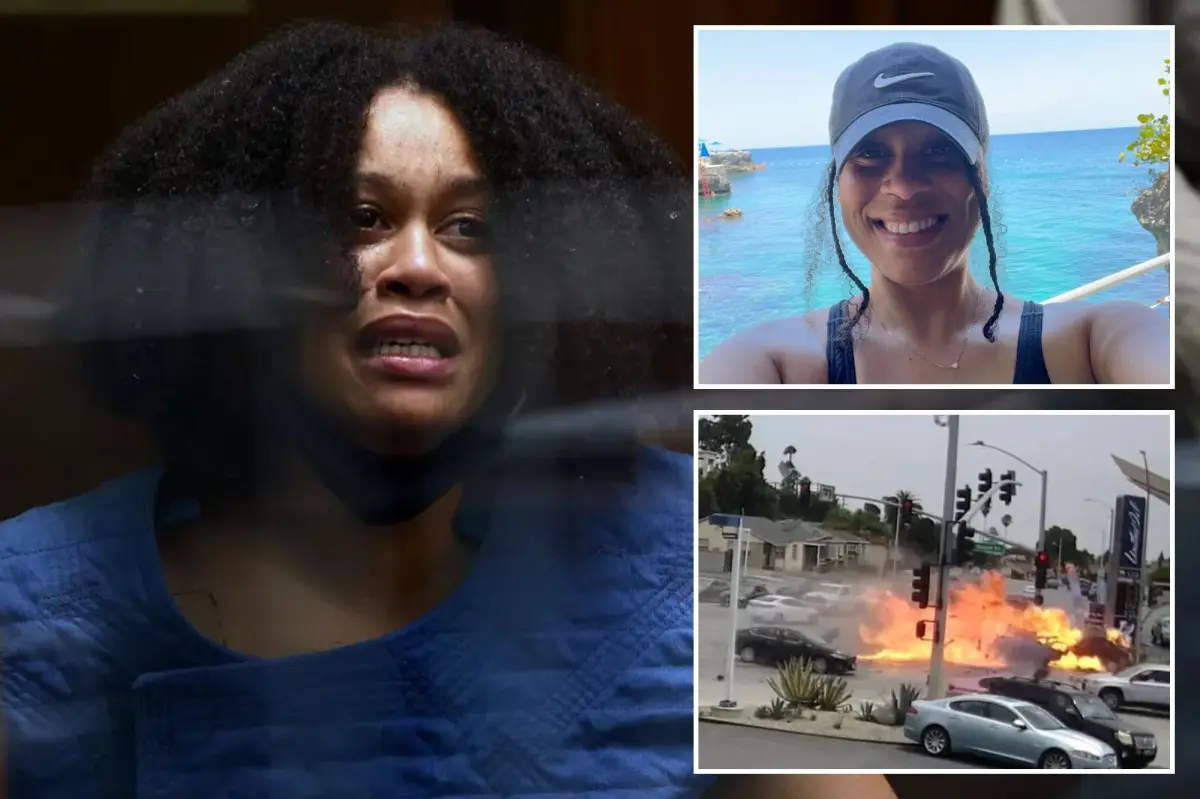
The courtroom felt heavy with grief as the trial of Nicole Linton unfolded, drawing together the raw sorrow of multiple families and the haunting details of a crash that ended six lives in a matter of seconds. Nicole, a nurse accused of killing six people after speeding through a red light at 130 miles per hour, sat at the center of a case defined by tragedy, confusion, and the search for accountability. The crash occurred on August 4, 2022, at the intersection of La Brea and Slauson avenues in Los Angeles, where her Mercedes tore through traffic and triggered a fireball near a gas station. Among the dead was Asherey Ryan, a 23-year-old mother who was more than eight months pregnant and heading to a prenatal appointment. She was killed along with her unborn son Armani, her 11-month-old son Alonzo Quintero, and her boyfriend Reynold Lester. Also killed were Nathesia Lewis, 42, and Lynette Noble, 38, who were traveling in another car. The sheer scope of the loss was difficult to absorb, especially for the family members who packed the gallery, many of whom wiped tears and held one another as prosecutors described the final moments of their loved ones. The trial was never going to be easy, but no one anticipated the strange and heartbreaking testimony that would come from Nicole’s own sister, testimony that painted a portrait of a woman unraveling in real time, minutes before she would change so many lives forever.
Kimberly Linton, the oldest sister of the defendant, took the stand and immediately became a key witness in a case that seemed to hinge on Nicole’s state of mind. Her voice often faltered as she described a series of bizarre video calls Nicole made while driving on the afternoon of the crash. According to Kimberly, Nicole made five video calls, including one that lasted six minutes, all while behind the wheel. On those calls, Nicole spoke in what Kimberly described as “gibberish” and “complete nonsense.” Her face appeared confused, her words disconnected from reality. At one point, Nicole mentioned Kimberly’s daughter, who lives in Philadelphia, saying, “Pack a lunch for daughter, I’m going to take her to school.” In another strange exchange, Nicole said she was going to marry Will Smith and told her sister to “meet me at the altar.” Kimberly’s testimony was delivered with visible anguish, as she realized that these were not just odd comments but warning signs that something was profoundly wrong. She also described her sister’s behavior in the days leading up to the crash, saying Nicole was “cleaning obsessively” and had once appeared naked on a video call, surprising and worrying her sister. Kimberly told the jury that the behavior was unusual, that something was off, and that she had tried to make sense of it all after the fact. The testimony offered a glimpse into a family trying to understand how a woman they loved could have ended up at the center of such devastation, and it left the courtroom in a silence punctuated only by Kimberly’s sobs.
The emotional weight of the testimony increased when Kimberly described a phone call she made to another sister, Camille, immediately after the strange video call, at around the same time Nicole slammed into traffic and killed six people. Kimberly blamed Camille for “triggering Nicole,” saying that Camille had texted Nicole days earlier during an emotional call that was later played in court. In that recorded exchange, Kimberly could be heard telling Camille, “You know she’s not well.” Camille responded with anger, shouting, “I don’t know she’s not well, I’ll never text her again.” Kimberly, already overcome with grief and guilt, was seen crying and wiping away tears as she listened to her own voice on the recording. The exchange laid bare a family fractured by worry, frustration, and love, a family that had noticed something was happening to Nicole but could not prevent the catastrophe that followed. Kimberly’s testimony suggested that the seeds of the crash may have been planted days earlier, in an emotional confrontation that left Nicole in a fragile state. The defense would later argue that Nicole suffered a seizure and lost control of her Mercedes, but Kimberly’s account of rambling, nonsensical conversations added a layer of complexity to the case, raising questions about whether Nicole was mentally impaired, under extreme distress, or experiencing some kind of medical emergency. For the jury, it was a painful window into the defendant’s humanity, as well as into the helplessness of a sister who watched from a distance as her sibling spiraled.
As difficult as the family testimony was, the prosecution’s evidence was even more harrowing for the victims’ relatives, many of whom stormed out of the courtroom during opening statements. Prosecutor Brittany Vannoy told the jury that graphic video of Ryan’s unborn baby following the wreck was shown, a moment so brutal that several family members could not bear to stay in the room. Vannoy described how the baby was “ripped from her womb,” a phrase that echoed through the courtroom and left many in tears. Ryan’s family had said she was on her way to a prenatal appointment, filled with hope for the future, when her life and the lives of her loved ones were extinguished. The prosecutor also displayed graphic photos of the victims’ burned bodies, prompting more family members to leave. Vannoy said, “You’ll hear from the medical examiner, the bodies were incinerated,” a statement that underscored the sheer violence of the crash. The fireball that engulfed the intersection had consumed everything in its path, leaving little for investigators to examine and leaving families with the impossible task of mourning bodies that had been destroyed. The graphic nature of the evidence was not just meant to shock; it was meant to convey the reality of what happened, to force the jury to understand that these were not abstract statistics but living, breathing people whose final moments were marked by terror and pain. For the families seated in the gallery, each photograph was a fresh wound, and many of them left the courtroom in waves, unable to watch.
One of the most dramatic moments of the trial came during the testimony of Tonya Boyd, a woman who had tried to save baby Alonzo after the crash. Boyd described how she attempted to perform CPR on the 11-month-old on a gas station convenience store counter, desperately trying to bring life back into a child who was already gone. She told the jury, “There was blood coming from the baby’s neck,” and that the baby “felt limp, mushy and not alive.” A horrific picture was shown of the infant sprawled out on the counter, surrounded by gum, candy, and other items for sale, an image so devastating that it caused more tears among family members in the gallery. During Boyd’s testimony, Nicole Linton herself began to break down. She had been wiping tears away as she listened, but at one point she let out a loud gasp and started sobbing. The judge immediately ordered the jury out of the room and demanded that the defendant “compose herself.” It was a rare and jarring moment of raw emotion from a woman who had remained largely impassive throughout the trial. Whether her tears were born of guilt, remorse, or something else entirely, the scene underscored the tragedy of the case: a nurse, trained to save lives, now accused of destroying them; a mother and her child, gone in an instant; a community left to grapple with the randomness of the loss. The image of baby Alonzo on that convenience store counter became a symbol of the crash’s senselessness, a tiny victim caught in a moment of violence that no one could have predicted.
Now, as the trial moves toward its conclusion, the legal questions remain deeply contested. Linton is charged with six counts of murder and faces life in prison if convicted. Prosecutors dropped five counts of vehicular manslaughter with gross negligence before trial, a decision that allowed them to pursue the more serious murder charges. The defense has argued that Linton suffered a seizure and lost control of her Mercedes before the crash, a claim that her family’s testimony about her bizarre behavior and rambling video calls may support. But the prosecution has painted a different picture, one of reckless indifference to human life, of a driver who chose to speed at 130 miles per hour through a red light in a densely populated area. On Monday, Linton waived her right to testify after the defense rested its case, meaning the jury will never hear her own account of what happened. The case is expected to go to the jury either later this week or next week, and the weight of that decision rests on the shoulders of twelve people who have spent days listening to heartbreak, examining gruesome evidence, and trying to determine whether this was a tragedy born of medical emergency or criminal negligence. Whatever the verdict, the trial has already exposed the fragility of life and the thin line between normalcy and disaster. It has also revealed a family struggling with its own role in the events, a sister who made a frantic call too late, and a community forever changed by a fireball at a Los Angeles intersection. In the end, there are no winners here, only survivors left to carry the memory of those lost and the haunting question of whether anything could have been done to stop it.