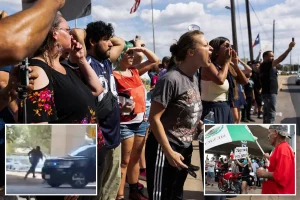


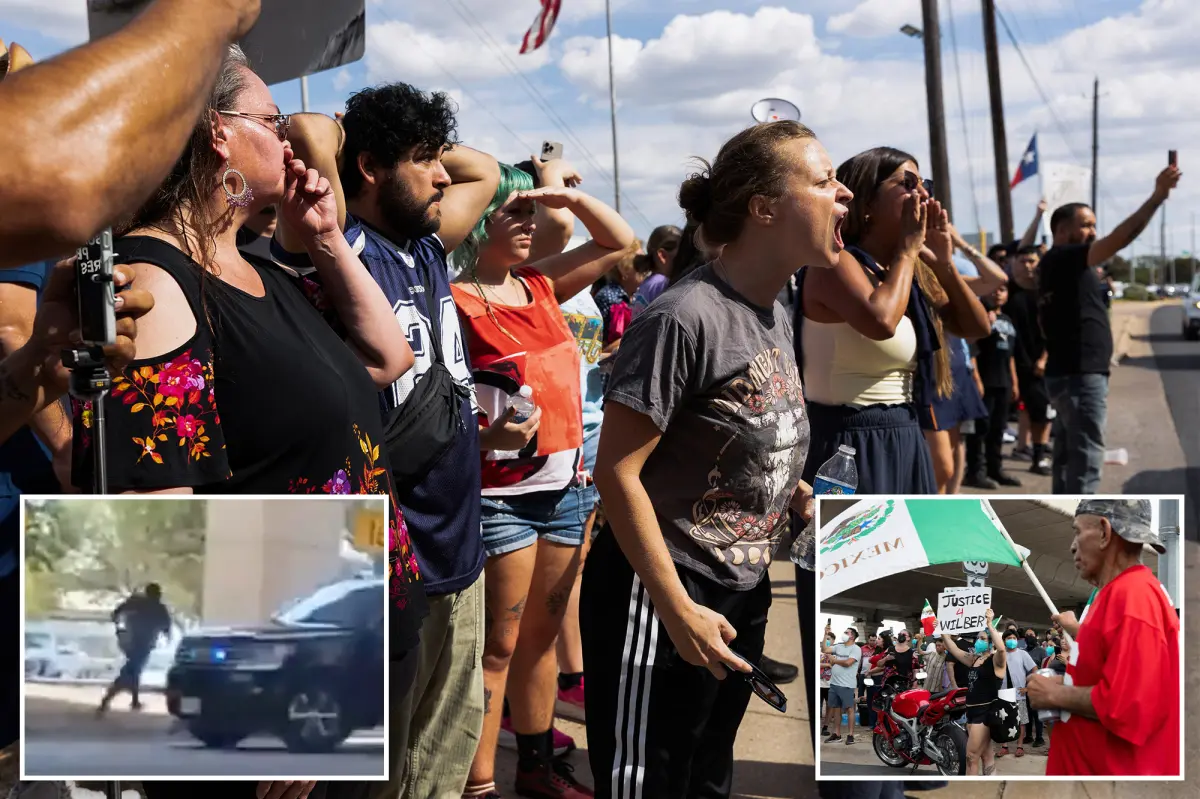
On the surface, it looked like a spontaneous outburst of community anger. Around 12:56 on a Sunday afternoon in Austin, Texas, an Immigration and Customs Enforcement agent shot Wilber Rafael Garcés Pérez, a 28-year-old Venezuelan national, during a traffic stop near the intersection of Anderson Square and Research Boulevard. Pérez was rushed to a hospital with serious injuries, and authorities later said he was stable and in federal custody. Local police were quick to note that Austin officers had not been involved in the shooting; federal authorities, with help from the FBI, would handle the investigation. Within a few hours, a crowd had gathered near the scene, waving Mexican flags, shouting against ICE, and confronting police. Local television described a handful of people who grew into a much larger protest over several hours, and the first reports framed the demonstration as a raw, unplanned reaction to a breaking-news event. It was easy to imagine neighbors stepping out of their houses, shocked by the violence in their community, and deciding to stand together in the street. But the full story is more layered than that. While the shooting was absolutely the trigger, the speed and coordination of the protest pointed to something beyond a naturally forming neighborhood vigil. By the time the sun set, the demonstration had become part of a much larger, well-organized political operation.
A detailed review by Fox News Digital found that the protests were not simply organized by local residents. Behind the scenes, a network of far-left socialist and communist groups was already mobilizing, including the Democratic Socialists of America, the Freedom Road Socialist Organization, and the Party for Socialism and Liberation. These groups have deep roots in activist communities and strong social media followings, and they share connections with nonprofits funded by Neville Roy Singham, an American-born communist tech millionaire who lives in Shanghai. Lawmakers on Capitol Hill have been looking into whether the Singham network is deliberately trying to create an image of chaos across the United States, from anti-ICE protests in Minneapolis to demonstrations outside the Delaney Hall detention center in Newark, New Jersey. On Sunday evening, BreakThrough News, a pro-communist media outlet funded by Singham through BreakThrough BT Media, posted a “BREAKING NEWS” report from Texas with the headline “Austin erupts in protest…” The language made it sound like a sudden explosion, but the pieces were already in motion. The shooting was the spark, but the kindling had been gathered long before, carefully arranged by organizations with established propaganda outlets, international connections, and years of experience turning local incidents into national stories. The fact that the protest looked spontaneous was itself part of the message.
The timeline makes the coordination clear. About four hours after the shooting, at 4:19 p.m. Central Time, the Party for Socialism and Liberation’s national account posted an urgent message on X: “BREAKING. MAN SHOT BY ICE AGENTS IN AUSTIN.” The post demanded that ICE leave Austin and called on residents to protest. The group’s Austin chapter then shared the same graphic, working alongside its national headquarters and four Texas chapters in Houston, San Antonio, Dallas-Fort Worth, and Waco. By the next evening, that post had thousands of likes, reposts, and shares. At around 4:30 p.m., the Austin chapter of the Democratic Socialists of America posted an “Emergency Demonstration/Vigil” graphic, asking people to gather at 8121 Research Boulevard from 5 to 8 p.m. for a “spontaneous” protest and vigil against “another instance of ICE and police violence.” The word spontaneous was right there in the announcement, even though the event itself was being organized through existing activist networks. About the same time, the Freedom Road Socialist Organization and its Austin chapter published their own material, with graphics claiming ICE had shot an unarmed civilian and describing the incident as part of a broader pattern of “ICE violence and killings.” Within a day, those posts also collected hundreds of likes and shares. None of this happened by accident. The same organizations had done this before, in Minneapolis and Newark, and they had the digital infrastructure in place to promote a protest, spread a narrative, and push the story through national and local channels within hours.
Understanding the ideology behind these groups helps explain why they moved so quickly. The Freedom Road Socialist Organization is openly Marxist-Leninist and says it is working to build a new revolutionary communist party. Its own program calls for replacing capitalism through socialist revolution. In July, the group saluted the Communist Party of China on its founding anniversary, and for years it has supported the Communist Party of Cuba, praising the Cuban Revolution and calling for an end to U.S. sanctions against Cuba. The Party for Socialism and Liberation describes itself in its manifesto as a revolutionary socialist movement that will open the way to communism and the end of class society. It sees the police and the state as tools of capitalist rule and wants to replace them with a workers’ government. The Democratic Socialists of America often provides a broader layer of street-level organizing, helping to pull in people who may not identify as communists but are drawn to anti-ICE and anti-police messages. Together, these groups form a tight ecosystem. The Party for Socialism and Liberation works alongside Singham-funded organizations like the People’s Forum, BreakThrough News, CodePink, and the ANSWER Coalition on protests, media campaigns, and international solidarity efforts. There is also overlap with the Freedom Road Socialist Organization through shared pro-communist, anti-imperialist coalitions. The groups have participated together in international solidarity delegations to Cuba and Venezuela. One self-described communist co-founder of the Party for Socialism and Liberation, Brian Becker, said the delegation traveled “as comrades in solidarity.” This isn’t a group of concerned neighbors brainstorming on a neighborhood app. These are organizations with a clear political project, and a shooting involving ICE is exactly the kind of event they are built to amplify.
Once the crowd was in the streets, the messaging shifted from breaking news to live protest theater. Videos posted by the groups showed demonstrators chanting, holding signs, blocking the roadway near the shooting scene, and lighting fireworks. At 5:44 p.m., the Party for Socialism and Liberation’s national account posted a video from the scene with the announcement, “LIVE: A crowd has gathered…” The group then shared the video on Instagram, synchronizing it with Rage Against the Machine’s song “We’ve Got to Take the Power Back.” The caption read, “Austinites flooding the streets where man shot by ICE: ‘ICE out of our neighborhoods.’” That choice of music and language was deliberate—it gave the impression of a city overflowing with spontaneous fury, while in reality the “flood” was being produced by a coordinated network that had been sending messages to followers all afternoon. At 8:27 p.m., the national account published an expanded statement headlined “Justice for Wilber Rafael Garcés Pérez,” demanding the detainee’s release and the agent’s arrest. The statement told supporters to follow the example of Minneapolis earlier that year “until ICE terror is defeated!” An identical post spread through the Party for Socialism and Liberation’s Texas and national Instagram accounts, and by early Monday evening it had more than ten thousand likes, thousands of reposts, and thousands more shares. The protest was no longer just about one man’s shooting; it had become a rallying point for a much broader agenda. By Monday evening, a new call to action urged activists to gather at the Pearsall Detention Center, where ICE agents were reportedly holding the detainee. The message was blunt: “WE NEED YOU BOOTS ON THE GROUND…!!!”
None of this answers every question about what happened on that Austin street. The facts surrounding the shooting are still under investigation, and Austin officials have called for transparency and an independent review. Federal authorities have said the ICE agent’s use of force is being investigated, and Pérez’s condition and custody status add another layer of complexity. It is entirely possible that many people who joined the protest were genuinely outraged and wanted to show support for a wounded man. The coordinated actions of socialist and communist organizations do not erase the reality that a shooting occurred, and people are right to ask questions about how law enforcement operates. But the social media posts leave little doubt about the political and ideological objectives of the protest’s organizers. The demonstration was not just a spontaneous gathering of neighbors; it was a carefully promoted event designed to push a specific narrative about ICE, police violence, and capitalism. The same groups have done this before, and they will likely do it again. The deeper lesson is that in the age of instant news, what looks like a sudden uprising may actually be the product of an established machine—one with international ties, ideological commitments, and a sophisticated understanding of how to turn a local tragedy into a political spectacle. The images of protest are real, but the story behind them is bigger than one afternoon in Texas. Understanding that difference is essential for anyone trying to make sense of the news.