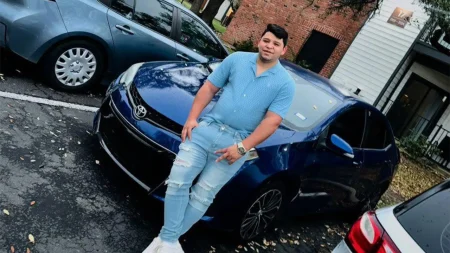



The name Wilber Rafael Garces Perez was not written on many signs before Sunday. It was not part of Austin’s political vocabulary, nor did it appear in the social media feeds of people who had never met him. But in a few hours, it became a name attached to a terrible question. Wilber, a Venezuelan immigrant who had made his way to the Texas capital in search of something so many people take for granted—stability, work, a future—was shot on Sunday after a traffic stop. The exact sequence of events remains unclear. What is known is that a police encounter that should have been mundane and brief ended in gunfire. The shooting has already drawn an urgent response from local officials, who are asking for a transparent investigation. They want to know why a traffic stop led to the use of force. They want the facts to be made public, not hidden behind procedural language. They want the community to see the evidence and judge for themselves whether what happened was justified. But underneath that institutional language, there is a quieter and more painful reality. Wilber Rafael Garces Perez is a human being. He has a history. He has a family. He has, perhaps, a particular laugh or a way of looking at the horizon when he misses Venezuela. The shooting is not just an incident; it is a rupture in a life and in the life of a community. The word “immigrant” often flattens a person into a category. It makes a man a statistic. It hides the fact that he grew up somewhere, went to school somewhere, and loved people somewhere. Wilber’s journey from Venezuela to Texas was not a simple transaction. It was long and costly, through countries and checkpoints where travelers are sometimes treated as burdens rather than human beings. He came with the hope of earning an honest day’s wage and walking home without fear. To lose that hope on an Austin street, after being pulled over for a traffic matter, is a tragedy that no policy document can fully capture. The investigation will follow its course. The body cameras, if they exist, will be viewed. The official reports will be written. But the family and friends left behind are not waiting for a file; they are waiting for a son, a brother, a father, a friend, and their lives will not be the same no matter what the next report says.
To understand Wilber’s presence in Austin, one must first understand what happened to Venezuela. The country that once had a strong middle class and a sense of possibility has been broken by years of economic collapse, political violence, exodus, and scarcity. Basic goods—medicine, cooking oil, milk—became luxuries. Hospitals stopped functioning. Electricity and water became unreliable. People began leaving by the millions, on foot and by bus, carrying what they could fit into a single backpack. The journey north is extraordinary in its difficulty. It crosses mountains and rivers, passes through countries that are themselves struggling, and often ends at a border where people must wait for a legal process or choose an alternative path. Those who finally arrive in the United States are usually exhausted, but they are not broken. They find work in construction, in restaurants, in landscaping, in the homes of families who do not think about the journey that brought these workers to their doorways. They learn English in their spare time, send money back to relatives, and try to rebuild a fragment of what was lost. In Austin, a growing community of Venezuelans has become part of the city’s texture. They are often invisible—until a news report mentions one of them. Wilber was part of this community. A traffic stop is a moment that can turn a hard-earned sense of security into dust. For someone from another country, especially one in which police forces have been militarized and corrupted, the sight of flashing lights in the rearview mirror may trigger something deeper than annoyance. It can trigger a primal fear of being misunderstood, detained, or simply erased. This fear is not irrational. It is the accumulated memory of all the stories of people like him, people who made one mistake and never recovered.
Sunday was not a day that began with tragedy. Maybe Wilber woke up late, made coffee, checked his phone for messages from home. Maybe he drove to a familiar place, thinking about the week ahead, about bills, about a conversation he had had with someone he loved. Then, somewhere in the rush of traffic, an officer found a reason to turn on the lights. We may never know whether it was a broken light, a missed turn signal, or something else. But the moments that followed turned a small mistake, or a mere coincidence, into the most important moment of Wilber’s life. The encounter must have had a rhythm of its own—words exchanged, hands moving, a license or documents requested, the atmosphere in the car growing tenser. What turned that tension into violence is exactly what the investigation is supposed to discover. But the result is already part of the world: a gunshot, a body falling, a street suddenly transformed into a crime scene and a place of grief. The sound of sirens after the shot would have been strange. The people who live nearby might have looked through their windows and seen the unmistakable shape of a police vehicle, an ambulance, yellow tape. Maybe they held their breath. Then someone, somewhere, received the news. A phone call. A text message. The words “he was shot” landing like a stone. The family and friends will carry that moment forever. For them, the details of the investigation are not merely procedural; they are the story of how the world changed in an instant. They will need to watch the video, if it exists. They will need to hear the audio. They will need to understand, not for the city’s sake, but for their own inner peace, why their loved one became a headline.
By Monday morning, Austin was no longer silent. The initial calls for a transparent investigation were issued by local officials whose jobs require them to respond to a public that is exhausted, frightened, and skeptical. They spoke about releasing footage from body cameras, about gathering witness statements, about ensuring that the investigation would not be conducted only by the same police force that employed the officer involved. The word “transparency” was repeated like a kind of prayer. It is a word that sounds administrative, but underneath it is a demand for something very human: the right not to be lied to, not to be hidden from, not to be told that a person’s life can be ended without explanation. For immigrant communities, the demand is even sharper. They have seen this movie before. They have watched cases in other cities in which official narratives shifted, evidence disappeared, and the reality of a shooting was buried under layers of institutional protection. They will not accept a closed-door review. So they have begun organizing vigils, writing open letters, convening emergency meetings in living rooms and small storefronts. They have learned, through painful experience, that the only way to force American institutions to pay attention is to refuse to be invisible. Wilber’s name, they say, must not become just the next hashtag, disappearing after a news cycle. It must become a reason for change. It must become a measure of whether the city’s promises have any real content. The local officials who have called for transparency are not doing anyone a favor. They are acknowledging that a police-involved shooting in which an immigrant was shot is a test of the entire community’s moral character.
All of this happens within a broader national pattern that cannot be ignored. Traffic stops are among the most common points of contact between police and civilians. They are also, for reasons that have been documented again and again, among the most dangerous. The driver is in a vulnerable position, isolated in a vehicle, unable to control how the officer perceives him. The officer, for his part, may be uncertain about what is on the other side of the window. The combination is volatile. When the driver is an immigrant, the volatility can be magnified. Language barriers can make ordinary commands sound like accusations. A moment of confusion—the driver reaching for a document, the officer interpreting that movement as a threat—can produce a deadly escalation in seconds. This is not a question of evil intentions in every case; it is a question of training, assumptions, and procedures. It is the reason why so many reform advocates argue that officers should be trained to disengage, to lower their voices, to wait an extra second before reaching for a weapon. It is also why independent oversight matters. No police department should be the final judge of its own use of force. The public, especially the immigrant public, must see that there are consequences for a wrongful shooting. On a larger scale, Wilber’s story is part of the story of a continent in motion. The Venezuelan diaspora is the largest that the Western Hemisphere has seen in a generation. Between a broken economy and the rise of a political system that has punished dissent, everyday life in Venezuela became unsustainable. Those who leave are not abandoning their country; they are trying to survive. When they cross into the United States, they should be met with the country’s best traditions: refuge, fairness, compassion. Instead, too often they encounter suspicion and fear. A traffic stop must not become a trap door.
At this point, the entire story could easily be reduced to policy debates. But the deeper truth is human. Wilber Rafael Garces Perez is not an abstraction called “the Venezuelan immigrant.” He is a man whose name we should remember the way we remember any neighbor’s name. He was a person who existed before the traffic stop, with a family tree, a school yard, a favorite dish, perhaps a memory of a particular place in Caracas or another Venezuelan city. He left all of that behind because he wanted a chance to live with dignity. He did not ask for a dramatic role in the great American conversation about immigration and policing. He only wanted a life. That life was interrupted, suddenly and violently, on a Sunday after a traffic stop. The investigation, if it is genuine, will reveal some truth. But the close of the investigation should not be the end of the community’s concern. The same energy that brought people to vigils must now be carried into city council meetings, into voting booths, into conversations with friends who have never known what it is like to fear a police car. A name can become a movement. But it should first be a reminder that all people—citizens, immigrants, legal residents, new Americans, and even those still waiting for a judgment of their papers—are equal in their fragility and worth. If Wilber Rafael Garces Perez is to be remembered, it should be as a call to conscience. The silence that used to cover such tragedies must be replaced by light: the light of inquiry, the light of accountability, and the light of a community that refuses to let an ordinary traffic stop become the last chapter in anyone’s life.