

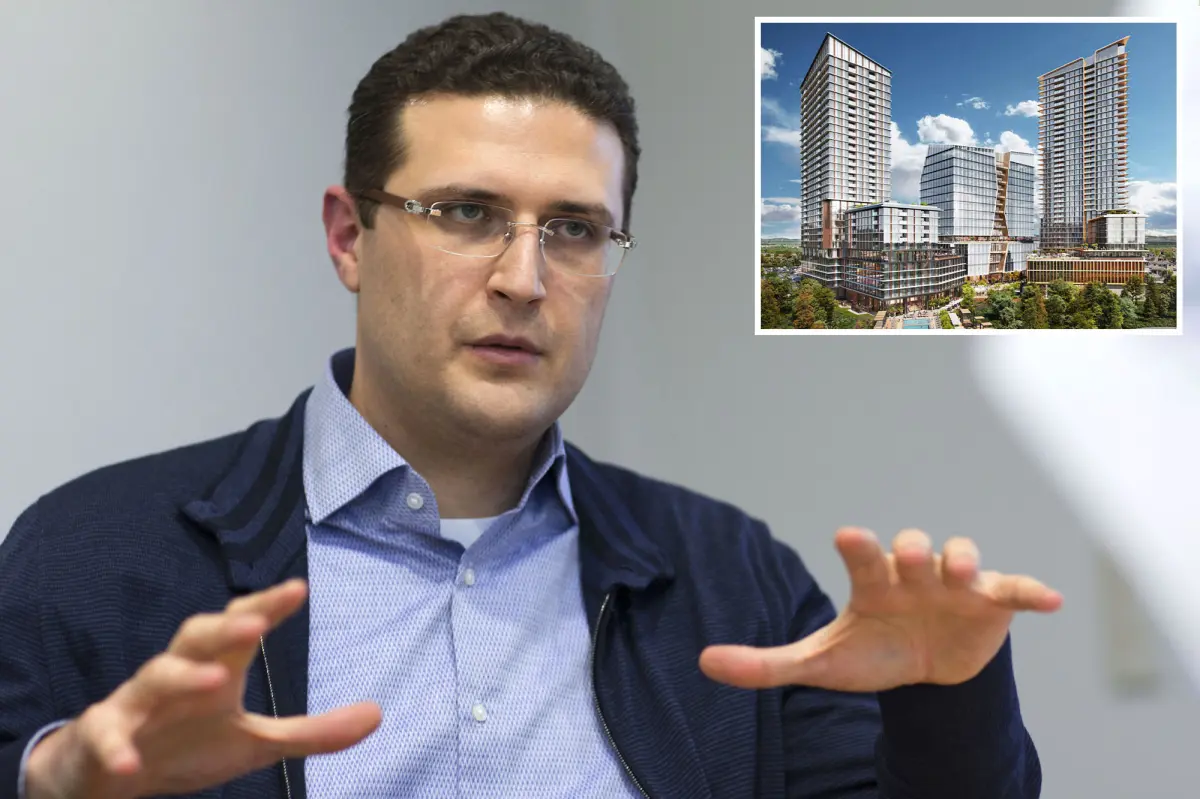
In the quiet, tree-lined streets of Menlo Park, a place better known for venture capital offices, leafy neighborhoods, and the storied former home of Sunset magazine, a towering controversy is taking shape. At 80 Willow Road, on the seven-acre property where the beloved lifestyle magazine once welcomed readers into a world of West Coast charm, a developer hopes to build a massive 39-story tower. But the project is now tangled in something far more complicated than zoning rules or neighborhood objections: international sanctions, Russian oligarch money, and the long shadow of Vladimir Putin. The property is owned by Vitaly Yusufov, a Russian investor whose father, Igor Yusufov, is a former Russian energy minister with close ties to the Kremlin. The father has been sanctioned by Ukraine and Canada, and Vitaly himself faces sanctions in Ukraine. As the United States and its allies have cracked down on wealthy Russians linked to Putin, the question hovering over this Silicon Valley construction site is whether those sanctions, or the fear of them, could stop the project before a single shovel hits the ground. It is a story about geopolitics colliding with local life, and about how a city’s fight over shadows, traffic, and skyline may ultimately be decided by global power struggles far beyond the council chambers.
The details of the plan are staggering, especially for an area that has long prided itself on a more modest, suburban character. Yusufov bought the property in 2019 for $72 million, and his vision includes 665 apartments, a hotel, office space, and a preschool, all spread across three towers. The tallest of those towers would soar 461 feet, making it the tallest building between San Francisco and Los Angeles. For many residents, the very idea is a shock to the system. Menlo Park is a city of single-family homes, oak trees, and open sky; a skyscraper of this scale feels less like development and more like an invasion. The project has already drawn fierce local opposition, with residents worried about the loss of sunlight, the increase in traffic, the character of their downtown, and the precedent it would set for the entire region. But the unusual twist here is that the developer at the center of it all is not just another real estate mogul. Vitaly Yusufov is the son of Igor Yusufov, a man once listed by Forbes with an estimated net worth of about $1.1 billion, who founded an investment vehicle called Fund Energy after his time as Russia’s energy minister. The father’s connections to Russian power have made him a target of international sanctions, and those sanctions are now creating a legal and political cloud over the son’s ambitious real estate project in California.
Sanctions are a powerful and often misunderstood tool. The U.S. Department of the Treasury’s Office of Foreign Assets Control, known as OFAC, describes them as restrictions that can block individuals and entities from engaging in certain trade, financial transactions, and can also lead to the freezing of assets. In practical terms, being sanctioned can mean that a person’s money becomes toxic, that banks refuse to do business with them, that property cannot be sold or leveraged, and that even everyday financial arrangements become nearly impossible. For a large real estate development, where financing, construction contracts, insurance, and leasing all depend on clean and traceable money, sanctions can be a death sentence. The threat to the 80 Willow Road project is not necessarily that OFAC has already placed Vitaly Yusufov on its most wanted list; rather, it is that the broader sanctions environment around his family and the political pressure building in Washington could make the project untenable. Some residents are so concerned about the ownership that they are preparing to raise the matter with the Committee on Foreign Investment in the United States, the federal body that reviews foreign investments for national security risks. The idea is that a project financed by a family so closely connected to the Kremlin should not be allowed to proceed on prime American soil, especially when the father is already sanctioned by allied nations.
The local opposition has been vocal, emotional, and determined. At public meetings, residents have spoken with the kind of passion that only people who love their town can muster. “I urge you to fight the 80 Willow project despite the risk of massive legal fees,” said resident Maria Kleczewska. “This project will be the ruin of our beautiful city.” Her words reflect a broader sense of loss: not just the loss of a particular view or a particular street, but the loss of a way of life. Another resident put the question directly: “How many residents will be looking at that monstrosity from their streets and yards instead of the open sky and trees that we love to see? How many houses will be in shadow? How many streets will experience a dramatic increase in traffic?” The frustration is not just about aesthetics, though. It is about power. Residents feel that the developer is pressuring the city, that the state is overriding local decision-making, and that the ordinary people who live here are being treated as obstacles rather than stakeholders. One resident pointedly told the council to push back: “Argue back at the Attorney General. He ain’t the only lawyer in town. Reject the developer’s deadline. Who died and made him God?” The raw anger in those words captures the mood of a community that feels it is being steamrolled by forces much larger than the neighborhood.
The legal battle has only intensified the pressure. In late July, California Attorney General Rob Bonta’s office sent a letter to Menlo Park, saying the city had improperly changed its justification for rejecting the proposal. The state’s intervention was based on Assembly Bill 712, a relatively new state law designed to strengthen enforcement against local governments that fail to comply with California housing laws. In effect, the state was telling the city that it could not simply say no to a housing project, especially at a time when California faces a severe housing crisis. Then, on August 3, the developer behind the project, Oisín Heneghan, sent the city council a letter of his own, arguing that under the law, the project must be approved by October 27. The message was clear: the developer is using state housing mandates as leverage, and the city is being asked to either approve the project or face legal consequences. For Menlo Park, this is an impossible bind. Approve a project that many residents despise and that has troubling ties to sanctioned Russian billionaires, or fight the state and risk millions of dollars in legal fees and a potential court loss. And all the while, the sanctions issue hangs overhead like a shadow. If the federal government were to impose sanctions directly on Vitaly Yusufov, or if the Committee on Foreign Investment in the United States were to step in, the project could stall or collapse entirely. The city council, however, has so far been cautious about invoking that possibility. Councilmember Drew Combs told the Palo Alto Daily Post that city officials have not contacted OFAC or the office of Representative Sam Liccardo about potentially seeking sanctions against Vitaly Yusufov. That suggests the city is walking a careful line, not wanting to appear to be weaponizing foreign policy while also not ignoring the issue.
This strange intersection of local land use and international sanctions reflects a much larger moment in American life. Since Russia’s invasion of Ukraine, Washington has scrutinized the financial and political activities of wealthy Russians with ties to Putin like never before. The days when oligarchs could quietly buy luxury real estate in American cities without questions are fading. Sanctions, once a narrow tool of diplomacy, have become a central weapon in economic warfare, and their effects ripple out into unexpected places. A property owner in Menlo Park may have bought his land in good faith, with grand plans and legitimate financing, only to find that the geopolitical tide has turned against him. The former Sunset Magazine headquarters, a place that once symbolized California dreaming, now sits at the center of a very modern nightmare involving national security, foreign money, and the limits of local control. The residents who look up at the cranes and the blueprints are not just worried about traffic and shadows; they are asking a deeper question about who gets to build the future, and in whose interest. The developer sees a historic opportunity to create housing and economic vitality in a region starving for both. The state sees a test of its housing laws and its commitment to breaking local resistance. The federal government sees a potential national security concern. And the people of Menlo Park see their home, their trees, their streets, and their sky, all hanging in the balance. For now, the project remains in limbo, caught between a state deadline, a skeptical city, a furious public, and an international sanctions regime that could change everything. The tower on Willow Road may never be built, or it may rise and transform the city forever. But whatever happens, the story is no longer just about a building. It is a story about how global power and local democracy collide, and about how a single piece of land can become a flashpoint for questions that have no easy answers.