



In a city where restaurants are expected to know their place, Jean’s has always been the loud, glittering exception. From the moment it burst onto the NoHo scene, this place made it clear that it wasn’t interested in the polite, predictable rhythms of a normal dining room. It’s a spot where dinner can dissolve into a dance party, where the line between a meal and a rager gets blurry, and where the usual rules simply don’t apply. Over the years, the venue has earned a reputation for gloriously over-the-top antics: guests have been known to ride motorcycles straight through the front doors, turning the entrance into part of the spectacle. The energy is deliberately chaotic, always hovering somewhere between high-fashion soirée and downtown underground club. That vibe isn’t accidental. Jean’s was built to feel like a never-ending wedding, with all the abandon, joy, and unpredictability that implies. A little bite, a little drink, a little dance, and somehow it all happens at once, in one beautiful, crowded, slightly sweaty room. People don’t come here just to eat; they come to be part of something that feels dangerously alive. It’s a setting where the usual boundaries between guest and performer, dinner and party, fancy and grimy, all get happily erased. So, perhaps it was only a matter of time before New York’s street vendors—those iconic Canal Street voices hissing “designer bag, nice bag, very cheap”—became part of the controlled chaos. If Jean’s is a love letter to the city, then why not include every messy, vibrant corner of it? That’s exactly what happened over the weekend, and the result was one of those only-in-New-York nights that seem to exist just to remind you why you put up with the rent and the subway and the noise.
The occasion was the latest installment of DOJOPOMODORO, Jean’s notoriously rowdy late-night party, and this time the guest list included the bootleggers who usually set up shop along Canal Street. On Saturday night, vendors who are more accustomed to dodging police on the sidewalks of Lower Manhattan found themselves standing on the other side of the velvet rope, hawking counterfeit Louis Vuitton totes, Prada crossbodies, and every knockoff imaginable to the stylish, buzzing crowd waiting to get inside. It was a surreal, perfectly ridiculous scene: the same bags that get plastered across five-cent postcards and draped over folding tables in Chinatown were suddenly part of the nightlife ecosystem at one of downtown’s most exclusive rooms. The party didn’t stop at the sidewalk, though. As the night wore on, the knockoff designer bags made their way downstairs, slipping into the club, appearing on shoulders and dangling from hands as the dance floor filled to capacity. Jean’s co-founder John Fiorentino, who is also the founder of creative agency Volta, captured the magic of the moment on X, writing, “Jean’s is all about serving and celebrating the true essence of New York City. So we brought a few Canal Street vendors to set up in front of our doors and sling designer knockoffs to the people in line.” If that sounds like a chaotic joke, it kind of was—but it was also deeply sincere. The dance floor, as he noted, was packed with proper counterfeit Louis and Prada all night long. The vendors didn’t just stand outside; they became part of the event, adding a layer of authentic street hustle to an evening that was already stretching the definition of what a restaurant can be. For a place that has always thrived on mixing high and low, this was less an aberration than a logical, inevitable evolution.
To understand why this moment felt so perfectly at home, it helps to know a little more about Jean’s and how it came to be. The restaurant opened its doors in 2023 at 415 Lafayette Street, taking over the storied former Butter space, a venue that already carried its own nightlife mythology. The project was spearheaded by Max Chodorow, son of veteran restaurateur Jeffrey Chodorow, alongside Ashwin Deshmukh, and it quickly established itself as one of downtown’s buzziest openings. The setup is a study in duality: upstairs, there’s a farm-to-table bistro serving thoughtful, seasonal plates; downstairs, there’s an ultra-exclusive nightclub with a no-frills disco ball spinning over a crowded, checkered dance floor. The juxtaposition is deliberate. You can come for a refined dinner, then descend into something far more primal, where the music thumps and the room moves as one sweaty, euphoric mass. It’s that friction that makes Jean’s so magnetic. Max Chodorow once told The Post that the goal was to build a place that feels like a never-ending wedding: “A little bite, a little drink, a little dance.” That formula has proven irresistible. On any given night, the upstairs hums with conversation and the clinking of glasses at tables, while downstairs, a crush of guests presses toward the club, hoping to get past that velvet rope. The parties are legendary: celebrity-filled, fashion-forward, packed with the kind of people who make downtown feel like the center of the universe. It’s the kind of place where you might spot a tech billionaire waiting by the door or a supermodel slipping through the crowd. But for all its exclusivity, Jean’s has always maintained a certain irreverence—it doesn’t take itself too seriously, and that’s exactly why it feels so authentically New York. It’s playful, a little dangerous, and unafraid to laugh at the very scene it inhabits. Bringing Canal Street vendors into that world wasn’t an act of desperation or a publicity stunt; it was an extension of the restaurant’s core personality.
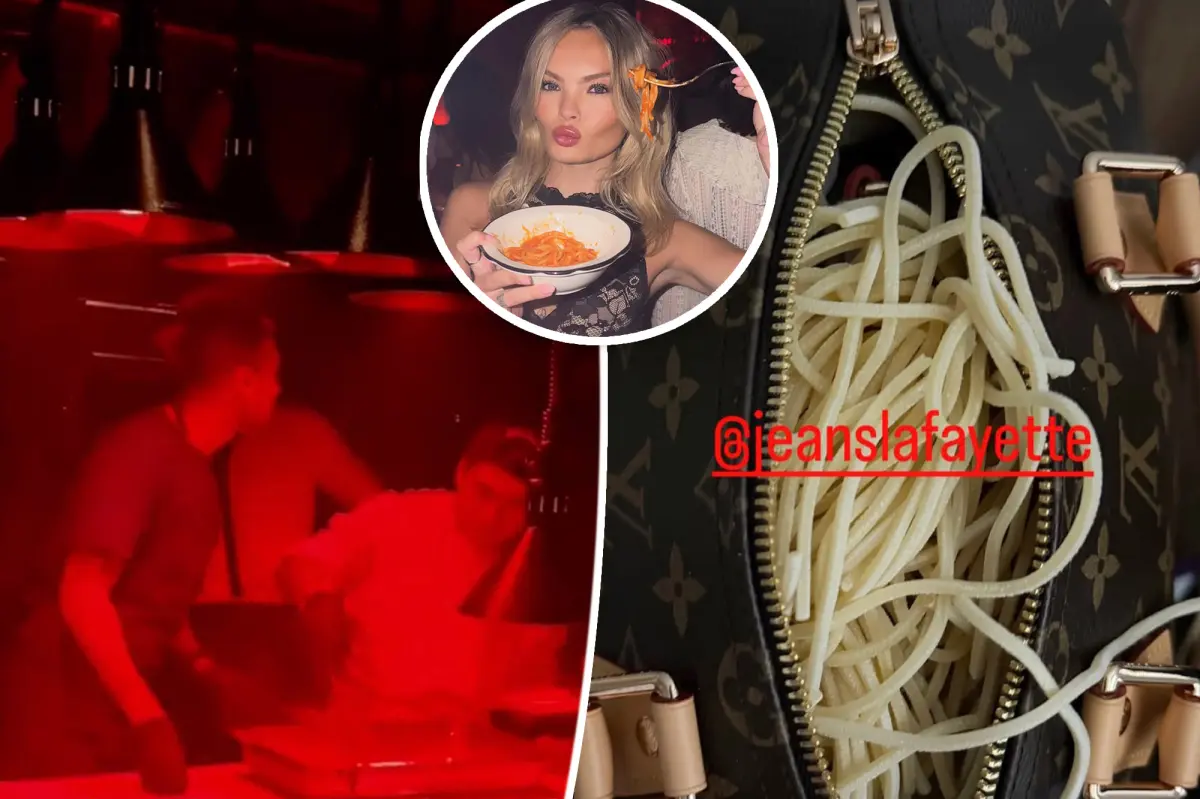
DOJOPOMODORO, the event that hosted this glorious collision, has become something of a fixture in its own right. The party, which is put together alongside Orson & Danya Zelikovsky, has twice taken over legendary venues like Boom Boom and Soho Beach House during Art Basel, where it earned a devoted following among the art-and-nightlife set. The concept is simple in its excess: music, dancing, and bowls of pasta passed through the crowd at unholy hours. The name itself is a mash-up of styles, evoking both a certain Italian-American restaurant feeling and the irreverent energy of a pop-up event. The marinara or pomodoro sauce features tomatoes grown on Chodorow’s own farm in New Hope, Pennsylvania, which adds a charmingly homegrown touch to an evening that is otherwise all glitter and bass. Previous editions of the party have featured a lineup of legendary DJs and taste-makers: Mona Matsuoka and DJ Ross-One have held court, as have Nicky Siano of Studio 54 fame and Greg Wilson from the UK. These are names that carry serious cultural weight, the kind of people who don’t just play music but shape the atmosphere of an entire era. Yet despite that pedigree, DOJOPOMODORO doesn’t feel precious. It’s a mess in the best way—a dance floor packed with revelers who are simultaneously trying not to spill their pasta and also completely losing themselves to the beat. One fan captured the absurd beauty of it all in a TikTok post: “Go to the club that serves you pasta at 2 am.” For the regulars, this is the whole point. Olivia Salomone, who is both a regular at Jean’s and, on occasion, a legal representative for the venue, goes out of her way to attend DOJOPOMODORO whenever it happens. She knows the door isn’t guaranteed, but that’s part of the appeal. As she told The Post, her friends fly in from Milan and Paris for it. She once saw Jensen Huang, the co-founder of NVIDIA, standing at the door. There is, she said, nothing else like it anywhere. And she’s probably right. Where else can you stand shoulder-to-shoulder with tech CEOs and fashion insiders while eating pasta off a paper plate and dancing to a legendary DJ spinning at two in the morning?
At the heart of all this controlled chaos is a genuine philosophy about what makes New York City special. A member of the Jean’s team once put it plainly: “The most important thing to us is the mix. That’s New York. Everyone leaves the Temu country clubs to rub up on strangers with us.” That sentence says more than any marketing campaign ever could. It captures a deep, almost nostalgic hunger for physical proximity, for the strange and thrilling intimacy of being packed into a room with people you don’t know, people who don’t look like you, people who are there for the same inexplicable reason you are: to feel something real. In an era where so much of social life has migrated online, where VIP sections are designed to keep people apart, and where exclusivity often means isolating yourself from the crowd, Jean’s has gone the opposite direction. It wants the friction. It wants the mess. It wants the weird mix of tourists and artists, financiers and skateboarders, downtown lifers and out-of-town invaders. The restaurant and nightclub exist in a constant state of blur; the line between the upstairs bistro and the downstairs club all but disappears as the night wears on. Pasta starts making its way through the crowd, DJs keep the room moving, and suddenly everyone is part of one enormous, celebratory organism. There is something profoundly democratic about that vision, even within the velvet ropes. Yes, there are guest lists and exclusivity and famous faces, but once you’re inside, the hierarchy dissolves into a shared physical experience. You’re all dancing on the same checkered floor, all holding plastic cups, all dodging elbows and singing along. That’s a rare thing in a city that can often feel brutally segmented by money, status, and neighborhood. Jean’s actively rejects those divisions, at least for the duration of a night, in favor of something messier and more alive.
Saturday’s Canal Street cameo took that ethos and made it literal. It folded one of New York’s most recognizable sidewalk scenes—the knockoff handbag vendors, the booming whispers of “Prada, Gucci, Fendi,” the nervous glances for police—into one of downtown’s most notoriously hard-partying rooms. On the surface, it was absurd: high-fashion counterfeiters standing outside a hotspot where the real version of those bags are likely being carried inside by the wealthiest guests. But that absurdity was exactly the point. Jean’s has always understood that New York City is a place of contrasts, and that those contrasts are what give the city its electricity. The vendors weren’t there to be mocked or romanticized; they were there because they are part of the texture of the city, just as much as the disco ball and the DJ booth and the farm tomatoes from Pennsylvania. For one night, the luxury economy and its shadow economy met and partied together, and somehow it worked. The knockoff bags got their moment on the dance floor, the vendors got a stage unlike any they’d ever had, and the guests got a story they’ll tell for years. At its core, Jean’s is a celebration of New York in all its contradictions: high and low, polished and gritty, exclusive and inclusive at the same time. It’s a place where the city’s most stylish and its most streetwise can stand on the same sidewalk, watch the same spectacle, and find a way to dance together. That’s not just a party trick. That’s a vision of what a restaurant can be—not just a place to eat, but a place where the city’s chaotic, beautiful soul gets to show up and play. And as the night wound down and the vendors packed up their bags, the oddest thing happened: the line between counterfeit and couture didn’t matter anymore. What mattered was that everyone had been part of something rare, something generous, something that didn’t just serve dinner but served the full, gloriously imperfect essence of New York.