

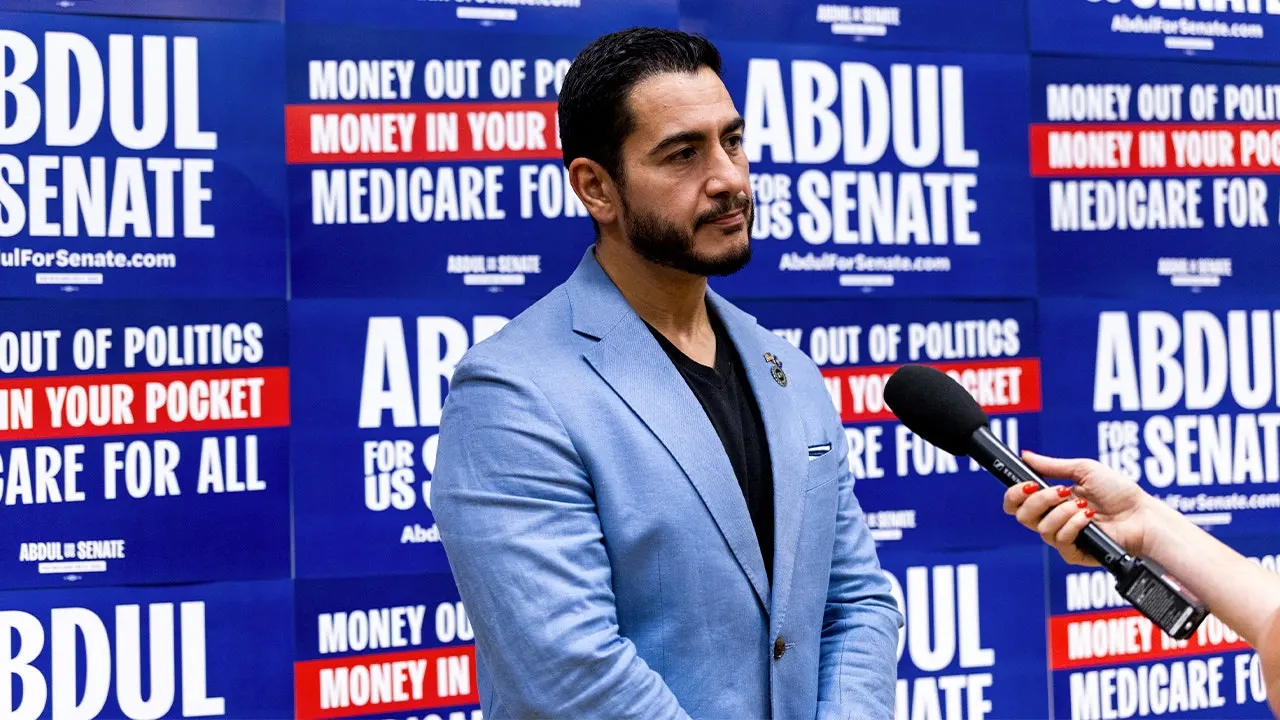
Let’s start with something strange about how Washington works: a U.S. senator can walk into a classified briefing room and hear some of the country’s most guarded secrets without ever going through the kind of security clearance a low-level Pentagon analyst would need. There’s no FBI background check specifically for the role, no polygraph, no formal review of foreign contacts, bank accounts, or travel history. The system simply assumes that being elected to the Senate is enough. That’s why Abdul El-Sayed, the Democratic nominee for Michigan’s open Senate seat, is getting so much scrutiny from conservative national-security voices. If he beats Republican Mike Rogers in November, he won’t need a clearance to be read into covert programs or to receive intelligence reports on adversaries. He’ll get that access because he holds office. For many experts, that’s concerning not because El-Sayed is a Democrat, but because of who he’s surrounded himself with. Over the years, the public-health doctor turned politician has appeared with people who’ve praised Hezbollah, celebrated Hamas’s Oct. 7 attack, minimized the Holocaust, and even said America “deserved 9/11.” None of that would matter much if he were a local official, but the Senate is different. Senators oversee the intelligence community. They get briefed on sources and methods. They learn where the bodies are buried, literally and figuratively. Giving that kind of access to someone whose political circles tolerate or cheer for anti-American terrorism is, in the words of critics, not a hypothetical worry—it’s a national-security red flag. The concerns are coming from serious people, too: counterterrorism experts, former congressional staffers, and legal scholars who have spent their careers watching how foreign powers try to influence Congress. They all seem to be asking the same question: what happens when a senator with questionable associations gets to hear the country’s deepest secrets, and nobody has ever vetted him?
The worry isn’t coming out of nowhere. El-Sayed has a documented pattern of appearing with and accepting support from people who have said truly disturbing things about America, Israel, and terrorism. At an April campaign rally, he was introduced by Amir Makled, a man who had previously celebrated dead members of Hezbollah—“martyrs,” as Makled put it. Hezbollah is a U.S.-designated foreign terrorist organization. A few months later, at a mosque opening, El-Sayed shared a stage with Sheikh Fadhel al-Sahlani, a cleric who praised Hamas’s Oct. 7 attack and who has made remarks minimizing the number of Jews killed in the Holocaust. El-Sayed also accepted an endorsement from Osama Siblani, who has publicly praised both Hamas and Hezbollah. And then there’s Hasan Piker, the immensely popular Twitch streamer who once said America “deserved 9/11.” El-Sayed has been friendly with Piker, appeared with him, and only after being pressed did he call that statement “dumb.” He distanced himself somewhat, but he stopped short of a full disavowal. That’s the problem, critics say. If you’re running for the United States Senate, you should be able to say clearly that someone who celebrates the worst terrorist attack on American soil has no place in your orbit. El-Sayed’s own record suggests he values the far-left online energy that Piker brings more than he values clean national-security hands. Daniel Samet, a Middle East policy research fellow at the American Enterprise Institute, put it bluntly: anyone who refuses to disavow an America-hater like Piker should never be elected to Congress. Samet argued that El-Sayed has shown sympathy for radical Islamist ideology and has surrounded himself with people who support intifada and terrorist causes. That may sound harsh, but in a Senate race, it’s a fair question: what does a candidate’s choice of friends and allies say about how they’ll handle classified intelligence? In any other part of the government, these connections would at least trigger a deeper look. In the Senate, there’s no such trigger.
El-Sayed and his campaign see all this differently. When Fox News Digital asked about the concerns, campaign spokesperson Cole Wozniak didn’t really address the controversial figures. Instead, he turned the attack on Republican opponent Mike Rogers. Wozniak said Rogers spent his entire career selling out Michigan and directly profited off “shady business dealings with foreign companies.” He claimed Rogers made hundreds of thousands of dollars working for companies that partnered with Chinese firms posing national-security threats to the U.S., and that Rogers worked for a Saudi-linked company that pushed for regulations that could have enabled Saudi Arabia to develop nuclear weapons. The implication was clear: how dare anyone question El-Sayed’s loyalty when Rogers has his own tangled international business history? It’s a classic political counterpunch, and it has some basis in fact. Rogers did work in the telecommunications industry after his time in Congress, and some of those companies had business dealings involving Huawei, the Chinese telecom giant repeatedly accused of spying. Still, while serving in the House, Rogers was a vocal critic of Huawei, which complicates the idea that he was secretly cozy with Beijing. The Saudi nuclear angle is even murkier. Rogers worked with a Saudi-linked firm that drew criticism over its efforts to transfer nuclear energy technology to the kingdom, but the details are complicated and not as black-and-white as the campaign ad makes them sound. The Rogers campaign didn’t respond to a request for comment when reached by Fox News Digital, so those charges are just hanging there. But for national-security hawks, this back-and-forth misses the point. They’re not saying Rogers is a saint. They’re saying El-Sayed is the one who could end up with a Senate seat, a security clearance by default, and a history of standing next to people who celebrate terrorism and hate America. Deflecting to the other guy doesn’t make those associations disappear, and it doesn’t change the fact that El-Sayed would be one vote away from classified briefings on covert operations, foreign adversaries, and America’s most sensitive defense secrets.
Then there’s the family component, which is awkward but impossible to ignore. El-Sayed’s half-sister posted what was described as an “October 7th blessing” on the one-year anniversary of the Hamas attack that killed some 1,200 people in Israel, many of them civilians, and led to the taking of hostages. That’s not a vague political disagreement. To critics, it’s glorifying an act of terrorism. El-Sayed previously told Fox News Digital that he loves his sister and that the two have disagreements when it comes to foreign policy. His campaign also stressed that no one speaks for El-Sayed except El-Sayed himself. That’s fine, but the half-hearted response leaves a bitter taste. If a close family member is publicly blessing the worst massacre of Jews since the Holocaust, wouldn’t you want to say something more forceful than “we disagree on foreign policy”? The broader issue, though, is bigger than El-Sayed’s family. Conservative activists point to a whole ecosystem of far-left organizations and candidates that seem to be moving in the same direction. Ashley Hayek, president of America First Works, told Fox News Digital she thinks the problem doesn’t stop with El-Sayed. She pointed to candidates being supported by groups like the Democratic Socialists of America, the Working Families Party, UnidosUS, and the Party for Socialism and Liberation. She said a lot of those groups are tied together and funded by the same people, including billionaire Neville Singham. A 2023 New York Times investigation identified Singham as a major funder within a network of activist organizations that the newspaper reported had connections to pro-Beijing messaging. So the fear is that El-Sayed isn’t just one oddball candidate. He might be part of a broader political wave that is comfortable with alliances that undermine American interests. If that wave keeps winning, more and more people with questionable ties will end up in positions where they automatically get access to classified information—without anyone having checked their homework.
This isn’t a hypothetical problem, either. We know what happens when a senator uses their office to benefit a foreign power, because it happened very recently. Former Democratic Senator Bob Menendez of New Jersey was prosecuted and convicted in 2024 for essentially acting as a foreign agent for Egypt. Prosecutors laid out an appalling story of bribes—cash, gold bars, a luxury car—exchanged for using his Senate power to benefit the Egyptian government. In 2025, he was sentenced to eleven years in prison. Bryce Poole, a senior legal fellow at Advancing American Freedom and a national-security law specialist, made the point that Menendez didn’t necessarily share classified information with the Egyptians. What he shared was non-public, sensitive information that he only had access to because he was a senator. That’s the danger. The Senate’s unique exemption from the formal clearance process means there’s no systematic review of a member’s foreign contacts, personal finances, or potential vulnerabilities. Voters are supposed to be the filter, but voters don’t know what the intelligence community knows. Members of Congress are given access to classified information because the Constitution and the separation of powers require them to oversee the executive branch. But that same trust can be exploited. Foreign intelligence services understand this better than anyone. They don’t need to turn a senator into a spy who steals documents. They just need to find a senator who is careless, arrogant, or sympathetic enough to share things they shouldn’t. They can use campaign donations, family connections, business deals, or ideological affinity. And because there’s no security-clearance process for senators, there’s no early-warning system that might catch those vulnerabilities before they become national-security disasters. As Poole said, this is not just a hypothetical problem. It’s happened before, and it can happen again.
At the end of the day, this isn’t really about banning someone from the Senate or stripping Congress of its constitutional role. It’s about asking whether voters in Michigan are comfortable with the trade-off they’re making. Abdul El-Sayed would take an oath to support and defend the Constitution, but he would also bring with him a history of embracing and being endorsed by people who cheer for America’s enemies, who praise terrorist groups, and who mock the very idea of American patriotism. His defenders will say he’s a progressive physician who cares about public health, economic fairness, and lowering costs for working families. Maybe that’s true. Everyone is capable of both good intentions and bad choices. But the national-security concerns aren’t fringe paranoia. They come from people who have spent their careers thinking about how foreign powers infiltrate democratic institutions. They know that the first step to being compromised is surrounding yourself with people who have no business being near secrets. They also know that a senator doesn’t have to be an enemy agent to do enormous damage. Sometimes a little carelessness, a little too much trust in the wrong person, and a little too much desire to please your base is enough to put American lives at risk. The security-clearance process exists for a reason. It’s not perfect, but it catches things. It forces people to disclose their ties, explain their foreign contacts, and answer awkward questions about their associations. The Senate doesn’t have that filter, which makes every Senate race, in a sense, a national-security decision. Michigan voters will have to decide whether El-Sayed’s relationships are just the messy reality of modern politics or something genuinely dangerous. The rest of the country will be watching, because the person they send to Washington will be getting briefings that could decide whether the United States stays safe in a very dangerous world. That’s a lot of power to hand to someone who couldn’t bring himself to fully disavow a man who said America deserved 9/11.