



A year ago, Donald Trump’s followers had something almost magical: faith. Not just political faith, but a kind of commercial faith that could turn air into money. The president didn’t need to build factories or invent products. He just needed to float his name over a venture, and thousands of believers would rush to fund it, often with little more than a vague promise. The first and strangest proof was Trump Media & Technology Group, the company behind Truth Social. Public investors valued it at $5 billion even though it was losing nearly $700 million. The arithmetic made no sense, but in Trump’s world, arithmetic was optional. Then came World Liberty Financial, a crypto venture that sold a billion dollars’ worth of tokens in 2025 on the fuzzy idea of “democratizing finance.” Finally, there was the $TRUMP memecoin—a joke currency, literally disclaimered as not an investment—that nonetheless made the president astronomically richer. By September of that year, Forbes calculated his fortune at $7.3 billion, the highest number ever attached to his name in the four decades he’s been on the Forbes 400. For a man who built his brand on the art of the deal, this felt less like business than alchemy. But faith is a fragile currency, and eventually, even the faithful started to look at their portfolios and feel the stirrings of doubt.
One of those doubters was Chad Nedohin, a Canadian worship leader who had become an unlikely captain for Trump Media’s small-time investors. He loved the idea of a social platform free from cancellation and censorship—a digital safe space for conservative Americans. He pushed the stock, rallied the online troops, and genuinely believed. Then the cracks appeared. He watched the company’s business model flounder, the president’s promises go unfulfilled, and the news from Iran take a dark turn. Worse, he found himself wrestling with Trump’s documented connections to Jeffrey Epstein. Eventually, the faith evaporated. “Nothing he says is true,” Nedohin said, with the bitterness of someone who once held the coins. “His only concern in his life is his own wealth and status.” And he wasn’t alone. As believers like Nedohin walked away, the numbers started to collapse. Trump Media’s stock fell by half, erasing nearly a billion dollars from the president’s stake. The memecoin tumbled roughly 70%, taking another $530 million with it. World Liberty tokens sank by 75%, wiping out an estimated $260 million. By the time the dust settled, Trump’s net worth had dipped to $7 billion—still absurdly rich by any normal yardstick, but $300 million lighter than the year before. On the Forbes 400, he slid 44 places to No. 245. The bigger story wasn’t the fall itself, though. It was how far he had already run with the money. Because while his followers were losing faith, Trump had been smart enough—or cynical enough—to turn their temporary devotion into permanent personal wealth.
That’s the part that deserves closer attention. Trump didn’t just sit on inflated paper wealth and pray. He monetized it. Trump Media’s absurdly high stock price became a kind of magic credit card. He used it to raise more than a billion dollars in new capital, then pivoted the company away from its money-losing social app toward crypto, and even promised to chase nuclear fusion—the kind of dramatic science-fiction ambition that keeps retail investors dreaming. Most recently, the company took the playbook one step further, launching a service that looked uncomfortably like selling insider access: high-frequency traders could pay $60,000 to $100,000 a month for faster delivery of the president’s social media posts. Whether that’s technically insider trading or not, it’s a deeply transactional use of presidential speech. Meanwhile, on the crypto side, World Liberty Financial dumped nearly $2 billion of tokens and equity, sending almost $800 million of proceeds directly to Trump. The memecoin added another $600 million in trading fees and token sales. When Forbes tallied it all up, the president’s liquid assets—actual cash and easily sold holdings—jumped from $1.1 billion to $1.9 billion after taxes. In short, while the fanboys lost money holding the bags, Trump cashed out early. He took the faith of the crowd, converted it into billions in fleeting valuation, and then systematically moved it into his own pockets before the music stopped. If there’s a lesson in all this, it’s that in the modern celebrity-economy, the last true believer always pays for the first believer’s dream.
But a man like Trump doesn’t leave his fortune to chance any more than he leaves his dinner to a menu. When the crypto and meme-stock tide began to recede, he found shelter in an older, more traditional empire: his private clubs and golf courses. These are not businesses built on hype or internet virality. They are physical, exclusive spaces where wealthy people pay huge sums for the privilege of being around other wealthy people—and, of course, around Trump himself. And those people have proven remarkably loyal. While everyday traders abandoned Trump Media in droves, the members of Mar-a-Lago have not flinched. Estimated profits at his American golf properties hit $110 million last year, up 21%. Mar-a-Lago alone now churns out an estimated $54 million in annual operating profits, up 63% from a year earlier. That income flow pushed the value of his beloved Palm Beach estate to a record high, and the entire golf-and-club portfolio is now worth an estimated $1.8 billion—half a billion more than last year. The upper-class clientele treats Trump like a king. Liz Fletcher, a former waitress at Mar-a-Lago, remembered the ritual: “When he comes out of his room, everybody stands. They stand clapping until he sits down. And they just kind of fawn over him. And then the members will have their guests, so they have their phones, they’re taking pictures because they’re like, ‘Wow, we’re seeing him in real life.’” That adulation is worth real money. It’s the same devotion that drove people to buy Trump watches, Trump sneakers, and Trump meme coins—but with one crucial difference: the wealthy club members are not expecting the asset to appreciate. They’re paying for access, for status, for a photo, for a nod across the dining room. That’s a much more stable business model than selling hope to day traders.
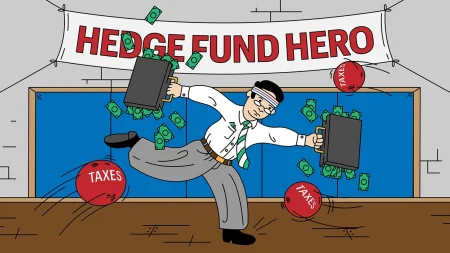
To understand the president’s financial position, it helps to make a ledger of his hits and misses. His liquid assets—cash and near-cash—rose by an estimated $800 million to $1.9 billion. His U.S. golf courses gained roughly $200 million in value, reaching $705 million. His licensing and management business grew to $655 million, up $155 million. Mar-a-Lago, valued at $620 million, gained another $160 million. Even Trump National Doral, that sprawling Miami resort, rose to $365 million, adding $110 million. All of these traditional brick-and-mortar Trump properties performed like a blue-chip portfolio. The misses were just as dramatic, but mostly in the paper-currency realm of internet speculation. Trump Media’s stake plunged from roughly $1 billion to $1 billion in the red column—actually, a drop of $980 million, leaving the company stake at just over $1 billion on paper. The memecoin position fell $525 million, leaving an estimated $185 million. World Liberty tokens sank $260 million, down to just $80 million. Add it all up, and Trump’s total fortune sits at $7 billion—down $300 million from a year ago but still luxurious. The real story hidden in these numbers is the transfer of risk. Trump turned the speculative enthusiasm of his followers into personal cash, then parked that cash in assets that don’t fluctuate with tweet volume: membership dues, initiation fees, real estate, licensing royalties. It’s a stunning evolution for a man who once made his name with glass towers and golden branding. In a way, he’s become his own private equity firm, using public hype as acquisition capital and private clubs as a fortress of compounding cash flow.
Now, though, comes the hard part. Trump wrote the modern playbook for how to turn political power into personal billions. His presidency gave him a platform unlike any in human history—a direct connection to tens of millions of people who would gladly spend real money just to feel close to him. He leveraged that connection shamelessly and brilliantly, converting loyalty into liquid wealth in a way no American president has ever attempted. But popularity is a volatile asset, and his is currently in decline. The midterm elections are approaching, and with them, the possibility of a political reckoning. If the Republicans lose control, and especially if Trump himself becomes a liability, the aura of invincibility could fade. And that aura is the foundation of everything: it’s what attracts the wealthy members to Mar-a-Lago, what drives celebrities to kiss his ring, and what prompts high-frequency traders to pay six figures for faster access to his posts. Take away the aura, and the clubs become just clubs, the golf courses just courses. Trump’s greatest challenge is no longer figuring out how to make money; he’s already proven he can do that, even from a swamp of failing meme coins. The challenge is holding on to the magic. Faith brought him to $7 billion. But as his believers grow weary, as doubt spreads through the ranks, the question is whether any amount of clever financial engineering can keep the spell alive. In the end, Trump may discover that the most valuable asset he ever had wasn’t a stock, a coin, or even a golf resort. It was the unthinking, unshakeable devotion of people who wanted so badlyto believe that they were willing to pay for it—until, one by one, they stopped.