



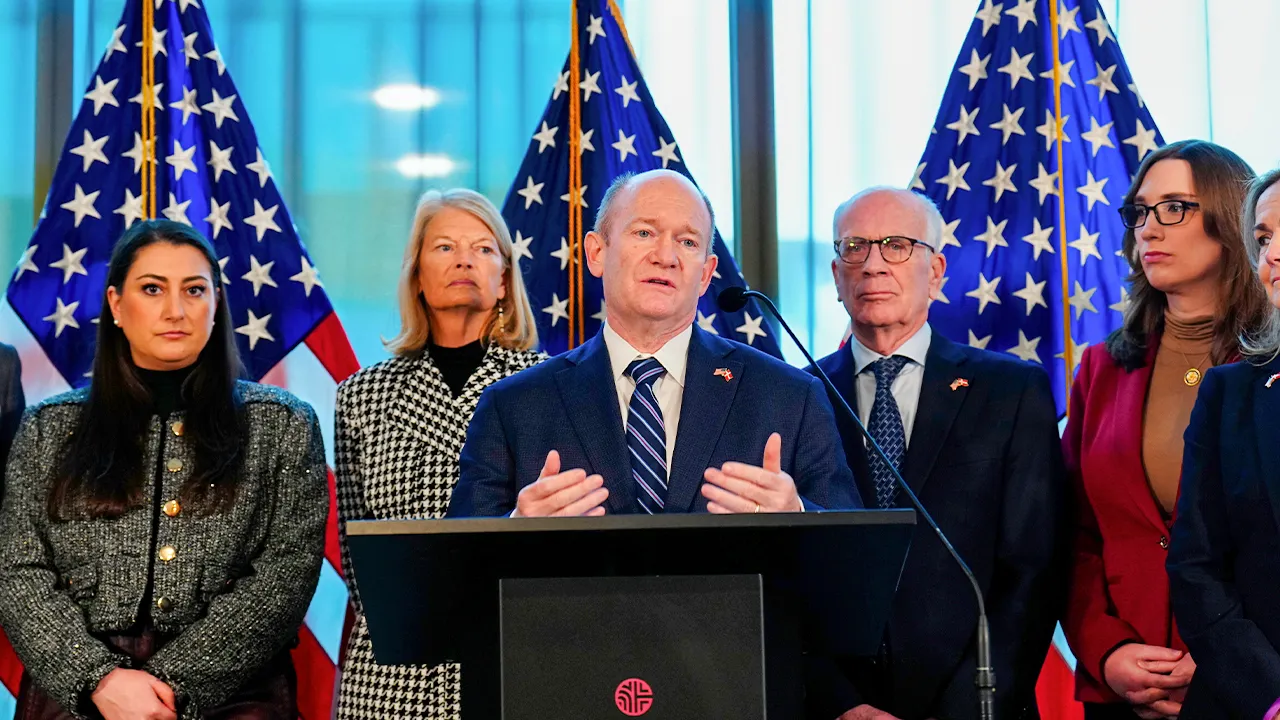
By the time the polls closed in Delaware on Tuesday, the suspense was mostly in the details. Chris Coons, the state’s senior senator and one of the quiet institutional pillars of the Democratic Party, had done what he has done since he first won a full term in 2014: he cruised through the primary as if it were a scheduled stop on a well-worn route. The list of challengers included Jeff Appelhans, Mary Louve, and a man legally known as E. No-Trump Hansen, a former business executive who had changed his name to make a political statement. Coons beat them all. It was not a surprising result, but it was a telling one. In Delaware, Democrats don’t merely win primaries; they absorb them. Coons has spent more than a decade in Washington, first arriving as a replacement for Joe Biden when Biden was tapped to join Barack Obama’s 2008 ticket. He won a special election, then a full term in 2014, then another in 2020, and he has now clinched the Democratic nomination for a third full term. Over the years, he has become so woven into the fabric of Delaware politics that many residents likely refer to him simply as “Chris.” And on Tuesday, he formally earned the chance to keep doing the job, one that carries far more weight than the small state he represents might suggest—particularly now that he sits as the top-ranking Democrat on the Senate Defense Appropriations Subcommittee.
If there was any color in the night’s otherwise predictable story, it came from the name attached to one of Coons’s primary opponents. E. No-Trump Hansen, formerly known as Eric Hansen, would not be satisfied with a subtle protest. He wasn’t running as a reflection of a platform or a slogan; he was running with a legal identity that made his mission impossible to ignore. Hansen is a former business executive who decided that the most honest thing he could do as a political candidate was to change his name to “No-Trump,” a full-throated rejection of the president and the direction he believes Trump is taking the country. According to campaign materials, the name was not a gimmick but “his complete commitment to positive change.” That language mattered to Hansen, who seemed aware that people might dismiss him as a stunt candidate. By making his name his platform, he was trying to force a conversation about presidential power, corruption, and the need for real checks and balances. He told the local outlet WHYY that Trump has said he will go after critics “by any means available,” and that he expected to be targeted. “He will go after me, but I’m willing to bear that risk anyway,” Hansen said, “because the alternative is letting things get worse for Delawareans.” Whether or not voters took him seriously, his willingness to put a target on himself was a reminder that even in safe primaries, some candidates are trying to say something larger.
Hansen’s backstory made his campaign even more unusual. He was not a lifelong Democrat who drifted left; he had previously run as a Republican. In 2024, Hansen won the GOP nomination and faced off against Delaware’s other senator, Democrat Lisa Blunt-Rochester, ultimately losing to her in the general election. That history suggests a political evolution, or at least a pragmatic recalibration. As a Republican, he had already shown a willingness to challenge the establishment; as a Democratic primary challenger with “No-Trump” in his legal name, he was signaling that his opposition to the president was the central organizing principle of his candidacy. His stated platform called for legislation that would limit presidential power, restore authentic checks and balances, and root out corruption and self-dealing. It was a message aimed at voters who feel uneasy about the expanding powers of the executive branch, and by changing his name in July, as indicated by his Federal Election Commission statement, he made sure that no one could confuse where he stood. He framed it not as political theater but as a kind of citizenship in an emergency. Whether Delaware Democrats agreed with his methods or simply shrugged them off, Hansen’s campaign was a reminder that even inside a deep-blue state, there are voters and candidates who want more than party loyalty—they want resistance made visible, even in the most unlikely forms.
For Coons, the primary wasn’t the real fight. The general election is expected to be a formality, with either Mike Katz or John Shulli emerging as the Republican nominee to challenge him in November. Neither is expected to seriously threaten a Democrat in a state that has not sent a Republican to the U.S. Senate since 1966. That was the year former Senator J. Caleb Boggs lost his re-election bid to a 29-year-old Joe Biden, a race that would eventually become part of Delaware political lore. Biden’s victory did not just launch a storied career; it cemented Rhode’s? No, Delaware’s reputation as a place where Democrats could reliably hold statewide office. Since then, the state has tilted increasingly blue, and Coons’s hold on the Senate seat is a continuation of that dynasty rather than an exception. Coons may be less flashy than Biden, but he has been no less durable. He represents a state that values continuity, civility, and committee positions—someone who shows up, votes, and works quietly. His role on the Defense Appropriations Subcommittee gives him a visible and influential position in national security and military funding, which is a significant asset for a small state with a large defense industry presence. In practical terms, the general election will likely be less about whether Coons keeps his seat and more about how many resources and attention he can command in a cycle where Democrats desperately need swing-state wins, not safe-seat reinforcements.
What makes Coons’s longevity remarkable is how directly it connects to the defining moment in modern Delaware politics. Coons was essentially chosen to inherit a seat that had been held by Joe Biden, and he stepped into it in 2010 when Biden left to become Vice President. There was no audition, no dramatic fight; there was simply need and opportunity. Coons was the New Castle County executive at the time, and he was selected to fill the vacancy until a special election could be held. He won that special election, and then he kept winning. “The lawmaker first entered Congress to replace then-Sen. Joe Biden,” the news story dryly notes, but for Delawareans that sentence carries a world of meaning. Biden was not just a senator; he was a hometown hero, a Amtrak commuter, a man whose name was inseparable from the state’s identity. Coons, by contrast, has been a more understated steward, but he has managed to preserve the seat as a Democratic stronghold for over a decade. He has also managed to avoid the kind of intraparty challenges that can unseat entrenched incumbents. Even in 2022, when national progressives were flexing their muscles, Coons held his ground. The fact that he easily dispatched a field of challengers this week suggests that his political standing remains strong, and the deep-blue legacy of the First State remains firmly intact.
In the end, Delaware’s primary was a small but meaningful portrait of American politics. On one side, a stable, institutional Democrat who represents the art of the possible and the value of seniority. On the other side, a man who legally renamed himself “No-Trump” to express the urgency of the moment. One is likely to return to Washington and keep shaping defense policy from the Senate floor. The other will almost certainly fade back into private life, his name perhaps becoming a curious footnote in Delaware primary history. Yet both stories are part of the same American experiment. The system allowed a longshot candidate to put a protest on the ballot, and it allowed an incumbent to prove that steady representation still means something to voters. There was no bitterness in the result, only the quiet hum of a functioning democracy. For Coons, the path forward is clear: a general election that may be low on drama but high on consequence. For Hansen, the message was always bigger than the outcome. And for Delaware, the night was simply another reminder that while the rest of the country may see the First State as small, it knows how to make political statements—whether through a long serving senator or a name that says everything at once.