

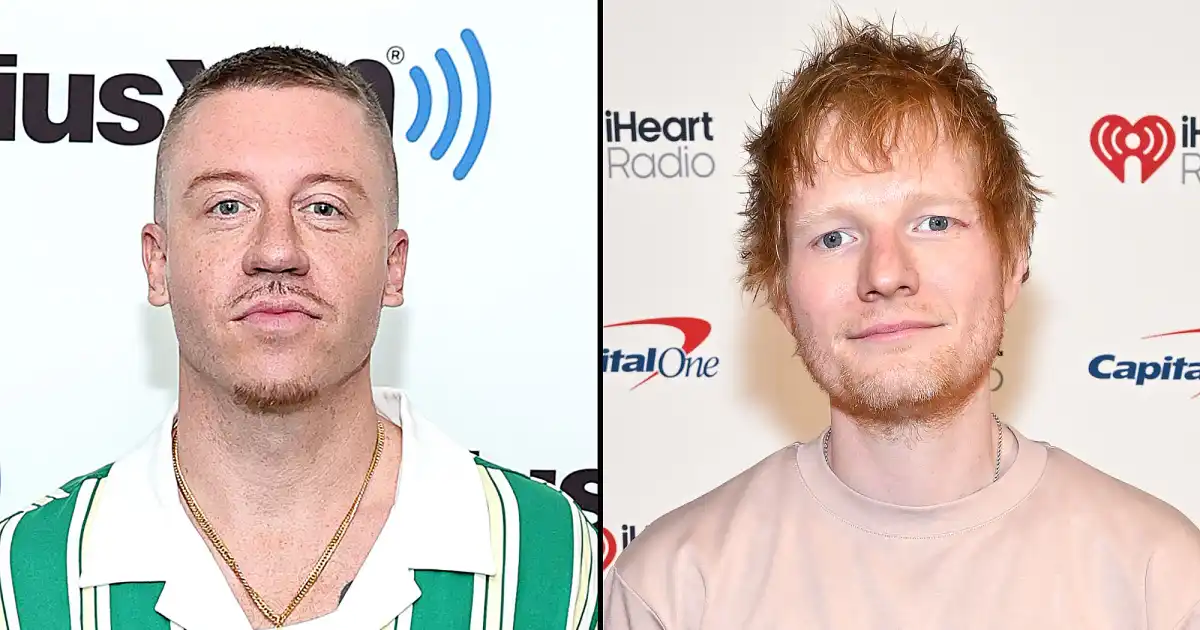
For two nights in early September, Macklemore stepped onto a stadium stage in New Jersey as an opening act and walked away from it as a central figure in a political storm. The concerts were part of Ed Sheeran’s Loop Tour, a moment meant to be about music, joy, and pop clarity. But Macklemore, 43, used his time onstage differently. He chanted “Free Palestine,” performed his protest track “Hind’s Hall,” and told the audience that one of the main reasons he had accepted the gig was to keep the spotlight on the suffering of Palestinians. In a world where stadium shows are usually polished and controversy-free, this was a deliberate rupture. It was not long before the consequences followed. On Monday, September 14, Macklemore announced on Instagram that Ed Sheeran and his team had made the decision to remove him from the rest of the tour. He began with a statement that sounded less like a press release and more like a confession: “I’m not sure how to start this. So I’m going to speak from the heart and share the truth.” But the truth he wanted to tell was not the usual story of a celebrity losing a job. He was careful to reject the language of victimhood almost immediately. “I am not a victim. Ed Sheeran is not a victim. Pink is not a victim,” he wrote. “We have careers, money, opportunities, safety and audiences around the world. Whatever consequences any of us face for what we say, we get to go home to our families.” This was a conscious reframing. Macklemore understood that the media would turn his removal into a headline, and he wanted to redirect that attention toward something he considered far more important. He was not asking fans to feel sorry for him. He was asking them to look at what was happening in Gaza and to ask themselves what they were willing to risk to say so.
Having established that he was not the real story, Macklemore then named who he believed the real victims are. “The victims are the Palestinian people who have been killed, starved, displaced and forced to live through unimaginable violence,” he wrote. He cited a number that he said should stop people cold: “More than 20,000 children have been killed in Gaza alone.” He added, with a kind of relentless moral clarity, that people are being killed today and people will be killed tomorrow. “I want to make sure that as I tell this story, we don’t lose sight of that.” The choice to focus on children was not accidental. It was an appeal to shared humanity, a way to cut through the political abstractions and legal debates that often dominate discussions of the Israeli-Palestinian conflict. Macklemore’s song “Hind’s Hall” carries its own symbolic weight. The title references a movement that emerged on college campuses, but it is also connected to the memory of a Palestinian child, Hind Rajab, whose death became a symbol of the war’s toll on young lives. By performing that song on a giant stage in front of tens of thousands of people, Macklemore was trying to bring a protest movement into the mainstream. He knew the phrase “Free Palestine” would be heard by people who had never seen it chanted in a stadium before. He knew it would anger some and move others. But he did not run from the controversy. He leaned into it, not because he wanted to be hated, but because he believed the suffering he was describing deserved more attention than his own career. It is impossible to read his statement without understanding that, for him, the moral math was simple: if losing a tour slot could turn the conversation back to the enormous number of children being killed, it was a price worth paying.
At the same time, the situation was not just political; it was personal. Macklemore described Ed Sheeran as “my friend,” someone he has known for 13 years. In the days between the New Jersey concerts and his removal, the two men had what Macklemore called difficult conversations about what to do next. According to Macklemore, Sheeran told him that “the words ‘Free Palestine’ and the image of the Palestinian flag were hurtful to a lot of people he spoke with.” That confession, if accurate, reveals how difficult it is for even close friends to find common ground in a conflict that touches so many raw nerves. Macklemore did not respond with anger. He did not accuse Sheeran of siding with oppression or of betraying their friendship. Instead, he expressed a hope that their bond could survive this test. “Thirteen years of friendship doesn’t disappear because of one painful disagreement,” he wrote. “I hope we both continue listening, studying what is happening in Palestine and wrestling with what neutrality means in a moment like this. My door will always be open to continuing that conversation.” The phrase “wrestling with what neutrality means” is important. Macklemore is suggesting that there is no innocent position in the middle of a crisis. To say nothing, to maintain a comfortable silence, is itself a choice. At the same time, he acknowledged that his words had caused pain. He did not pretend to have all the answers. He asked only that the conversation continue. Whether Sheeran shares that willingness is not yet known. Us Weekly reached out to Sheeran’s representative for comment, but no statement was offered. What remains is the image of two artists, separated by a political chasm, each left to wonder whether friendship can withstand a disagreement over the meaning of a flag and a phrase.
The decision to remove Macklemore from the tour was not made by one person alone. The Messina Touring Group, the concert promoter for Ed Sheeran’s U.S. Loop Tour, released a statement in which they said the upcoming venues had made it clear they would not allow a concert with Macklemore on the lineup. If he remained on the bill, the entire tour would have been at risk of cancellation, impacting “hundreds of thousands of fans.” After discussions with stakeholders, Macklemore was removed from the remaining support dates. The statement was carefully worded, placing the pressure on the venues rather than on Sheeran or his camp. It suggested that this was not a simple creative decision but a practical one designed to save the shows and protect the audience. Still, the result was the same: Macklemore was out. The controversy expanded when Pink, 47, entered the conversation. She reposted a message from StopAntisemitism, an organization that accused Macklemore of spreading “anti-Israel propaganda.” The repost immediately turned into a story of its own, adding another celebrity to a conflict that was already generating enormous attention. Pink later tried to clarify her position in a separate Instagram post. “A repost isn’t a statement, and a meme isn’t a spine,” she wrote. “Social media makes all of us cheap and fast, and we all know it. But I’d rather be disagreed with for what I actually said than hated for what anybody else wrote.” The line was both an apology and an excuse, a way of saying that she did not fully control the meaning of her own actions. Macklemore, in his initial response, had already mentioned Pink by name, grouping her with Sheeran and himself as people who are not victims. It was a strange kind of inclusion, one that acknowledged her role in the incident while also refusing to treat her as an enemy. The whole episode illustrates how quickly a single performance can spiral into a public navigation of alliances, injuries, and loyalties.
As Sheeran prepared to continue the tour at the end of the week, Macklemore gave his most revealing answer yet. He had no regrets. He wrote that he had not needed ten shows from Ed. “I needed 2. Two chances to stand in front of 90,000 people and say the words that somehow became too dangerous to say. Free Palestine. But if those words cost me the stage, while turning the conversation back to Palestine, then it was the most successful tour I’ve ever been on.” Those are not the words of a man defeated by his own choices. They are the words of someone who measures success in a completely different currency. For most musicians, being added to a major tour is an opportunity to grow an audience, sell merchandise, and build momentum. For Macklemore, the two nights in New Jersey were a chance to speak directly to 90,000 people about something he believes is a matter of life and death. He was not naive about the risk. He knew that saying “Free Palestine” in a massive, celebrity-driven environment could cost him his slot. He said it anyway. And when the consequences arrived, he accepted them without self-pity. He even turned them into part of the message. The fact that the phrase was considered dangerous enough to get him removed from a tour only proved, in his mind, that it needed to be said. This is consistent with the rest of his public life. Macklemore has never been an artist who stays comfortably inside the lines. He has rapped about marriage equality, addiction, racism, and the failures of the American Dream. For him, the personal has always been political. The stage in New Jersey was simply the latest version of that impulse. It cost him a job, but it gave him something he values more: the feeling that he stood on the right side of his own conscience.
Ultimately, this is not a simple story about a celebrity being fired. It is a story about the collision of art, morality, and power. There are real and legitimate concerns about antisemitism, about the safety of Jewish communities, and about the way political slogans can become weapons. There is also a devastating humanitarian crisis in Gaza, one that has killed tens of thousands of people, according to the figures Macklemore cited, and that has left children bearing the heaviest burden. Neither of these truths cancels the other, and pretending otherwise is part of why the conversation has become so painful. Macklemore’s response does not offer a policy solution. It does not resolve the complexities of the Israeli-Palestinian conflict. What it does is ask a question that is difficult to avoid: What does it mean to remain neutral when people are dying? He acknowledged that his words hurt people, but he did not apologize for them. He said he is still listening, still studying, still wrestling. He left his door open to Sheeran, to Pink, and perhaps to anyone who wants to talk. But he also made clear that he would not trade his platform for the comfort of silence. He believes he was given two nights in front of a huge audience, and he used them to say what he considered to be the truth. If that decision cost him the tour, he seems to accept that as part of the deal. The tour will go on, the headlines will fade, and other artists will make other choices. But the memory of that moment in the stadium, and the conversation it started, will not disappear as quickly. Macklemore did not get to tell his message to the audiences at all ten shows. He got two. And in his telling, that was enough. It may not be enough for everyone, but it is the choice he made, and he is going home to his family with his conscience intact. For the people he was trying to speak for, the story is far from over.