


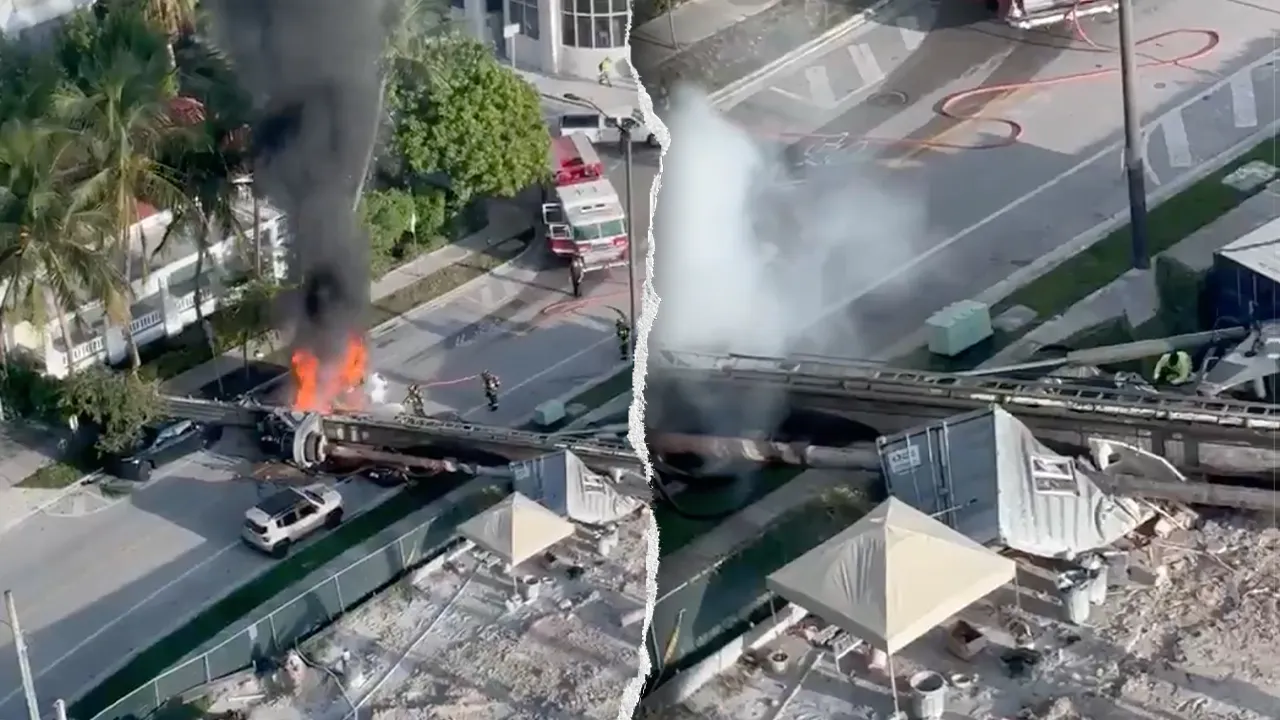
On a bright Monday morning in Miami’s bustling Brickell neighborhood, the ordinary rhythm of rush hour was shattered in an instant. Just after 8 a.m., near Southeast 12th Street and Brickell Bay Drive, a massive drilling rig suddenly gave way and crashed onto the street below, crushing three vehicles and a construction container in a chaotic tangle of metal and debris. What followed was a dramatic and delicate rescue operation that brought together firefighters, technical rescue specialists, and police officers in a race against time. Four people were ultimately taken to local hospitals, but remarkably, all were reported in stable condition. The incident unfolded in one of the city’s most densely populated and vibrant districts, a place where luxury high-rises, financial offices, and busy commuters normally coexist with the constant hum of construction. On this day, however, the sounds of drilling were replaced by sirens, shouts, and the urgent work of first responders who faced a scene that Miami Fire Chief Robert Hevia described as highly complex—a fire raging, victims trapped, and a collapsed structure that demanded both courage and precision.
The collapse itself was as terrifying as it was sudden. According to Miami Fire Rescue, the drilling rig fell onto three vehicles, including a BMW that was occupied at the time. The impact crushed the car and sparked a fire that quickly began consuming the vehicle. In a moment of sheer instinct and presence of mind, the driver managed to throw the car into reverse and escape through the back as flames engulfed the wreckage. Fire Chief Hevia later recounted the moment with visible amazement, calling it “really incredible” that the driver was able to pull away and pop out of the burning car just in time. Meanwhile, two construction workers, ages 27 and 29, were not so fortunate. They were trapped inside a crushed construction container—a heavy-duty Conex box used for tools, materials, or shelter—that had been flattened by the massive rig. The Technical Rescue Team was immediately deployed, working alongside crews who were simultaneously battling the vehicle fire. It was a race on two fronts: extinguishing the flames while carefully cutting through the mangled container to reach the two men. The rescue required specialized equipment, steady hands, and an unwavering focus, as any wrong move could have further endangered the victims. After what must have felt like an eternity, the firefighters successfully extricated both workers from the wreckage, pulling them to safety and rushing them to waiting ambulances.
For the victims, the morning was a brush with death that left them shaken but alive. The two trapped construction workers, both in their late twenties, were rescued with minor injuries, a testament to the skill and speed of the rescue teams. The 47-year-old rig operator, who had been at the controls when the structure gave way, was also taken to a local hospital with minor injuries. So too was the quick-thinking BMW driver, whose escape from the burning vehicle became the most talked-about moment of the incident. In total, four patients were transported, and all were in stable condition, according to officials. Perhaps even more reassuring was the confirmation that all 18 construction workers who had been on the site were accounted for. In the chaos of a collapsed rig, a fire, and a crushed container, the fear of missing workers always lingers. But by the time the rescue operation concluded, the roll call was complete: everyone was found, and no lives were lost. The relief was palpable among the first responders, who had faced a scene that could have easily turned into a tragedy. Instead, it became a story of survival, quick thinking, and the extraordinary efforts of those who run toward danger when everyone else is running away.
The location of the collapse added another layer of significance to the incident. Brickell is not just any Miami neighborhood—it is a thriving financial district, a hub of luxury living, and a symbol of the city’s rapid growth and ambition. The construction site where the rig collapsed is reportedly the future home of billionaire Ken Griffin’s planned Citadel headquarters, a project that represents billions of dollars in investment and a major milestone for Miami’s economy. For months, the area has been a hive of activity, with cranes, drills, and workers shaping the skyline. But on Monday morning, that progress was abruptly halted as police closed Brickell Bay Drive between Southeast 12th and 13th Streets, urging motorists to avoid the area and seek alternate routes. Commuters faced delays, residents looked on from balconies, and the neighborhood’s usual flow of traffic was replaced by a cordon of emergency vehicles and the steady hum of investigation. The closure was a stark reminder that even the most carefully planned construction projects can go dangerously wrong, and that the machinery we rely on to build our cities can, in an instant, become a source of destruction.
As the dust settled and the injured were transported, the focus shifted to the inevitable question: why did this happen? Officials did not immediately provide a cause for the collapse, and Fire Chief Hevia confirmed that the Occupational Safety and Health Administration (OSHA) had been called in to investigate. The investigation would likely examine the rig’s maintenance, the conditions at the site, the procedures followed by the operator, and any structural or mechanical failures that may have contributed to the accident. For the workers, the company, and the broader construction industry, the incident serves as a sobering reminder of the dangers that are inherent in heavy machinery and high-rise development. Miami has seen its share of construction-related incidents, and each one reignites conversations about safety standards, oversight, and the pressure to build quickly in a booming city. While the cause remained unknown, the fact that no one was killed was seen as a small miracle. The response from Miami Fire Rescue was widely praised, with officials noting the complexity of the scene and the seamless coordination between fire suppression and technical rescue teams. But the investigation would take time, and until answers emerged, the people of Brickell would be left with the image of a fallen rig, a burned-out car, and a crushed container—a powerful reminder of how fragile our daily routines can be.
In the end, Monday’s collapse in Brickell was a story of near-tragedy and remarkable heroism. It was a morning that began like any other, with workers reporting to the site and drivers navigating the streets, only to be thrust into a life-or-death situation. The quick actions of the BMW driver, who somehow managed to escape a burning car, and the tireless efforts of the technical rescue team, who cut through steel to free two trapped men, will not soon be forgotten. The four people who went to the hospital will likely carry the memory of that moment for the rest of their lives, but they will also carry the gratitude of a community that watched the rescue unfold and breathed a collective sigh of relief. As OSHA begins its investigation and the city works to understand what went wrong, there will be time for reflection and, hopefully, for changes that make such accidents less likely in the future. But for now, the focus is on the human spirit—the instinct to survive, the courage to help, and the resilience of a city that has faced far worse and always rebuilt. Miami’s skyline will continue to rise, but on this day, the tallest structures were not made of glass and steel, but of the bravery and determination shown by ordinary people in an extraordinary moment.