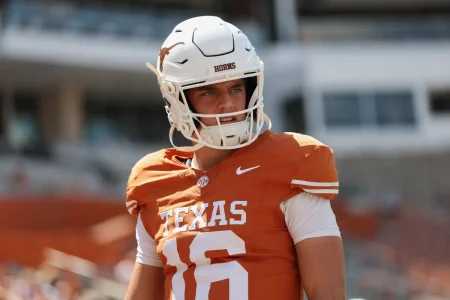



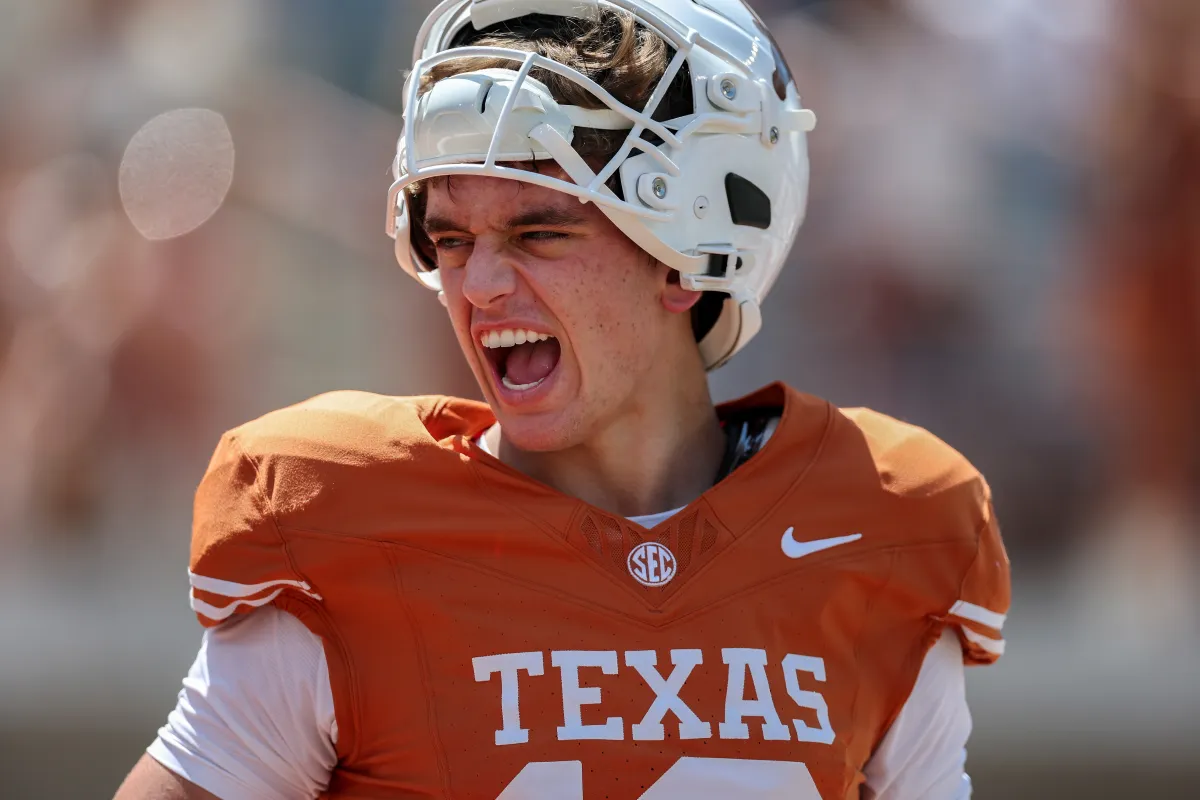
The early evening sky above Austin had turned a deep shade of burnt orange as Arch Manning emerged from the tunnel at DKR-Texas Memorial Stadium, and with each step, the weight of the past year pressed down on him. This wasn’t just another Saturday in September. This was the rematch, the chance to exorcise a ghost that had followed him since the previous season, when Ohio State had walked away with a painful 14-7 victory and left the young quarterback with a bitter taste he couldn’t seem to swallow. Manning had spent months replaying that night in his head—the throws he missed, the seconds he hesitated, the silent bus ride back to the locker room. He had called it a nightmare. Now, standing in front of a roaring home crowd filled with Longhorn faithful wearing their hopes on their sleeves, he understood that redemption isn’t given. It has to be seized. The No. 4 Longhorns were hosting the No. 1 Buckeyes in a top-five showdown that had playoff implications written all over it, but for Manning, the stakes were far more personal. He had grown up in a family defined by football greatness, and he knew better than anyone that names don’t win games—performances do. As he looked across the field at the Buckeyes, who were stretching and jawing with quiet confidence, he felt his heart thumping against his chest. He was no longer the wide-eyed backup watching from the sideline. He was the starter, the leader, the one entrusted with carrying Texas back to national relevance. The pressure was enormous, but so was the opportunity. All he had to do was show that he had learned what it takes to win the hard games.
The first half, however, was an exercise in frustration and pain. Ohio State came out with the kind of hostility that made it clear they were not fazed by the hostile environment, and Texas, frankly, looked like a team still searching for its identity. Manning found a few short completions, but the Ohio State defensive front lived in the backfield, making every dropback feel like a race against time. The Longhorns’ opening drive promised something better, only to stall deep in Buckeye territory and settle for three points. After that, the offense seemed to shrink. Manning was forced to throw into tight windows, his receivers struggled to find separation, and the rhythm that had made Texas look like a title contender all offseason was nowhere to be found. Meanwhile, Ohio State’s offense moved the ball with methodical precision, chewing up yardage and converting third downs with the cold efficiency of a team that had been here before. By halftime, the scoreboard read 20-3, and the DKR crowd had fallen into a strange, uneasy silence. There was no panic in Manning’s eyes as he walked to the locker room, but his jaw was clenched and his helmet was tucked under his arm like armor. On the ABC broadcast, Ohio State head coach Ryan Day offered a strange warning that sounded more like a prophecy. He said he knew this would be a fourth-quarter game, that his players would need to be ready for the final fifteen minutes. It was a curious thing to say with a seventeen-point lead, but in the Texas locker room, those words were like a match dropped onto dry grass. Manning looked his offensive linemen in the eyes and told them the game wasn’t over. “Keep trusting,” he said. “We’re not leaving here without a fight.” It was the kind of moment that doesn’t appear in box scores, but it saved the season.
When the third quarter began, Texas desperately needed a spark, but Ohio State delivered the first blow, extending the lead to 23-3 and making the mountain feel as tall as the stadium itself. From the outside, the game looked lost. The Longhorns had been outplayed in almost every phase, and their quarterback had been rattled. But then something changed. Manning started using his legs, scrambling on third downs, turning broken plays into first downs with the kind of determination that inspires an entire team. He scrambled for 22 yards on the night, and while that number isn’t staggering, the timing of those runs was everything. He didn’t look like a quarterback trying to force a comeback. He looked like a competitor refusing to accept defeat. The receivers, initially shut down, began winning contested catches. The offensive line, battered all night, started holding its ground. Even the defense, which had been gashed in the first half, started making stops and giving the offense a pulse. And then, in the midst of the momentum shift, Manning threw the interception that could have broken a lesser quarterback. It wasn’t his fault—receiver Cam Coleman dropped a ball that bounced off his body and landed in the hands of Buckeye safety Jaylen McClain—but the stat sheet didn’t care about fault. Manning could have sulked. He could have blamed his teammate. Instead, he put his arm around Coleman on the sideline and told him the game wasn’t over. “We’re still winning this game,” he said. It was a small gesture, but it resonated through the entire sideline. The Longhorns settled down, the crowd found its voice again, and by the time the third quarter ended, the deficit felt manageable. Ryan Day’s prediction was coming true, but maybe not in the way he expected. The fourth quarter was about to become a test of wills, and both teams were about to discover who wanted it more.
The final fifteen minutes were a symphony of tension, desperation, and, ultimately, triumph. Texas scored the first of their three remaining touchdowns, and suddenly a game that had felt like a blowout was a real fight. Every possession became a chess match, every throw a life-or-death decision. Manning showed the poise of a veteran, staying calm in the pocket, making quick reads, and trusting his arm when it mattered most. He led a gutsy drive filled with third-down conversions, and when he found his receiver in the end zone, the stadium erupted in a deafening roar. Ohio State, which had controlled the game for three quarters, suddenly looked tight and nervous. Their offense stalled, their defense began to bend, and the momentum was unmistakably shifting. Texas took the lead with another touchdown, and then the defense made the kind of stop that defines seasons, forcing a punt and giving Manning the ball with the game on the line. He didn’t try to be a hero. He didn’t need to. He managed the drive methodically, took what the defense gave him, and trusted his teammates to make plays. When the final whistle blew, the score was 24-23, and the Longhorns had pulled off one of the most memorable wins in recent program history. The stadium dissolved into pure chaos—fans storming around, players hugging, hats flying through the air. Manning found his family in the crowd, his face wet with sweat and emotion, and when the cameras found him on the ABC broadcast, he spoke from the heart. “I’m so proud of our guys, they’re all competitors,” he said. “It wasn’t very pretty, but we found a way to win. That’s what good teams do.” It wasn’t the elegant statement of a polished superstar. It was the raw sound of a young quarterback who had just learned something important about himself.
For Manning, this game was never just about the standings or the playoff rankings. It was about revenge, redemption, and the quiet satisfaction of proving that he was built for these moments. He admitted without hesitation that last year’s loss to Ohio State had haunted him. “I had nightmares about that game last year,” he said after the final whistle, and the honesty in his voice was striking. “We’ll have a good night in Austin.” His stat line—23 of 37 for 196 yards, one touchdown, one interception, and 22 rushing yards—doesn’t tell the whole story. It doesn’t capture the way he kept the offense composed despite the chaos, or the way he refused to let a bad first half define his night. It doesn’t show the leadership that emerged when the game was on the edge. But to the people who watched closely, it was obvious that Manning had grown up in a single evening. He had faced the team that tormented him, watched his mistakes pile up, and still found a way to walk off the field victorious. The weight that had followed him into the stadium was gone, replaced by the pride of knowing he could carry a team on his back when everything was going wrong. Revenge, he learned, doesn’t always look like highlight-reel touchdowns. Sometimes it looks like a young man standing in the middle of a roaring stadium with tears in his eyes, finally free from the nightmare that had kept him up at night.
The implications of this win ripple far beyond the joy of one night in Austin. Texas, a year removed from a heartbreaking three-loss season that left them on the outside of the College Football Playoff, has now beaten the No. 1 team in the country and cemented its place in the national championship conversation. More than that, the Longhorns earned something that is hard to quantify but impossible to overstate: margin for error. With a brutal nine-game SEC schedule still ahead, the confidence from a comeback against the nation’s best can carry a team through the inevitable slumps and injuries that define college football. The road to the playoff remains long and treacherous, but it looks far more welcoming with a win like this in the rearview mirror. For Arch Manning, the future is suddenly bright in a way it hadn’t been before. He is no longer the famous last name carrying expectations; he is the quarterback who faced his demons and emerged stronger. He proved to himself, to his team, and to the entire country that he is not afraid of a challenge, even when the first fifty minutes are a disaster. The Longhorns have a leader who refuses to quit, and a team that believes in him completely. The nightmare is finally over. In its place, Austin is dreaming again.