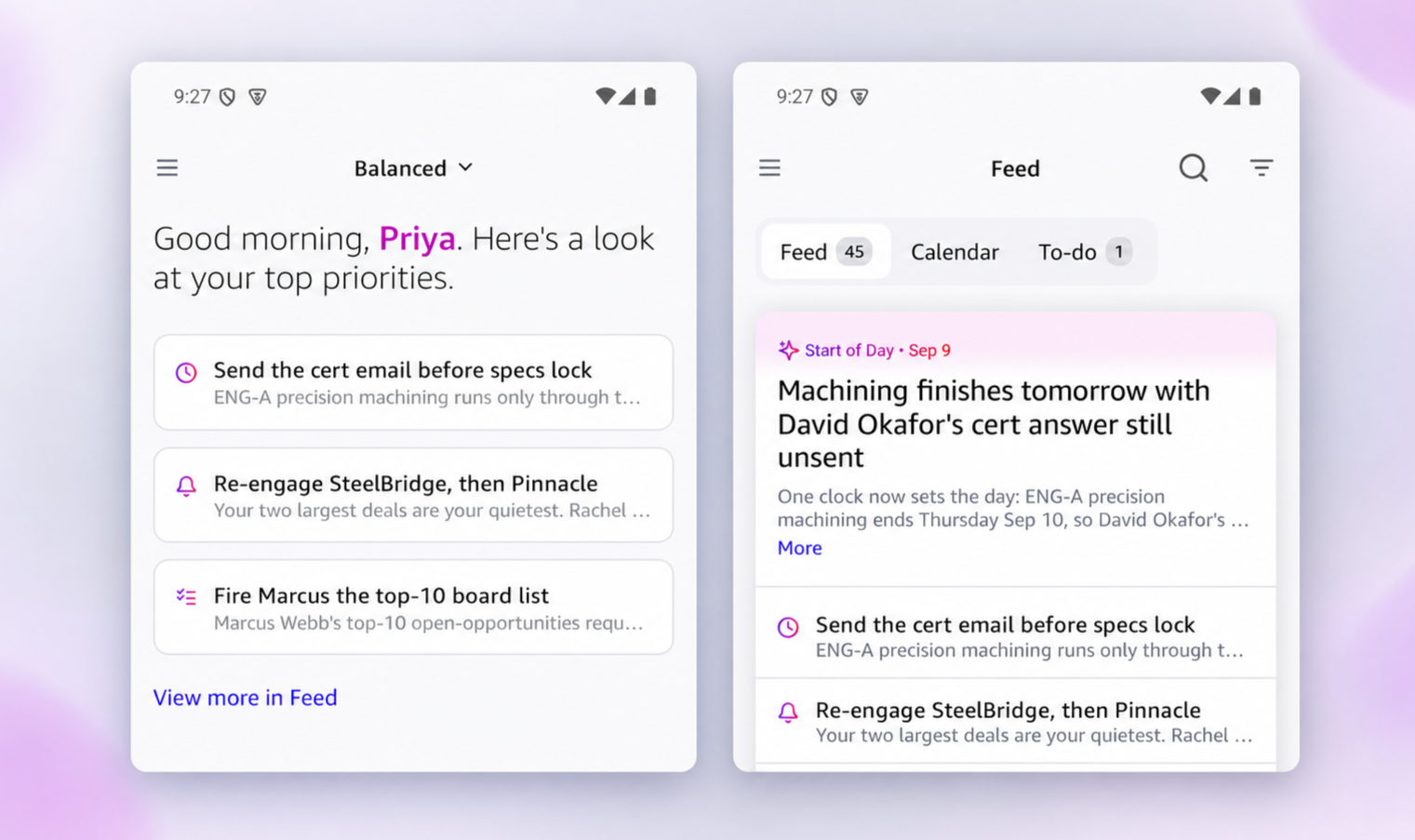
It is a familiar morning scene for anyone who works in the modern knowledge economy: eyes barely open, heart rate climbing, as the phone illuminates with a cascade of notifications. Ten unread emails from yesterday, a Slack message marked urgent, a calendar reminder for a meeting that was just moved, and a CRM notification that a major client is on the verge of signing. Toggling between a maze of apps feels like doing mental gymnastics before the coffee has even brewed. It is precisely this overwhelming digital chaos that Amazon seeks to conquer with its AI assistant, Quick. In a significant announcement on Wednesday, Amazon revealed that it is bringing the assistant’s signature “Activity Feed” to its mobile applications for both iOS and Android, marking a profound step towards making the assistant truly ubiquitous. Previously, this powerful feature was exclusive to the desktop experience, but today, it is breaking free from the office confines. As Todd Bishop reported on September 10th, this is not just a simple port of a feature; it is a philosophical acknowledgment that work has fundamentally changed. We operate in a distributed, hybrid world, and our tools must reflect that reality. The psychological weight of “notification fatigue” is a real phenomenon—the constant dread of missing a crucial piece of information, the frantic swiping between apps that leaves us mentally exhausted before we even reach our desks. By placing the Activity Feed directly into the pocket-sized devices we carry everywhere, Amazon is making a bold bet that the future of productivity is not just intelligent—it is disarmingly portable. The “morning priority view,” visible in the provided imagery, gives users a distilled, at-a-glance summary of what truly demands their attention. It is a digital sorter that turns the terrifying wall of notifications into a curated, manageable list of tasks that need immediate action, rather than a relentless cacophony of dings and buzzes.
To truly appreciate the gravity of this mobile expansion, one must delve into the underlying magic of the Activity Feed itself. At its core, the Activity Feed is a sophisticated aggregation engine that merges disparate streams of communication—email, Slack messages, calendar invites, and CRM updates—into a single, unified queue. But the raw aggregation is just the first layer of its intelligence. The true genius lies in the prioritization algorithm, which leverages artificial intelligence to understand the context of each message and rank them by urgency and relevance. It learns from your behavior—who you reply to quickly, what meetings you never skip—and adjusts its sorting accordingly. A direct email from the CEO will naturally outrank a routine marketing newsletter. A calendar conflict between a client meeting and a team sync will be flagged immediately, complete with a visual prompt to resolve the overlap. And a sudden update on a critical sales pipeline will rise to the top of the stack, ensuring the user doesn’t miss a lucrative window. However, the most “human” and consequential aspect of this design is the ability to act directly on these items without ever leaving the feed. Tapping an email card allows you to read the full thread, type a response, and send it within seconds, all without launching a separate mail client. Invitations can be accepted or declined with a single tap, immediately updating your calendar and notifying the organizer. A CRM card allows you to change the deal stage or add a note, syncing the data back to your enterprise system in real-time. This closed-loop system eliminates the friction of “double handling”—the exhausting practice of reading something in one app, memorizing it, then switching to another app to act on it. On a mobile device, where screen space is limited and attention is fragmented, this ability to manage one’s professional life with a few intuitive swipes is not just a convenience; it is a revolution in efficiency. It transforms the dreaded morning scroll into a productive session of triage, where the assistant acts as a hyper-efficient chief of staff, shielding the user from noise while empowering them to make decisive, impactful moves.
While the mobile application represents the most visible customer-facing update, the underlying technical advancements announced on Wednesday are equally transformative, particularly for the desktop experience. Amazon officially declared that the Quick desktop app is moving from the preview stage to general availability for both Windows and macOS. This formal release signals that the platform has achieved a level of stability, security, and feature completeness that Amazon deems suitable for the most demanding enterprise environments. Yet, the architectural shift that accompanies this release is the true game-changer. Amazon has announced that Quick’s agents now operate in the cloud, decoupled from the local machine entirely. This subtle but profound change ensures that tasks do not cease when the laptop lid shuts. Previously, agents were constrained to the user’s local session, effectively shutting down during off-hours and losing momentum. Now, these digital minions live in the secure hinterland of AWS, tirelessly working around the clock. A user might assign the agent to compile a competitor analysis report before leaving for a dinner engagement, or ask it to parse through hundreds of incoming invoices to flag discrepancies. Upon opening the app the next morning, the completed report will be waiting in the Activity Feed, perfectly formatted and thoroughly researched, as if a tireless night-shift worker had labored over it. This persistent cloud execution synergizes beautifully with the new cross-device synchronization feature. The desktop and mobile experiences are now fully in sync, allowing a workflow to migrate fluidly between screens. A user could begin drafting a complex email on their desktop, pause mid-sentence, and pick up the exact same draft on their phone while waiting for a ride. The clipboard, the conversational context, and the task history all transition seamlessly. This harmonious integration eliminates the jarring disconnects found in lesser productivity tools, creating a single, continuous thread of work that follows the user through their day, culminating in an experience that feels genuinely connected.
Naturally, a product of this sophistication requires a careful pricing strategy, and Amazon has positioned it to be both accessible to individuals and scalable for enterprise giants. The Quick ecosystem offers a generous free tier, which allows casual users to experiment with the core conversational features and basic task management, serving as a low-risk gateway to the platform. For those looking to harness the full power of the Activity Feed, the persistent cloud agents, and the deeper integrations, the individual plan begins at a competitive $20 per user per month, billed annually. This move places Amazon in direct, head-to-head competition with the other titans of the AI assistant market. Microsoft Copilot offers deep integration with Office 365, often priced around $30 per user, while Google Gemini leverages its massive Workspace user base, embedding itself into Gmail and Docs. OpenAI provides ChatGPT Enterprise, and Anthropic offers Claude for business, each with their own robust capabilities. Amazon’s strategy distinguishes itself through its relentless focus on action rather than mere generation. While competitors are often excellent at creating paragraphs of text or summarizing meetings, Quick is built to be the conductor of the entire operational orchestra. It doesn’t just respond to queries; it manages your email threads, updates your CRM database, taps into your Slack channels, and rearranges your calendar—all without prompting. This “agentic” focus appeals to businesses drowning in operational tasks, not just those seeking to draft better copy. For organizations, the pricing scales from $20 to $40 per user per month, dependent on the tier and the complexity of administrative controls, data residency, and compliance features required. The tiered structure allows finance departments to calculate a clear Total Cost of Ownership, ensuring they only pay for the level of data governance they need. By anchoring the price competitively and offering robust free usage, Amazon aims to disrupt the market, betting that the profound time-saving capabilities of the Activity Feed will quickly justify the subscription cost in the eyes of both individual users and CIOs checking their ROI.
The key to the success of any enterprise workflow tool lies in the trust of the early customer base, and Amazon showcased a remarkably diverse and prestigious roster of companies already reaping the benefits of Quick. The announcements highlighted Southwest Airlines, the massive airline; LabCorp, the healthcare diagnostics titan; and the PGA Tour, the professional golf organization. These are not boutique startups; they are complex, heavily regulated, and data-rich entities where downtime or miscommunication carries massive financial and reputational risks. The decision by these organizations to adopt Quick is a powerful market signal that the concept of “agentic AI” has evolved from theoretical hype to practical, mission-critical software. For Southwest, the challenge lies in coordinating crew schedules, weather patterns, and maintenance alerts across a sprawling national network. Quick can aggregate these disparate feeds, allowing dispatch coordinators to see the full picture in a single glance and act on operational issues instantly, preventing costly delays. For LabCorp, handling patient data is subject to strict privacy regulations such as HIPAA. Their adoption validates Amazon’s robust security infrastructure and compliance frameworks. The Activity Feed helps lab managers and physicians track specimen statuses, prioritize urgent results, and communicate with colleagues, all while maintaining the highest levels of data integrity. The PGA Tour, where time is a precious commodity during fast-paced tournament weekends, relies on Quick to merge sponsor requests, media interviews, and scoring updates into a digestible feed for its operations team. This diversity of use cases proves the versatility of the platform. It demonstrates that Amazon is not just selling a novelty, but providing a critical infrastructure layer that can adapt to logistics, healthcare, and sports management. This adoption also highlights a key competitive advantage for Amazon: the deep integration with AWS. For IT departments, knowing that Quick is backed by the same cloud infrastructure that powers their existing workloads offers a comforting consistency in security standards and data governance. It allows for seamless IAM (Identity and Access Management) integrations and provides a unified vendor relationship, simplifying procurement and compliance audits, making the path to widespread enterprise adoption significantly smoother.
Perhaps the most inspiring aspect of this whole rollout is the incredible story of speed and agility that lies behind the creation of the desktop app itself. In an industry where large software suites typically crawl through multi-year development cycles bogged down by corporate bureaucracy, Amazon has demonstrated a startling level of startup agility. Swami Sivasubramanian, the AWS vice president of agentic AI, provided a remarkable window into this process during a June interview with GeekWire. He disclosed that the Quick desktop app was born from a highly focused team of just six engineers. This microscopic scrum team did not have the luxury of months of padded timelines. They began their work in late January, and by April 28, a mere quarter later, the product was already released to the public in preview form. This feat is a testament to a shifting culture within Amazon, moving away from heavy hierarchical management towards a more radical hyper-specialization. This speed allowed the team to quickly prototype features, receive immediate feedback from early adopters, and iterate aggressively, ensuring the product met the real-world needs of users rather than internal assumptions. The rapid shipping of the mobile app and the cloud agents just months later proves that Quick is not a one-off experiment but a permanently accelerated platform. As Amazon continues down this trajectory, we can expect further integrations with other business tools, enhanced voice capabilities, and even deeper customization for specific industry verticals. In the broader context of the AI revolution, Amazon’s approach stands out. While others are racing to build the largest general-purpose models, Amazon is doubling down on a pragmatic, action-oriented assistant that integrates seamlessly into the messy, chaotic reality of our daily work. It is building a tool that doesn’t just understand language but understands workflows. The introduction of the Activity Feed to mobile, the general availability of the desktop app, and the liberation of agents to the cloud collectively signify that Amazon is not just participating in the AI assistant race; it is actively redefining the finish line. They are crafting a future where our digital assistants are always awake, always synced, and always one step ahead, allowing us to be more focused, more present, and ultimately, more human in the tasks that truly matter.