


For as long as football has been woven into the fabric of American life, there has always been a singular face of the game—a player whose presence feels larger than the sport itself. In one era it was Joe Montana’s icy calm, in another Peyton Manning’s analytical brilliance, and then Tom Brady’s relentless championship gravity. For the past several years, that face has belonged to Patrick Mahomes, the Kansas City Chiefs magician whose no-look passes and fourth-quarter comebacks have redefined what is possible on a football field. But the NFL is a league built on change, and the question of who will carry the torch for the next decade is never far from the minds of those who work inside it. Recently, that question was put to a group of two dozen NFL agents, and their answer was not the one most fans would have expected. There was Mahomes, of course, still earning his share of votes. But the player who came out on top was not Mahomes, and it wasn’t Josh Allen either. It was Caleb Williams, the young quarterback of the Chicago Bears, a player whose blend of raw talent, personal flair, and dramatic playoff moments has convinced some of the sharpest minds in the business that he is the future. It is a bold prediction, one that says as much about the changing culture of football as it does about Williams himself. In a sport that has traditionally prized conformity as much as athleticism, Williams represents something different—something unapologetically individual, wildly creative, and impossible to ignore. And according to the agents who watch the league closely, that is exactly why he is poised to become the next defining figure of professional football.
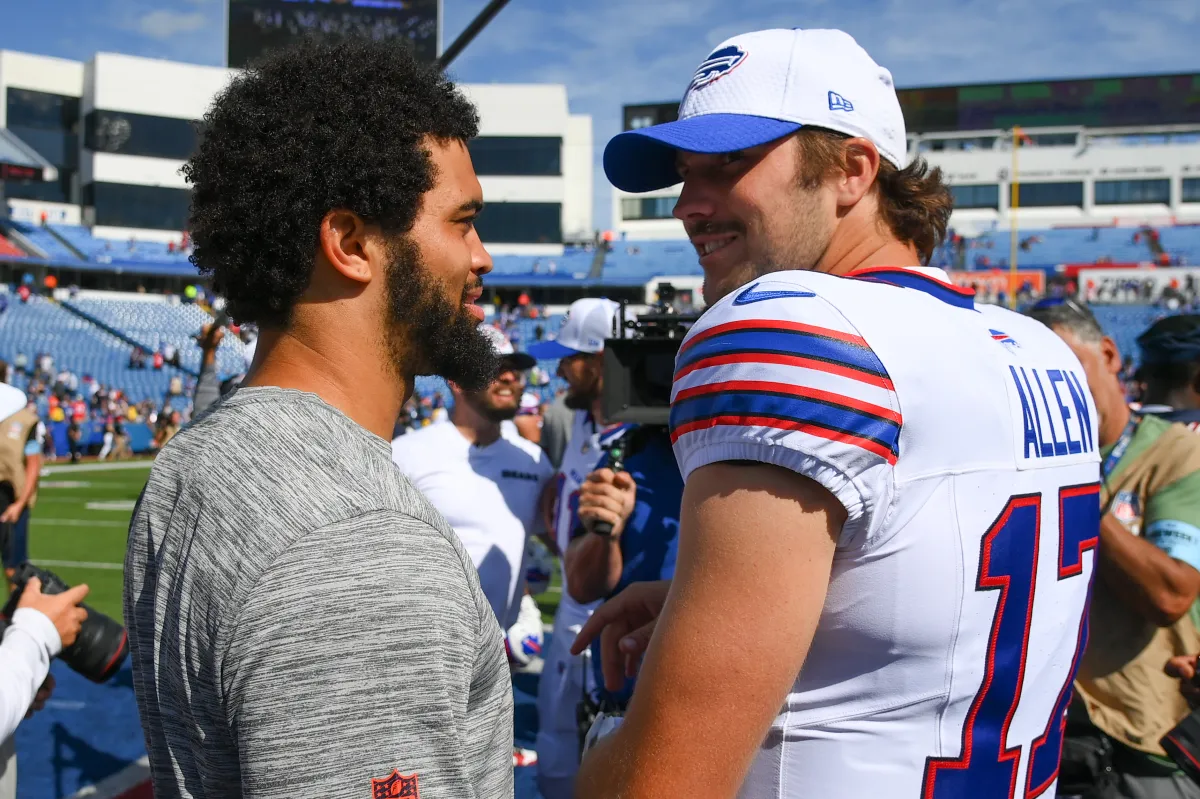
The survey, conducted by NFL reporter Ben Standig, was straightforward: two dozen agents were asked to identify the player most likely to define the next decade of the NFL. The results were telling. Mahomes, still in the prime of his career and already a three-time Super Bowl champion, received four votes—good enough for second place but far from the top spot. Buffalo Bills quarterback Josh Allen, who has become a perennial MVP candidate and was recently ranked as the second-best player in all of football, received three votes, landing in third. On the surface, Allen seems like the obvious heir apparent. He has the arm strength of a superhero, the mobility of a running back, and a growing list of accolades that includes an MVP award. Off the field, his star power has been amplified by his marriage to actress and singer Hailee Steinfeld, giving him the kind of crossover celebrity that modern NFL stars increasingly enjoy. Yet even with all of that, Allen could not match the appeal of Caleb Williams. The agents’ choice was not a verdict on who is better right now, but rather who will define the next ten years—and for many of them, Williams is the answer. The reasoning goes beyond statistics. It is about presence, style, unpredictability, and the ability to capture the imagination of a generation that craves authenticity. One agent put it simply: “Caleb is right there with talent and personality-wise—he’s a different dude.” The agent went on to praise the fit between Williams and new Bears head coach Ben Johnson, calling Johnson the perfect, somewhat unconventional coach for him. Together, they might turn Chicago into an annual contender. That thought alone is enough to send a shiver through a league that has long seen the Bears as a sleeping giant, a franchise with a rabid fanbase but a history of stumbling at the quarterback position. Caleb Williams, in the eyes of the agents, is the one who might finally wake it up.
To understand why Williams inspires such confidence, you have to look at what he has already done on the field. At USC, he won the Heisman Trophy in spectacular fashion, dazzling crowds with throws that seemed to bend physics and escapes from pressure that looked more like choreography than football. He became the kind of player people tuned in to watch regardless of team allegiance, a human highlight reel with a competitive fire that burned hot. Then came his postseason breakthrough with the Bears. In a playoff win over the rival Green Bay Packers—a team that had tormented Chicago for years—Williams delivered a performance that felt like a passing of the torch in real time. He stood in the pocket against pressure, scrambled for key gains, and made throws in critical moments that few quarterbacks on earth can make. It was the kind of game that turns doubters into believers and believers into evangelists. More than the stats, it was the moment itself: the energy of the crowd, the weight of the rivalry, the sense that something was changing in the Midwest. Williams did not merely win that game; he announced himself as the new face of a franchise and, perhaps, the new face of the league. His talent is unmistakable, but what makes him truly special is the way he carries it. He plays with an almost artistic freedom, improvising when the script breaks down, never afraid to try something audacious. That is the quality that separates superstars from mere stars—the ability to make the impossible seem routine, and the willingness to attempt it in the first place. Combined with the guidance of Ben Johnson, one of the most creative offensive minds in the game, Williams has everything he needs to ascend even higher.
But Williams’s appeal is not limited to what he does between the sidelines. In fact, part of what makes him such a compelling choice to define the next decade is the way he lives his life off the field. Williams is known for supporting other Chicago athletes, like Cubs outfielder Pete Crow-Armstrong, but he is also known for something far more personal and far more symbolic: he paints his nails. It is a small thing, a cosmetic choice, but in the hypermasculine world of professional football, it carries significance. By painting his nails, Williams challenges traditional gender norms with a quiet confidence that speaks louder than any pregame speech. He does not ask for permission to be himself, and he does not conform to the image of what a quarterback is supposed to look like. That iconoclasm is precisely what makes him so attractive to a younger generation of fans who are tired of polished, manufactured sports personas. They want someone real, someone who shows up as exactly who he is, unbothered by criticism and unafraid of labels. Williams embodies that spirit. He has a natural charisma that cannot be coached or manufactured, the kind of magnetism that makes camera crews gravitate toward him and fans hang on his every word. In an era when NFL players are increasingly becoming cultural figures beyond the field, Williams is poised to be a leader of that movement. He represents a new archetype of the modern sports star: one who is equally comfortable in a pocket under pressure, on a fashion magazine cover, or speaking out about issues that matter to him. He is not trying to be the next Tom Brady or the next Patrick Mahomes. He is trying to be the first Caleb Williams, and that authenticity is a magnet for attention.
The agents’ choice of Williams over Mahomes and Allen reveals something deeper about how the NFL is changing. The “face of the league” used to be chosen almost entirely based on winning. Championships mattered more than charisma, rings more than rings in the social media sense. But the game has evolved, and so has the definition of stardom. Today, a player’s influence is measured not just in touchdown passes but in social media followers, endorsement deals, and cultural resonance. Mahomes has a thriving profile, but he is already an established king, a figure of the present rather than a glimpse of the future. Allen is beloved and tremendously talented, but his stardom fits a more traditional mold—the strong-armed Midwestern quarterback with a movie-star wife and a highlight reel full of powerful runs and deep throws. Williams, by contrast, offers something riskier and more exciting. He is unpolished in some ways, unconventional in others, and entirely unpredictable. That unpredictability is an asset in a league that thrives on narrative. Every week, Williams gives people something to talk about, whether it is a no-look pass, a bold outfit, or a candid press conference. He is not afraid to be controversial, not afraid to be different, and not afraid to fail in public. That kind of vulnerability makes him relatable in a way that flawless perfection never can. The agents understand this instinctively. They know that the next decade of the NFL will be defined not only by the best player but by the most captivating one, the player whose name becomes synonymous with the sport itself. And in their eyes, Caleb Williams has the potential to be that player.
Of course, predictions are just predictions, and the path from promising young quarterback to defining face of the league is filled with obstacles. Injuries, bad seasons, coaching changes, and the sheer unpredictability of professional football can derail even the most promising careers. Caleb Williams will have to continue to develop, win big games, and ultimately chase the one thing that every great quarterback is measured by: a Super Bowl title. But if the end of last season was any indication, he is squarely on that path. His playoff performance against the Packers was a statement, and the arrival of Ben Johnson signals that Chicago is serious about building an offense around his unique talents. The pieces are in place, the stage is set, and the spotlight is already finding its way to him. It is easy to imagine the next ten years unfolding in front of him: the annual MVP conversations, the deep playoff runs, the cultural moments that extend beyond football, the young fans painting their nails in emulation of their hero. The NFL has always been a league of dynasties and legendary figures, and the wheel is always turning. Patrick Mahomes has not faded away, and Josh Allen will have plenty to say about who ultimately rules the league. But the agents who voted in Ben Standig’s survey saw where the wind is blowing. They saw the talent, the personality, the iconoclasm, and the hunger, and they chose Caleb Williams as the player most likely to define the next decade. Whether he becomes that player is not guaranteed. But he has everything he needs to try—and that is more than enough to make the next chapter of the NFL one worth watching.