


In the quiet, pre-dawn hours of a Sunday morning, the Israel family’s world was shattered not by a violent storm or a tragic accident, but by a series of gunshots that echoed across their peaceful pasture in Rockmart, Georgia. The victim was not a person, but a beloved member of their family—a young, bottle-fed donkey named HeeHaw, who was shot and killed by a Cedartown police officer. The surreal and heartbreaking sequence of events began when officers, responding to a report of a missing child, entered the family’s property without warning. The child was eventually found safe at a nearby church, but by that time, the damage was irreparable. For Hannah Israel, the 30-year-old owner who had raised HeeHaw from a fragile newborn, the loss was not merely the death of an animal but the violent taking of a son, a companion, and a source of unconditional joy.
The Israel family’s bond with HeeHaw was far from a typical farmer-animal relationship. Hannah Israel has been open about the fact that HeeHaw was her “bottle baby,” a creature she raised with the same tenderness she would have given a child. For the first three months of his life, the miniature donkey slept in her bed, nestled between the pillows, a warm and comforting presence that she treated as her own flesh and blood. He was not just livestock; he was a personality, a character who believed he was human. As Israel described, whenever HeeHaw saw anyone approach, he would run up to them, braying loudly, followed by a goofy, endearing sound that was his unique way of communicating. He did this not out of aggression, but out of an overwhelming love for people and an unshakable belief that he was one of them. He participated in petting zoos, bringing smiles to the faces of countless children, and was a fixture of warmth and whimsy on the Elsberry Farm. He had a name, a history, and a personality, and his sudden absence has left a gaping wound in the family’s daily life.
According to Hannah Israel, the terrifying ordeal unfolded shortly before 1:00 AM when officers entered the property where the donkeys graze. The officers were in the middle of a frantic search for a missing child, and their search led them into the pasture. It was then that they encountered HeeHaw, who, as was his nature, ran toward the unfamiliar intruders. Donkeys are naturally alert animals, and their braying is often a form of alarm or a greeting. To HeeHaw, these were strangers in his territory, and he did what donkeys do—he alerted. Israel insists that the officers misinterpreted his curiosity and noise as a threat. She claims the officer attempted to tase the animal first, and when that failed to deter him, they made the fatal decision to use lethal force. The officer shot HeeHaw, killing him instantly in his own pasture, a place that should have been his sanctuary. “They claimed he ran up to them braying and they thought they were in danger,” Israel wrote, her words dripping with anguish and disbelief. “There is no way this is legal!” For her, the justification is flimsy and the action inexplicable; a baby donkey posed no real threat to an armed police officer.
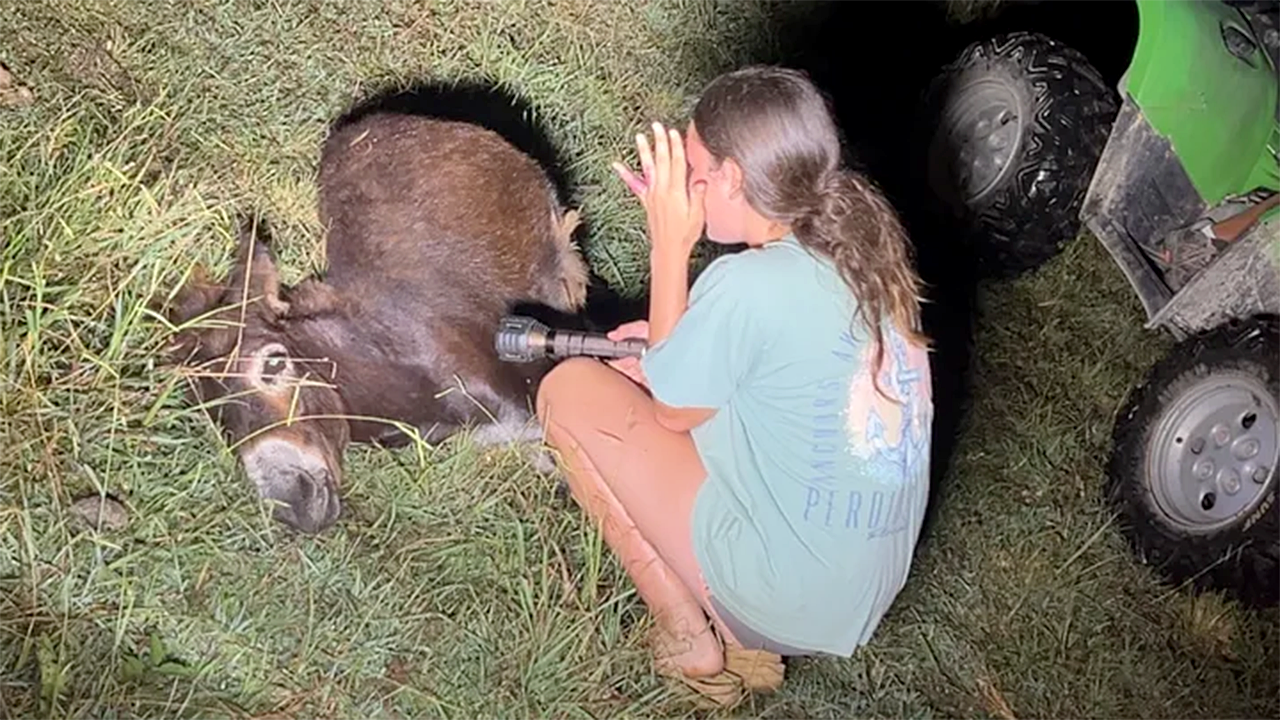
The emotional aftermath has been devastating for the family, a grief that is palpable in the photos shared on social media. One particularly harrowing image shows Hannah Israel crouched over the lifeless body of her donkey, her face buried in anguish, sobs wracking her body while HeeHaw’s wide eyes stare blankly into the night sky. The image is a stark testament to the depth of their loss. Israel has since shared her pain with local media, describing the void left in their lives. “He would normally be standing right over there talking while I’m talking because he thought he could talk like a person could talk,” she told 11Alive, her voice heavy with sorrow. The routine of the farm is now broken; the pasture is quieter, and the silence is a constant reminder of the violent act that took him away. “We are heart broken. He was my SON!!” she wrote in a separate post, rejecting any notion that this was just a “farm animal.” Her questions remain raw and angry: “We miss him so much where is safe?? When my own baby was shot in his own home?” The safety of her own property has been violated, and the trust in the institutions meant to protect has been shattered.
In response to the public outcry and the family’s outrage, the Cedartown Police Department has taken immediate administrative action while also attempting to control the narrative. The officer involved in the shooting has been placed on paid administrative leave, a standard procedure in such investigations, but one that feels cold and insufficient to the grieving family. The department has officially handed over the investigation to the Georgia Department of Agriculture’s Law Enforcement Division, the proper authority for animal-related incidents, ensuring the case is reviewed by an external body. Police Chief Jamie Newsom acknowledged the incident, stating he has personally reviewed the body camera footage from the officers involved. He expressed his understanding of the profound heartbreak the family and the community are feeling, referring to the animals as members of the “human family.” While the department is adhering to protocol, the family’s lawyer is preparing for a legal battle. Israel has hired legal representation and is vowing to pursue every avenue of justice for HeeHaw. The central question remains one of proportionality: Was the use of deadly force against a baby donkey in an open pasture a reasonable act of self-defense, or a reckless overreaction?
As the official investigation gets underway, the court of public opinion has already rendered a swift and emotional verdict. The story of HeeHaw has resonated far beyond the small community of Polk County, touching the hearts of animal lovers nationwide. In a matter of hours, a GoFundMe campaign launched by Israel to cover legal costs skyrocketed, raising more than $113,000. The overwhelming support is a testament to the public’s discomfort with the use of force against an animal that many view as harmless. Israel has been adamant that the funds will be used strictly for legal fees and for further care of her animals, and she has mentioned the possibility of creating a “HeeHaw foundation” with any remaining funds. The public outrage speaks to a broader societal reflex regarding the sanctity of human-animal bonds and the expectation of restraint from law enforcement. The image of a police officer shooting a beloved pet over a misunderstanding seems, to many, to be an abuse of power that demands scrutiny.
Moving forward, the Georgia Department of Agriculture’s Law Enforcement Division has taken over the investigation, a move that suggests the case is being treated with seriousness beyond a simple internal review. While the Cedartown Police Chief, Jamie Newsom, has expressed his heartbreak over the incident, he has remained tight-lipped about the specifics of the shooting, citing the ongoing investigation immobilizing. As the investigation unfolds, the Israel family is left to navigate a new reality. They are demanding justice, not only for the death of HeeHaw but to ensure that no other family has to experience this senseless tragedy. While the police maintain that the officer acted out of fear for his safety, the family and their growing legion of supporters believe the use of lethal force was unjustifiable. HeeHaw was a creature of love, not a threat, and his death serves as a somber reminder of the fragility of life and the unintended consequences that can occur when fear overrides judgment. In their grief, the Israels are not just mourning a donkey; they are mourning the loss of innocence and the feeling of safety on their own land, all while demanding a justice that, while it cannot bring HeeHaw back, might prevent such a tragedy from occurring again.