


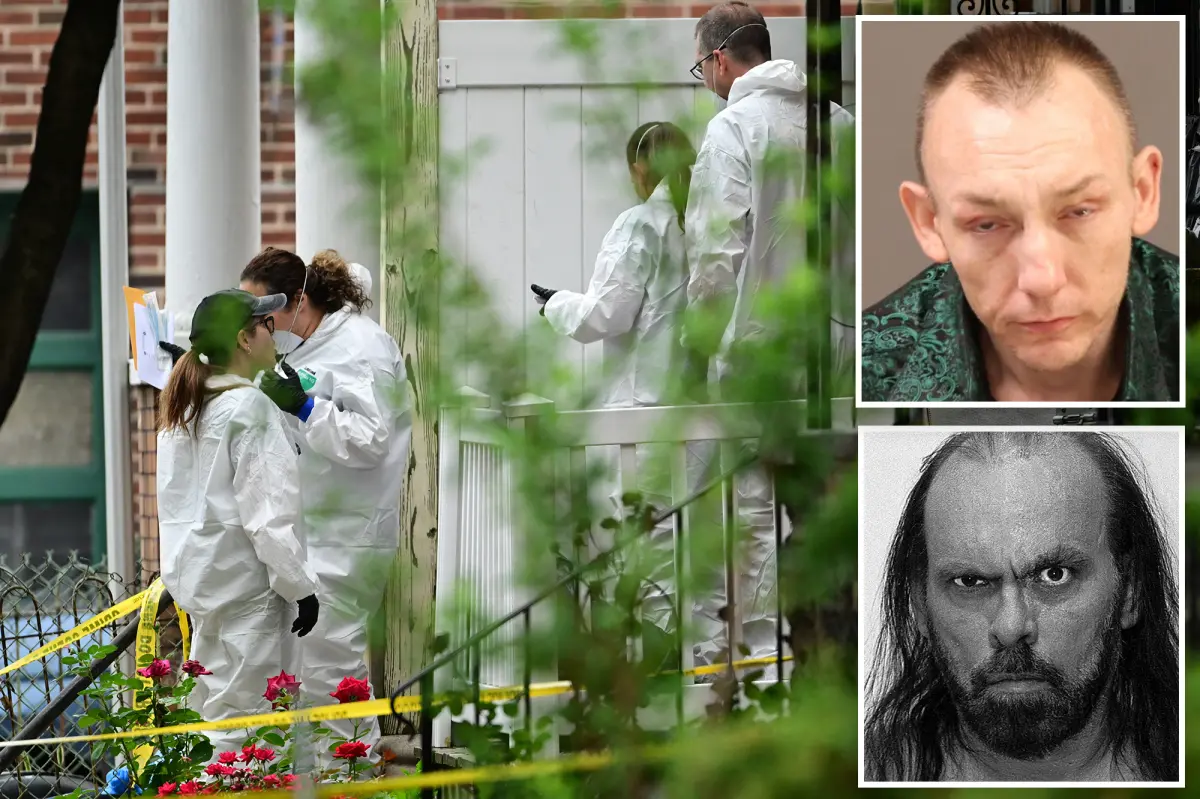
The unassuming row house on the quiet, tree-lined street in Philadelphia’s Olney neighborhood held a secret so profound and so dark that it would shatter the peace of the entire community. It was here, in the home once shared by the late Raymond Horsch and his son Eugene, that investigators stumbled upon a hard drive containing what they believe to be a snuff film—a horrific, real-time recording of a woman being murdered. The discovery, made after Raymond’s death in May 2025, sent shockwaves through the city, transforming a seemingly ordinary property into the focal point of a sprawling, multi-victim investigation. For the detectives who first laid eyes on the footage, the chilling realization dawned that they were not just looking at a single act of violence, but at the tip of a monstrous iceberg, a cache of evidence that hinted at decades of predation, hidden in plain sight among the neatly kept homes and bustling sidewalks of a working-class neighborhood. The house, which had stood silently for years, now became the epicenter of a nightmare, its walls whispering secrets of unspeakable cruelty.
The sheer scale of the archive discovered within the property is staggering, painting a picture of an obsessive and methodical collector of suffering. Authorities recovered approximately 600,000 digital images and 70,000 videos, a digital library of depravity that would take months to fully catalogue. Alongside this mountain of visual evidence were over 10,000 pages of handwritten documents, journals, and writings that detectives believe contain the dark fantasies, meticulous notes, and potential confessions of a serial predator. The physical evidence is equally disturbing; five urns containing what are believed to be cremated human remains were found, alongside more than twenty containers of unidentified chemicals and an oily, ominous substance. This collection transforms the narrative from a simple missing persons case into a forensic nightmare, suggesting a chronicle of prolonged and systematic abuse. The sheer volume of material suggests that the elder Horsch did not act impulsively, but rather curated his crimes with a chilling level of dedication, treating the suffering of women as a collection to be amassed, catalogued, and relived. For the investigators tasked with processing this dark treasure trove, the immense scale is not just a logistical challenge, but a harrowing descent into the depths of one man’s twisted psyche, a journey through thousands of hours of pain and fear.
The tragic names and faces of the women entwined in this case are beginning to emerge from the shadows, each representing a life brutally interrupted and a family left in agonizing limbo. Three women have been specifically linked to the property via the recovered digital evidence: Gabrielle Amarando, who vanished in 2012; Maribel Fresses, last seen in 2018; and Blair Tonzelli, who disappeared in 2023. These women, vulnerable due to struggles with addiction, fit a tragic and clear profile—they were high-risk individuals who could disappear from the streets without raising immediate alarm. The case takes on an even more personal and sickening dimension with the mention of Amy McHale, Raymond’s ex-wife, who has been missing since 2016. The inclusion of a former partner suggests that Horsch’s predatory behavior was not confined to strangers, but extended to the very people closest to him, blurring the lines between domestic violence and serial murder. For the families of these women, the discovery of the hard drives offers a horrifying glimpse into the final moments of their loved ones, replacing the pain of not knowing with the trauma of certainty. The investigation is a race against time to piece together the lives and deaths of these women, to give them back their identities and, hopefully, to provide their families with some semblance of closure amidst the overwhelming grief.
At the center of this dark legacy stands the late Raymond Horsch, the alleged architect of this horror, who managed to evade justice by dying of natural causes in May 2025, just weeks before the depths of his crimes were uncovered. He built a perverse “career” out of luring female addicts from the notorious Kensington neighborhood, offering them shelter or solace, only to exploit their desperation in the most brutal way imaginable. He adopted a disturbing persona—an “empathetic” killer who rationalized murder as a means of ending his victims’ suffering, a delusion that allowed him to continue his reign of terror for years. His son, Eugene Horsch, 44, now stands in the shadow of his father’s alleged monstrosity. Eugene was arrested in June 2025—a month after his father’s death—in the company of a female companion, in possession of a fraudulent DEA badge, drugs, and loaded firearms. While he currently faces only federal charges for firearms and credential fraud, the sheer proximity to the evidence and the circumstances of his arrest suggest a far deeper involvement. Investigators are scrutinizing Eugene’s role, questioning whether he was a passive inheritor of his father’s secret or an active participant indoctrinated into a world of violence from a young age.
To make sense of the profound darkness of this case, the investigation has turned to former FBI profiler James Fitzgerald, a man who possesses a rare and deeply personal understanding of the environment where these crimes unfolded. Fitzgerald grew up in the Olney neighborhood, just blocks from the house of horrors, and recalls a time when the area was a tight-knit, safe enclave of “row-house neighborhoods, mostly Italian, German and Irish,” with a “very, very low crime rate.” He watched the community change as the opioid epidemic and drug trade moved in, creating a vulnerable population that predators like Horsch could easily target. Fitzgerald’s analysis of the case is chillingly direct; he notes that the victimology—women struggling with addiction—was not a byproduct but rather a calculated element of Horsch’s methodology. When reflecting on Eugene’s potential involvement, Fitzgerald points to the cyclical nature of violence, stating that “past behavior is the best predictor of future behavior.” He poignantly adds, “If there are multiple missing women, and Eugene was found with a missing woman’s ID… apples don’t usually fall far from trees,” suggesting that the son likely learned these predatory behaviors from his father, creating a chilling lineage of abuse.
As the investigation continues, the haunting question of how many more victims remain unidentified looms large. Law enforcement is diligently working through the immense trove of 600,000 images and 70,000 videos, desperately searching for faces to match the names of other missing women from the region over the past several decades. The failure to find the remains of the confirmed victims—their bodies or ashes likely scattered in the various chemicals and containers found at the scene—means that prosecuting Eugene for murder will be an uphill battle, though the digital evidence provides a damning narrative that is difficult to refute. The silence from the Philadelphia Police Department and from Eugene Horsch’s defense attorney only deepens the public’s anxiety and frustration. For the community of Olney, the revelation has forever changed the way they look at their own streets, forcing them to confront the uncomfortable truth that heinous evil can thrive behind the most ordinary facades. As the world watches this tragic story unfold, the families of Amy, Gabrielle, Maribel, and Blair await a justice that feels perpetually out of reach, while the city grapples with the ghastly reality that a serial killer was living, and dying, among them for years. The true scope of Raymond Horsch’s evil may never be fully known, but his dark legacy will haunt Philadelphia for a generation.