



The First Impression That Sours the Experience
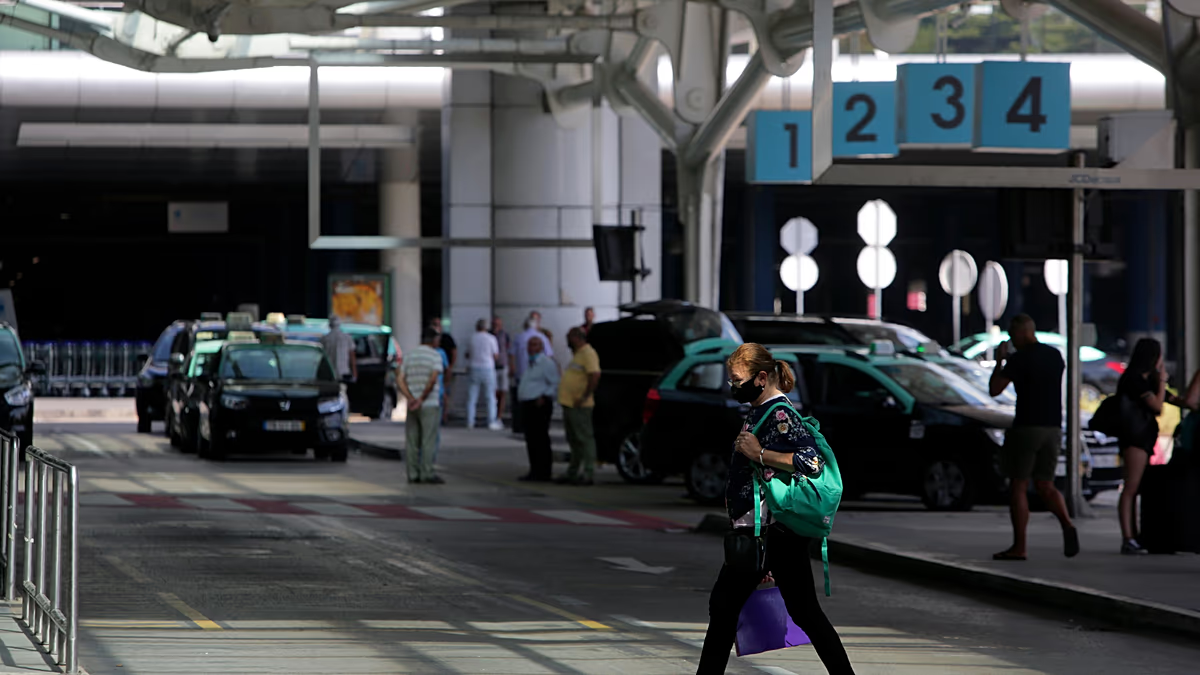
Arriving at Lisbon’s Humberto Delgado Airport is an assault on the senses. After hours of cramped seating, recycled air, and the sterile hum of an airplane cabin, the sliding doors open and release you into the warm, boozy haze of a Portuguese afternoon. The smell of diesel and the roar of idling thermal engines greet you, along with a cacophony of touts, shuttle drivers, and the impatient horns of the taxi rank. For most visitors, this chaotic corridor is their very first taste of Portugal—a country famed for its azulejo tiles, melancholic Fado music, and the deep, Atlantic melancholy of its coastal cliffs. Yet, for increasing numbers of travelers, this welcome is anything but warm. It is here, amid the scuffed curbs and impatient dispatchers, that a dark cloud hangs over the iconic black-and-green taxis. The cloud is a persistent, gaslighting scam that has been meticulously documented by tourists, content creators, and journalists alike. Canadian social media personality Josien Nation became the latest voice of this collective frustration when she posted a video on her Facebook page earlier this month, bluntly labeling the airport taxi service a “trap” for tourists. Her video didn’t just feature a bad ride; it outlined a systemic fraud. She detailed how unscrupulous drivers routinely employ a brazen double-switch: either forcing a hasty price negotiation before the journey begins, or, more insidiously, simply pretending the meter does not exist, then presenting an arbitrary, inflated final figure at the destination. The footage struck a nerve, amassing thousands of shares and a chorus of corroborating stories from angry travelers who felt their hard-earned vacation money had been drained right at the starting gate.
The Two Acts of the Financial Ambush
To understand exactly what tourists face, we have to dissect the two distinct “scenarios” that Nation outlined in her viral rant. The first is the “Tourist Negotiation Trap.” Here, a driver engages the fare before the car even moves. Knowing that the tourist is ignorant of local traffic times, distance, or standard pricing, the driver demands a fixed price—say, twenty-five euros for a ride that should cost twelve. Desperate to haul luggage and reach a hotel, the weary traveler often agrees, only to later realize they have paid double or triple the going rate. The second, and perhaps more galling, scenario is the “Silent Meter Fraud.” The passenger gets into the taxi, waits for the click of the meter, yet nothing happens. They might be distracted by their phone or simply too polite to protest. By the time they arrive, the driver names a sum that has no basis in reality. This complaint was vividly, and painfully, illustrated by Zeynep Tinaz Redmont, a Turkish journalist living in Portugal. In a poignant account published in Diário de Notícias, Redmont detailed her weekly ordeal. A ride from the airport to Largo do Rado, a journey she has made for over a decade, routinely costs around eleven to fourteen euros. But recently, the meter games became so hostile that she experienced two blatant overcharges in a single week. One driver took detours through kilometers of congested traffic, claiming the route was necessary, while another used a fake digital meter app on his personal smartphone—a phantom gadget displaying a bogus tally. The climax came when Redmont politely pointed out that the meter was off. Her driver slammed on the brakes with terrifying force, pulled over, and barked: “If you want to get out, get out. The journey has a fixed price: 25 euros.” Utterly exhausted, and realizing that arguing on a dark street with an aggressive man was a losing proposition, she paid the 25 euros, her heart pounding with a mixture of fear and resentment. Her story is a perfect microcosm of the experience: the quiet victimization of a traveler who knows they are being duped but lacks the local power, language, or physical courage to fight back.
The Long Arm of the Law—And Its Heavy Fist
Eventually, these rampant complaints reached the local authorities, specifically the Polícia de Segurança Pública (PSP). On a recent Tuesday, the PSP launched a massive, coordinated road inspection operation at the airport’s arrivals area—a targeted strike designed to clean up the terminal. The results were staggeringly damning. Officers inspected around one hundred taxis, and their findings painted a picture of a fleet riddled with negligence, unseaworthiness, and outright law-breaking. A total of 67 offences were recorded in a single swoop. The breakdown is a bureaucratic laundry list of deep-seated rot: 32 drivers were cited for a specifically fraudulent act—the improper positioning of taximeters. A further eight were fined for lacking a proper CMT (Taxi Driver’s Certificate), essentially driving without a license to operate. Six taxis lacked mandatory documentation, another six had expired fire extinguishers—a safety hazard in a vehicle hauling human beings. Three were driving vehicles that had failed their mandatory mechanical inspections, and three more lacked the “Group 2” certification requisite for commercial passenger transport. The list continues with two taxis running outdated meter calibrations, two in visibly poor condition, one driver not wearing the mandatory seatbelt (a laughable violation given his profession), one without any insurance, and a grave concern—one driver was found to be under the influence of alcohol. To cap it off, one taxi was illegally parked, and two drivers were issued notices to present further documents later. This was not merely a slap on the wrist; it was a shotgun blast of fines aimed at the entire rank. For the casual observer, this operation looked like a decisive victory for the consumer—a signal that the state was protecting tourists from predation.
The Taxi Union’s Counterattack: A Cry of Unfairness
Yet, where the PSP saw righteousness, the national taxi association, ANTRAL, saw a spectacle. Their reaction was swift, furious, and surprisingly defiant. Rather than welcoming the scrutiny as a chance to clean house, ANTRAL lashed out, accusing the police of orchestrating a “media show” for the cameras. In an official statement, they argued that the operation had effectively paralyzed the ability of legitimate drivers to pick up passengers. By swarming the rank, checking documents, and inspecting meters with dozens of officers, they claimed the police had created a traffic jam that left the taxi stand completely deserted. Their core argument was that this crackdown was not about safety or honesty, but about optics—a performative act intended to placate the public outcry while unfairly stigmatizing the entire profession. They clung to the logistical complaint that the operation targeted vehicles while passengers were already on board, which they argued was invasive and humiliating for both the driver and the customer. Most tellingly, ANTRAL accused the PSP of having ulterior motives, stating that the operation appeared to be aimed at “other ends” that harmed both the hard-working taxi drivers (who are mostly just trying to feed their families) and the passengers themselves, by destabilizing the transportation ecosystem. The association’s defensive posture highlights a painful truth: the taxi industry feels besieged. They are locked in a death struggle with ride-hailing apps like Uber and Bolt, their traditional monopolies eroded, their margins squeezed. In their minds, a criminal pickpocket at the airport is a criminal, but a taxi driver who overcharges a rich European tourist is merely engaging in aggressive capitalism. They fail to see that their own rogue members—the ones using fake apps and playing games with tourists—are the ones providing the ammunition for these “media shows” in the first place.
The Systemic Root of the Distrust
Stepping back from the immediate fracas, the conflict exposes a profound psychological and economic chasm. The core issue is the asymmetric relationship between a transient visitor and a local operator. A tourist is a one-shot customer; the driver knows that they will never see this passenger again. This anonymity is the fuel for the fraud. Why build a reputation with a person who will be gone in 48 hours? The tourist, conversely, is exhausted, jet-lagged, linguistic deficient, and vulnerable. They carry heavy bags and a wallet full of unfamiliar currency. This power imbalance invites exploitation. The “meaningless” negotiation and the “off” meter are not mere oversights; they are calculated gambits predicated on the tourist’s inability to fight back. Furthermore, the rise of the “fake digital meter”—where a driver pulls out a smartphone with a custom-coded app—demonstrates a chilling technological adaptation to crime. It’s no longer about a broken mechanical meter; it’s about a simulator that allows the driver to claim any distance traveled. Meanwhile, the traditional taxi driver’s psyche is one of embattled nostalgia. They remember when the airport rank was a place of easy money, a symbol of status. Now, they watch tourists bypass them entirely, walking to the Uber pickup point with their phones held aloft. The police crackdown, from their perspective, confirms their suspicion that the state is aligned with the tech giants, using PR stunts to crush them. This tit-for-tat leaves the passenger caught in the crossfire. They don’t care about the driver’s existential crisis with the gig economy; they just want a fair, transparent price for a 20-minute ride into the city.
A Journey Toward Transparency
Ultimately, the saga of the Lisbon Airport taxi scam is a mirror reflecting the broader friction of the modern travel industry. It is a struggle between legacy systems and disruptive technology, between local tradition and global tourism, between the desire for profit and the necessity of trust. Josien Nation’s video and Zeynep Redmont’s story are not just isolated complaints; they are warnings that travel in the digital age is predicated on reliability. When a tourist steps into a taxi, they are not just hiring a car; they are hiring a guide, a safe harbor, and a promise of arrival. The PSP’s enforcement action, however clumsy and PR-driven it may seem, sends a vital signal: that the state recognizes the taxi rank as the front line of its national brand. But a single raid will not solve the problem. ANTRAL, despite its defensive bluster, holds the key. They need to pivot from defending the indefensible to actively educating their members on ethical service, pushing for mandatory digital receipts, and implementing a zero-tolerance policy for the rogue drivers that give them a bad name. For the traveler, the onus remains on vigilance—always demanding the meter be turned on before the car departs, agreeing on a price in writing if the meter is “broken,” and bravely refusing to pay a fare that defies mathematical logic. As the sun sets over the Tagus River and the planes continue to land, the black-and-green fleet waits at the curb. The question is whether they will be seen as ambassadors of a warm welcome or predatory sharks circling a pool of confused newcomers. Until the meters tick honestly and the fare reflects the map, the laughter of the street performer in the arrivals hall will always be drowned out by the quiet, frustrated sigh of another traveler realizing they just got scammed. But the journey is at a crossroads; with pressure from the police, scrutiny from social media, and a shared desire for economic survival, there is hope that the next ride will finally be measured in kilometers, not in stolen trust.