


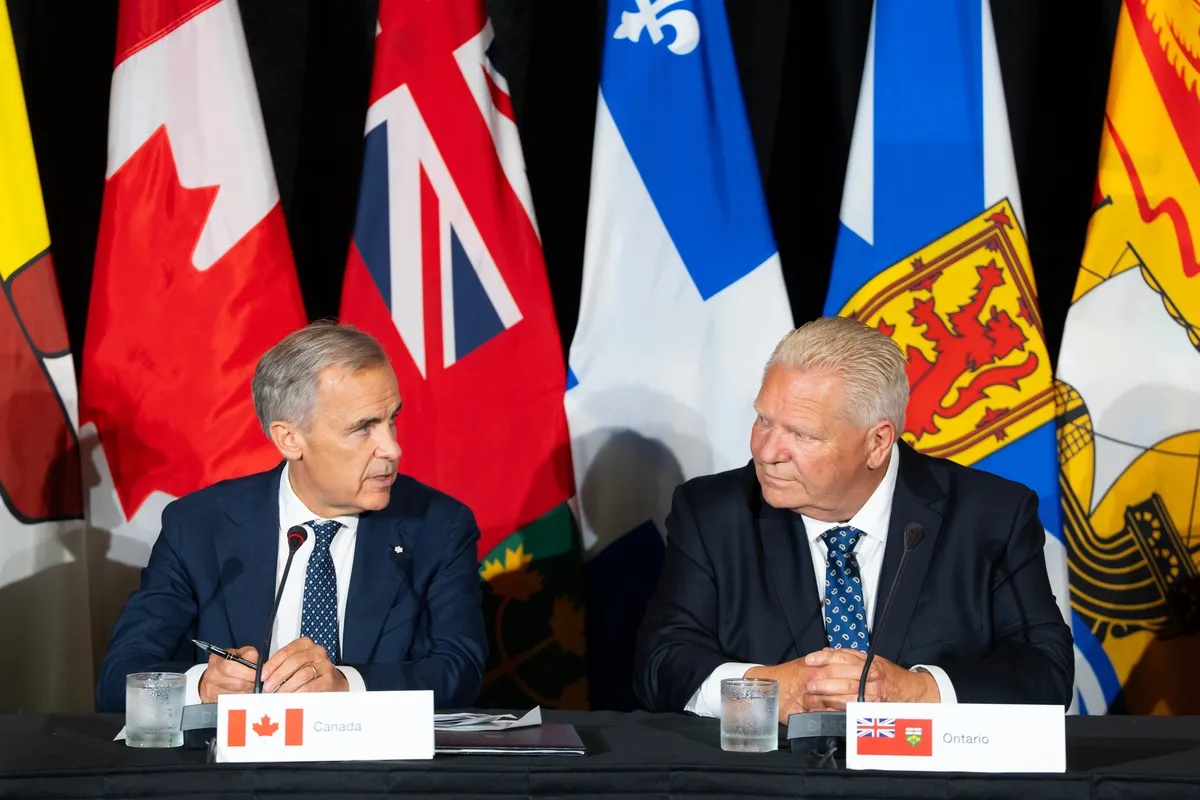
Something shifted on the U.S.-Canada border this weekend—not just at the crossings, but in the way two longtime allies look at each other. Trade talks that had seemed close to resolution collapsed late Friday, and Prime Minister Mark Carney pulled Canada’s negotiators back to Ottawa, calling the U.S. proposals “unfair” and declaring that the neighbors were now in a trade “war.” The hurt and anger were not hard to read. Ontario Premier Doug Ford, one of the bluntest voices in Canadian politics, responded by writing to Carney with a list of American states he wants to hit with what he called “additional retaliatory tariffs.” His letter, dated August 17 and widely shared over the weekend, named eight states—Alabama, Arkansas, Florida, Iowa, Missouri, Montana, Texas and Wisconsin—because they are, in Ford’s words, “politically significant states to the current administration’s base of support.” It was a deliberately political counterpunch, aimed not at an abstraction called “the American economy” but at the electoral map behind President Donald Trump. Within hours, whatever optimism remained had evaporated. The U.S. imposed a new 50 percent tariff on many Canadian goods, a levy that the U.S. Trade Representative’s office said would impact close to $20 billion in Canadian imports. Carney called it a “miscalculation.” That single word, delivered with cold understatement, carried the weight of a friendship suddenly turned into a transaction.
To understand why this is so personal, you have to understand how deeply the two economies are woven together. More than 75 percent of Canadian goods exports go south, and Canada remains the second-largest U.S. goods export market, behind only Mexico. The U.S. leans heavily on Canada for energy and critical minerals; Canada, in turn, has long relied on American motor vehicles, auto parts, heavy machinery and electrical equipment. This is not a distant trading relationship between strangers. It is a bridge-crossing, a pipeline, a family business across the longest undefended border in the world. Yet that very closeness has become a source of friction. Canada’s government says it has spent 2025 deliberately expanding into new markets, and its imports from the U.S., along with its exports to the U.S., dropped for the first time in a decade when the pandemic period is set aside. That diversification is partly economic strategy, but it is also emotional. Trump has repeatedly referred to Canada as the 51st state, and the joke has worn thin; it has angered Canadians and fueled the wave of anti-American sentiment that helped sweep Carney into power. In the early hours of Sunday, Trump went further, saying Canada “wants the benefits of being a State, without being one!!!” and claiming Canada had put “massive” tariffs on American farmers for years. The provocation was hard to miss. Carney’s response was equally deliberate: “America has changed. We will not return to our old relationship.” Those words, from a leader not known for dramatic language, sounded less like a policy statement than a eulogy for a partnership that a week ago still seemed capable of being saved.
Only days before, there had been real reason for hope. Dominic LeBlanc, the Canadian minister responsible for trade relations with the United States, said on Thursday that an agreement was “very close.” Then the tone changed. Late Friday, Carney announced that Canada had suspended negotiations after Washington proposed “unfair” last-minute changes. The U.S. Trade Representative’s office, run by Jamieson Greer, responded on X with a very different version of events. Canada, the statement said, had refused to sign a deal that had been agreed earlier in the week and had “upended the careful balance reached in the past days” by making new demands. The office added that Canada would have received “the best treatment of any major exporter to our market.” Neither side sounded like a liar. Both sounded like two negotiators who had lived through the same conversation and came out with opposite memories of what was said. But the outcome was not ambiguous. The U.S. imposed a 50 percent tariff on a broad range of Canadian goods, a move Washington’s own estimates said would affect roughly $20 billion in Canadian imports. Ford, meanwhile, was already talking about fighting and winning. “We never started this fight, but I can assure you, we’re going to win this fight,” he told reporters. It is a line that draws cheers in Canada, but the bravado cannot hide the fact that both economies are about to feel real, measurable pain.
Ford’s targets were not random. The states he named—Alabama, Arkansas, Florida, Iowa, Missouri, Montana, Texas and Wisconsin—are states where the current administration’s political base runs deep. His letter, dated before the talks collapsed, quickly became part of the post-collapse atmosphere, a reminder that trade is not only about money but about leverage and loyalty. On Saturday, Carney met with Canada’s premiers to discuss “dollar for dollar counter-tariffs” set to come into force in September. He said Ottawa would impose these retaliatory measures “reluctantly,” because some U.S. companies and some U.S. states are “innocent bystanders in a dispute that they did not want.” That admission matters. It shows that even as Canada sharpens its weapons, it understands who will be caught in the crossfire. Ford has no intention of softening the message. “We’re going to use every single tool we have here in Ontario,” he said, “and hopefully, the rest of the premiers feel the same way.” For Canadians who have watched this relationship deteriorate in real time, his pugnacity feels like validation. For American border-state residents who just want to sell their goods and continue their daily lives, it sounds like a threat. The truth is that both reactions are fair. The politics are clear, the economics are tangled, and the people in the middle are already starting to wonder what this will mean for their jobs, their businesses, and their communities.
The American political reaction has been profoundly mixed. Senator Susan Collins, a Republican from Maine, said the turbulent trade talks were putting businesses in her state in danger and warned that U.S. tariffs would raise costs for ordinary families. Vermont Democrat Peter Welch went further, calling the 50 percent tariffs on Canadian imports “a slap in the face to businesses and farmers in Vermont and northern border states across America.” It is hard to overstate how many livelihoods are tied to this single relationship. A farmer in Maine, an autoworker in Michigan, a machinist in Wisconsin—all of them have a stake in a dispute born in Washington and Ottawa, far above their kitchen tables. Behind every percentage point in the trade statistics is a truck idling at a border crossing, a warehouse with unfilled orders, a family checking the news to see whether they still have a job. The tariffs may be designed with political significance in mind, but they land on real people. That is the uncomfortable truth both governments seem reluctant to say aloud: a trade war between neighbors is not a clean economic strategy. It is a demolition project that no one fully controls, and once the wreckage begins to fall, it does not stop to check whether you voted for the people who started it. It hits the “innocent bystanders” Carney mentioned, the same ordinary families Collins worries about, and the border towns that have long treated the Canada-U.S. line as a shared street rather than a fortress.
The stakes for the eight targeted states are not abstract. Alabama sent roughly $4.3 billion in goods to Canada last year, making Canada its largest export market and accounting for just under a fifth of the state’s total exports, with transportation equipment and metals at the top. Arkansas sent $1.3 billion north in 2025, making Canada its second-largest export market, just behind Mexico, which bought $1.5 billion in Arkansas goods—22 percent of the state’s overall exports. Florida, the sixth-largest exporting state, recorded a record $79.1 billion in exports last year; Brazil was its biggest customer, but Canada was a close second at $5.6 billion. Iowa sent about 30 percent of its exports to Canada, worth $5 billion, while Mexico took $3.2 billion; the state’s main exports to Canada include agricultural products and chemicals. Missouri hit its own export record, with Canada its largest market at $6.7 billion, a full 34 percent of all its exports. Montana’s export economy is smaller in dollar volume, yet nearly half of the state’s exports went to Canada, totaling $1 billion. Texas, the giant among state exporters, sent $448.2 billion of goods around the world in 2025; Mexico absorbed more than $124 billion, about 28 percent, and Canada was second at just under $35 billion. Wisconsin sent $7.6 billion to Canada, its largest market and 28 percent of its total. These are not just numbers in a trade ledger. They are harvests, factory shifts, paychecks, and the quiet routines that tie neighbors together. When the dust settles and the tariffs are finally negotiated, lifted, or hardened, the real question will not be who won the argument, but who lost the peace. For the families and communities that live along this border, the answer may already be painfully clear.