



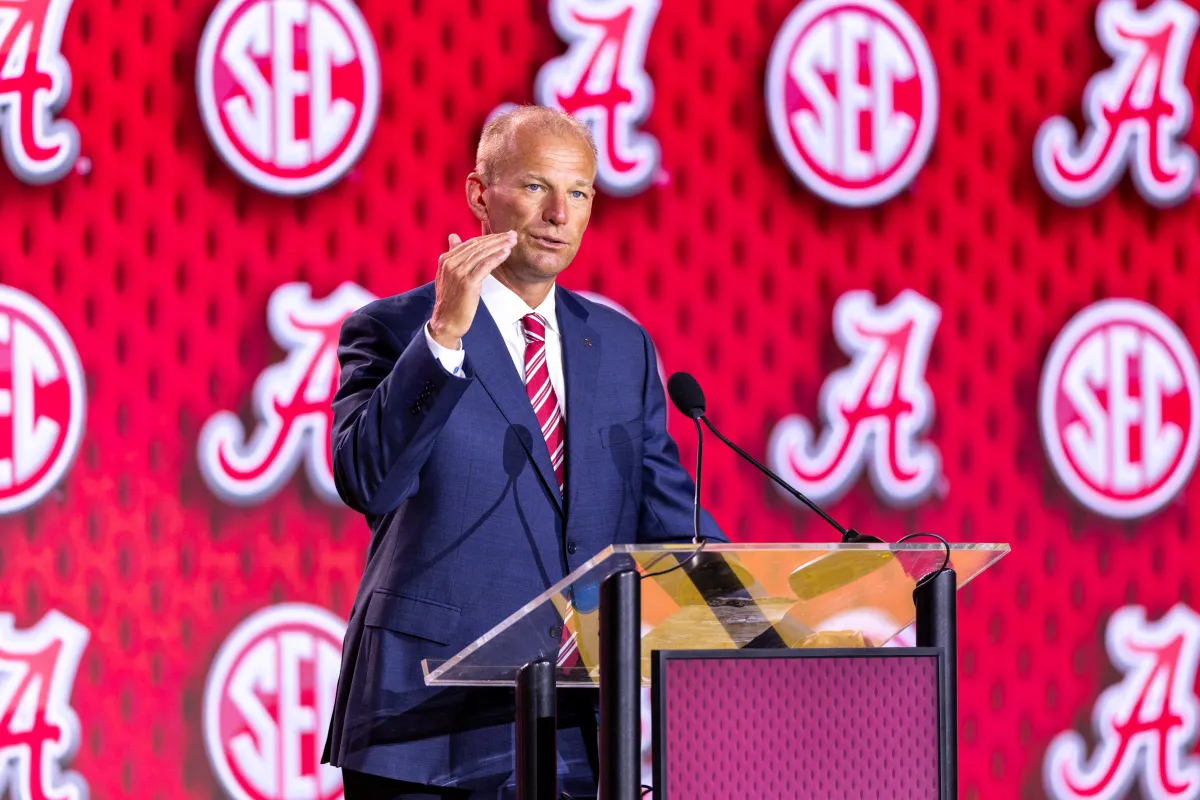
For the better part of two decades, the Alabama Crimson Tide wasn’t just a college football team; it was the monolith against which all other programs measured their worth. The image of Nick Saban stalking the sideline in Tuscaloosa, his stoic glare dissecting the opposition, was synonymous with ultimate success, discipline, and an almost dynastic inevitability. This was a program that didn’t just win national championships; it defined the standard of excellence that other teams desperately aspired to reach. However, the landscape of college athletics has shifted so dramatically that this iconic identity is now being challenged. A recent report by John Talty and Chris Hummer for CBS Sports has illuminated a stark, somewhat uncomfortable truth for the Crimson Tide: while Alabama remains a famous and historically rich brand, its financial muscles haveatrophied in the new era of Name, Image, and Likeness (NIL) and the transfer portal. The old days of sheer gravitational pull based on a legendary coach are over, and the recent offseason spending figures prove that Alabama is no longer sitting at the top table of the college football economy—a reality that no amount of crimson jersey nostalgia can ignore.
The financial figures circulating within the sport paint a revealing portrait of the new pecking order. According to the report, top-tier programs are now allocating roughly $40 million annually to construct and maintain championship-caliber rosters, with a dozen schools either meeting or exceeding that astronomical threshold. These are the factories of modern talent acquisition, places where collectives and boosters open their wallets wide to secure the best high school prospects and the most coveted names in the transfer portal. Alabama, however, finds itself in a precarious and somewhat diminished financial position, with its roster valuation landing in the low $30 million range. While that is still a significant sum of money that would make most programs envious, it represents a clear two-tier gap between the Crimson Tide and the true economic superpowers of the sport. This disparity is more than just a number in a spreadsheet; it is a strategic handicap. Alabama is being outspent by programs like Texas, Ohio State, and Georgia, and this fiscal reality means that the Tide can no longer simply out-recruit everyone. The era where Saban could dramatically walk into a recruit’s living room and the process would end then and there is gone, replaced by a raw capitalistic environment where a kid often asks, “What is your offer going to do for my family?” rather than “What can you do for my development?”
The fascinating explanation for Alabama’s ability to remain competitive despite being outspent lies in what has been dubbed the “Saban discount.” For years, elite high school players willingly accepted lesser NIL packages to play for Saban, because the indirect economic benefits of playing under the greatest coach in history were immense. They knew that a few years under Saban’s tutelage would almost certainly result in an NFL draft pick, a massive professional contract that dwarfs any college NIL money. Saban’s brand, his defensive scheming, and his iron-fisted culture were the ultimate premium assets, effectively serving as a form of non-monetary compensation. This allowed Alabama to stretch its dollars further than any other program, assembling five-star talent on a budget while their rivals threw around cash like confetti. But this discount evaporates the moment the coach leaves the building. When Saban retired, the very foundation of that value proposition disappeared with him. The players who had signed on the dotted line to play for the legendary coach were suddenly staring at a very different calculus. Rivals knew this, and they pounced, dangling transfer offers that Alabama simply could not and would not match, fundamentally altering the roster’s composition overnight through attrition rather than strategic rebuilding.
The painful human impact of this financial and emotional shift is best illustrated through the story of Caleb Downs, a generational safety who epitomized everything Alabama wanted to be. A true freshman All-American, Downs was the heartbeat of the defense, a player who seemed destined to lead the Tide back to glory. His decision to enter the transfer portal following Saban’s retirement sent shockwaves through the college football world, but his own words revealed the deeply personal nature of the split. As he recounted on the “St. Brown Podcast,” his initial motivation was entirely tied to the coach himself: “I went there for Coach Saban. It was really when he retired that I was like, ‘I don’t necessarily know why I came here’ because at the end of the day I wanted to go there to learn from him.” This honest admission cuts to the heart of the modern dilemma. Downs was loyal to a man, not just a jersey. When the man left, the school lost its magnetic core. Ohio State, a program with deep pockets and an established winning culture of its own, swooped in and secured his talents. This wasn’t just a loss of a player; it was a clear emotional and symbolic rejection of the premise that ‘Alabama football’ alone was enough to hold on to its best assets in the absence of its coaching deity.
The winter transfer portal window provided an even more brutal demonstration of Alabama’s financial limitations, where the hard realities of the open market would play out in excruciating public detail. The Tide had targeted North Carolina State transfer running back Hollywood Smothers, a dynamic playmaker who seemed to be the perfect solution to a pressing roster need. Alabama reportedly landed him, filling a critical hole in the running back room and giving fans a reason to feel a glimmer of confidence that the program could still compete in the portal under new coach Kalen DeBoer. Yet, in a twist that has become all too common in this transactional era, Smothers flipped his commitment just days later, choosing to join the Texas Longhorns instead. As Talty and Hummer pointed out, the agent for this sudden change was the financial reality of Rich Texas. The Longhorns, equipped with a massive NIL war chest and the backing of wealthy alumni, simply offered a better deal. The very notion of a handshake agreement or a verbal commitment has become worthless in the face of a wire transfer. The Tide tried to utilize their pedigree and traditional charm to secure a difference-maker, but they were outgunned in the cash-for-talent shootout, leaving the coaching staff to scramble for second-choice options and fans to feel the sting of being treated as a consolation prize in their own living rooms.
Yet, amid this financial austerity, it would be a mistake to write off Alabama entirely, as the roster still possesses a reservoir of elite talent built on the remnants of the Saban dynasty. The Tide are expected to start five-star quarterback Keelon Russell, a player with exceptional physical gifts and a high ceiling, embodying the kind of raw, undeveloped potential that Alabama traditionally cultivated into superstars. However, this reliance on high school potential rather than proven collegiate production is a massive gamble in the current climate. While rivals are spending heavily on transfer quarterbacks—guys who have already played against top competition, thrown for thousands of yards, and proven they can handle the pressure of a crowded stadium—Alabama is essentially betting on a future that hasn’t happened yet. The Texans and Ohio States of the world are buying finished products, eliminating the risk of development. Alabama, due to salary constraints, is forced to play the long game, hoping that Koellen Russell matures rapidly and that the young supporting cast matures faster than the opposing defenses they face. It is a strategy that is both nostalgic and highly dangerous. The margin for error is razor-thin; a couple of injuries, early struggles, or developmental setbacks could turn a promising season into a disastrous one, as the Tide no longer have the financial power to ride in and rescue the season with a high-priced veteran mid-year transfer.
Ultimately, the question looming over Tuscaloosa is whether this approach can still generate championships in a sport that has now fully embraced its corporate, pay-for-play reality. The lore of Alabama football was built on a foundation of stability, loyalty, and extraordinary coaching—intangibles that can no longer fully compensate for a $10 million annual budget deficit against your top rivals. The report from CBS Sports is a stark, undeniable admission that the Crimson Tide are now competing in a two-tier system, and they are on the wrong side of that line. To stay relevant, Alabama must adapt by finding new income streams, activating their massive donor base to catch up in the NIL arms race, and convincing high school recruits that their developmental path is still superior to a payday at a Texas or an Ohio State. It is a massive and uncertain undertaking. The “face of college football” is no longer a single coach with a singular vision, but a complex conglomerate of booster clubs, trusts, and corporate sponsorships. For Alabama, this isn’t just about winning games anymore—it’s about preserving their identity and learning how to compete in a brave new world where the loyalty of a player lasts as long as the biggest bidding war dictates, and where the old kings of the sport must either adapt to the new economic iron age or be relegated to the ranks of proud, but struggling, has-beens.