

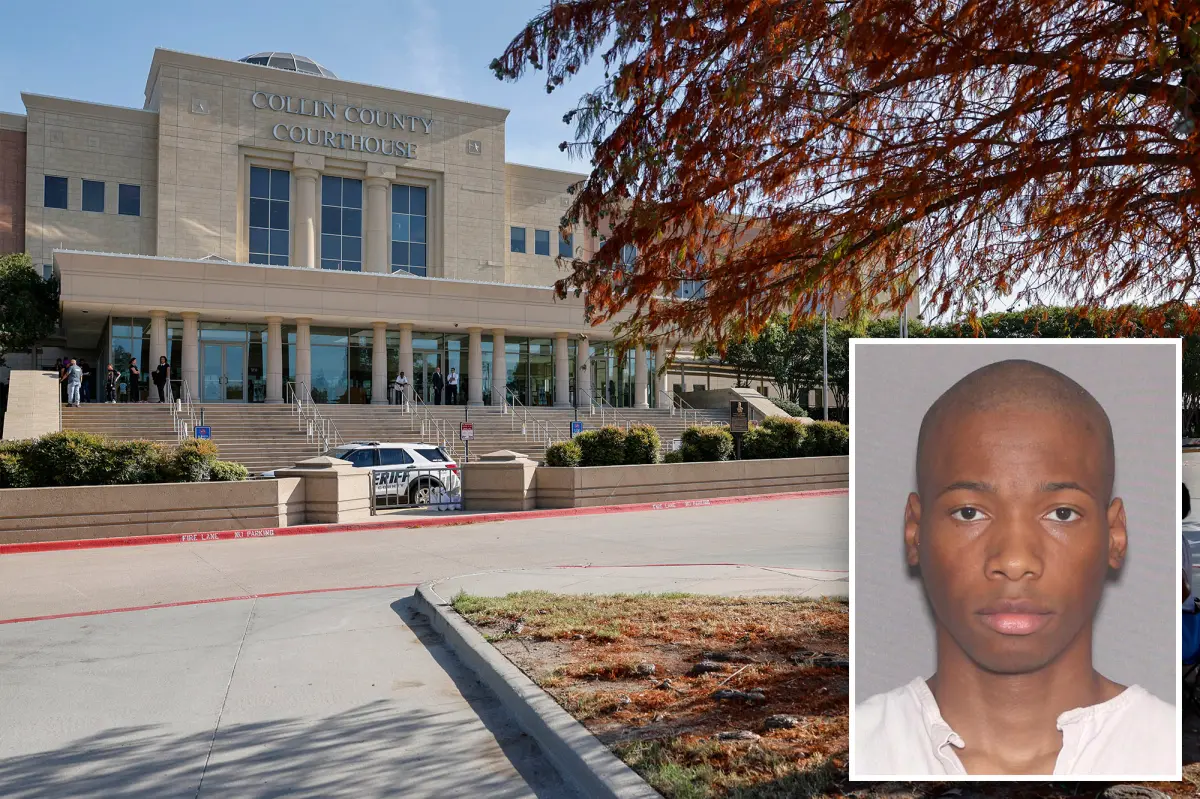
The trial of Karmelo Anthony, a case that has gripped Collin County, Texas, took a dramatic turn on Friday as defense attorney Russell Wilson grilled prosecutors over alleged secrets that could unravel the entire case. At its heart lies a staggering accusation: that a backroom deal between legal teams, meant to “keep things clean,” kept a mountain of shocking evidence out of the courtroom and hidden from the jury. Anthony was found guilty on June of murdering 17-year-old Austin Metcalf, a track athlete who was stabbed to death after an argument at a high school track meet. Now, new legal proceedings are exposing the shadowy actions of the justice system in this case. Prosecutors revealed that Anthony had a history of violent threats, including an alarming text that said “imma shoot the school up tmr,” along with other messages and disturbing behavior. This evidence, along with photographs of weapons, was kept secret, leaving many to question whether the true extent of Anthony’s conduct and the full picture of his state of mind were never presented to the jury that decided his fate. A hearing is now taking place to determine if Anthony is entitled to a new trial, bringing these promises to light and challenging the fairness of the original judicial process.
As the hearing unfolded, the testimony of prosecutor Bill Wirskye provided a window into the delicate and questionable negotiations that shaped this case. In his testimony, the prosecutor said that there was an arrangement between the defense and the prosecution to stay away from the character of both the accused and the victim. He called it a “gentleman’s agreement,” a phrase that now seems deeply ironic given the weight of the information that it excluded from the record. Defense attorney Mike Howard, who represented Anthony in the original trial, brought up the grades and chess hobby of his client, which the prosecution said opened the door for the defense to investigate the victim’s own past. The goal, as Wirskye insisted from the witness stand, was to “avoid historical character and stick to the facts of what happened under the tent” (the place where Metcalf was killed), a decision that had grave ramifications. However, as the agreement was finalized to protect the character of both sides, it also meant that key details of Anthony’s history with violence could never be brought to light, which the new defense is arguing caused a serious miscarriage of justice. In a strange way, both sides were engaging in a balancing act with evidence, but in hindsight, this deal only served to undermine the case.
The prosecution’s revelation of Anthony’s prior behavior included not only his disturbing and threatening texts about shooting up a school, but also incidents of stalking that he had reportedly committed against an ex-girlfriend. It was revealed that in the hours before the fatal stabbing, she had even informed a vice principal about Anthony’s stalking and his threatening behavior. Yet this evidence was deemed inadmissible because of the agreement. The history also included reports that Anthony’s violent tendencies had been so apparent that his parents had to send him to a special program at a college for children with behavioral issues. This important context might have painted a picture of an individual with escalating violent behavior, but it was all withheld from the jury. The courtroom, instead of hearing about these direct threats made by the defendant, was instead focused on limiting the details of the proceedings. The new legal complaint argues that this lack of context during the punishment phase runs the risk of keeping key evidence from fully helping the jury determine a just sentence, since a jury would have evaluated Anthony’s behavior more surgically had they known about this history of threats and escalating tension.
The deal cut both ways, however, and prosecutors said they held back damning evidence about the victim, which could have changed the trial’s outcome. Austin Metcalf, the 17-year-old victim, had a juvenile criminal history, which included his conviction for spray-painting a series of hatred-filled graffiti messages, such as an upside-down cross and slurs including racial epithets and “Heil Hitler.” According to the testimony, he and his twin brother were sentenced to 12 months probation for this incident, after which they had to serve that punishment and follow the guidelines of the law. Photos and videos found on Metcalf’s phone also showed a pervasive pattern of a discriminatory outlook, creating a picture that was radically different from the innocent victim that the prosecution would have presented. This, of course, would have been a key factor that would have inflamed the jury’s opinion about who the true victim was, possibly giving more context to the behavior that preceded the stabbing. This leads to the question of whether or not the suppressed evidence would have altered the defense strategy, granting at least some angle of self-defense or providing a way to demonize the victim to avoid the death penalty and made the jury see it as a conflict, not a pure homicide.
In the appeals, Mr. Wilson is also arguing the trial judge John Roach might have been biased, and this week he was removed from handling the appeal. Roach had done a TV interview in which he declared that the jury got it right when they convicted Anthony. Wilson argued that the original trial was full of issues with courtroom rules and jury instructions flawed, which made the process unfair. The legal victory of getting Roach removed is a symbolic sign that there is reason to believe the trial was compromised in some way. Wilson has attacked the “gentleman’s agreement” which, he say, prevented Anthony from taking the stand. Because his own defense attorney broke the deal by raising questions about Anthony’s personal life, Wilson feels that Anthony was not able to fully defend himself. In it, we see a mix of legal technicalities and outside-the-box dilemmas involving a press-interviewing judge, a secret arrangement, and a deep defense that looks at the system’s fairness. While this could be considered a normal appeals tactic, the sheer amount of dedicated facts that were almost buried indicates that this case is far from open and shut, and the appeal may get the guilty verdict overturned or remanded for a new trial.
This case is more than just a legal review; it is a tragic story about the lives of teenagers and how their actions are shaped by a larger context of school violence and threats. It shows the struggle to keep social order, maintain fairness, and to expose truth in a judicial system that sometimes values good courtroom images over getting at facts. For the families of both Anthony and Metcalf, the case is a catastrophe of grief and anger. They are trapped in a process where their sons’ lives are being framed by a set of untold evidence, which in many ways have made this legal battle a referendum on justice. Whether it’s about threats, violence, or racism, we are forced to see that the case is a complex tapestry, not a simple story of a bully and his victim. The “gentleman’s agreement” symbolizes how sometimes justice is often not transparent and easy to define; instead, the legal system has its own hidden parameters of what should be told to a jury. The latest development, which is the push for a new trial, not only is about technicalities, but about deeper need to air out all of the truth, even if that truth is dark. This case will now define how we think about the process that was effectively hiding behind closed doors.