




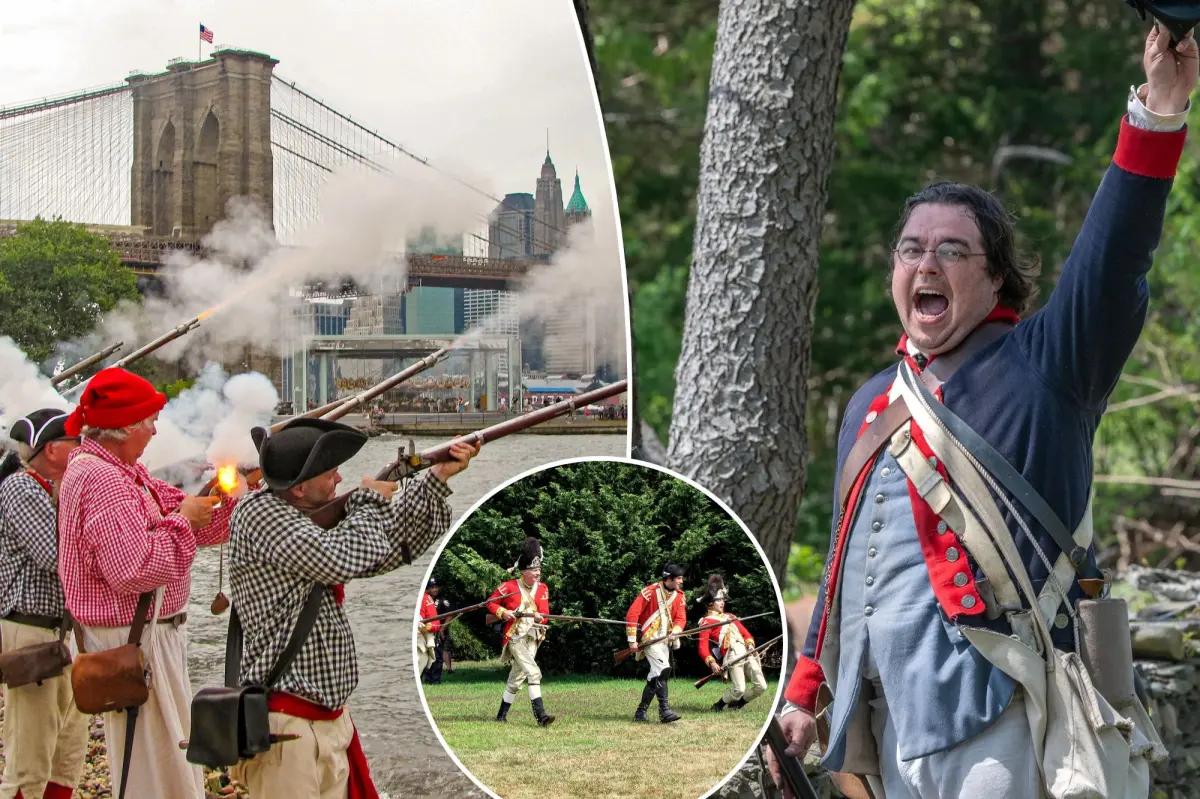
Once More into the Breeches: A Battle Reborn
The streets of Brooklyn are set to stage an extraordinary spectacle this Saturday, one that might initially cause a double-take from unsuspecting New Yorkers. Imagine stepping out of the subway at Grand Army Plaza only to be confronted by a seemingly impossible sight: squadrons of soldiers in the iconic red coats of the British army, marching with purpose and intent. But before panic sets in and thoughts turn to a time-traveling invasion, rest assured—the Revolution is not being re-fought. This is a party, a grand celebration marking two and a half centuries since one of the most pivotal moments in American history.
The cause for this gathering is the 250th anniversary of the Battle of Brooklyn, a monumental skirmish in the fight for independence. Those preparing for this historical throwdown are not professional actors, but rather a dedicated group of individuals, the kind you’d find in any doctor’s office, accounting firm, or corporate park. As Kim Maier, the event’s organizer, points out, they’re simply “working stiffs who happen to have an ardent love of history.” The battle reenactment is set to begin in Prospect Park at 10 a.m., transforming the landscape into a time machine, transporting onlookers back to the chaotic days of late August 1776, until the British claim victory in the mock battle around noon.
This will be the largest reenactment of the Battle of Brooklyn since 2001, with nearly 400 soldiers gathering to bring this slice of history to life. Maier, the executive director of the nearby Old Stone House, explained to the press the route of the action. The troops will form up on Prospect Park’s expansive Long Meadow and then push forward down Third Street through Park Slope, concluding at the Old Stone House—a building steeped in the legacy of the original conflict. This was the very place where the struggle for New York reached its climax on August 27, 1776, and it’s here that the echoes of that fight will resonate once more.
This historic clash represented the very first major military engagement after the signing of the Declaration of Independence. The enormity of the original event is best understood through the sheer numbers involved, with around 20,000 British regulars and Hessian mercenaries overwhelming the roughly 10,000 Continental soldiers under General George Washington. The outcome was a resounding defeat for the colonists, who found themselves vastly outnumbered and outmaneuvered. Yet, in a desperate and masterful tactical retreat under the cover of night, Washington managed to lead his army across the East River, escaping total annihilation and preserving the future of the Revolution. This skirmish is often recalled as the moment the fledgling nation nearly lost everything.
Justin Costantino, a re-enactor with the Long Island Companies of the Third New York regiment and a PhD candidate in history, offers a cinematic comparison: “This is the Empire strikes back.” He argues that the sheer scale of the assault—an entire British army sent to America with the goal of capturing and eliminating George Washington, killing him to stop what they saw as a flicker of rebellion—underlines just how fragile the American cause was. More remarkably, he sees this event as the moment the country came closest to failing. “It’s also the closest the country ever came to not existing,” he added, pointing out that if the British objective had been achieved, the dream of a United States would have died right there in Brooklyn.
Yet this immersion into 18th-century warfare is far more than a simple costume party. Costantino dismisses the word “costume” entirely; for him, and the many he reenacts alongside, this is a “uniform” and the activity represents a serious, second career. As a self-described “historical interpreter,” he participates in upward of twenty-five events a year, a commitment that he refers to as a “full-on part-time job.” The commitment is almost monastic, a dedication to a detailed world that takes precedence over other common pastimes, like watching sports. When his friends question the lack of compensation, his answer is straightforward: “No.” This zeal is humorously highlighted by his relationship with his authentic reproduction firearm—a Charleville 66 musket—which he describes, with a laugh, as his pride and joy since he has neither pets nor children.
The scale and authenticity of the upcoming event are major feats of organization. Ben Theis, a reenactor with a 25-year tenure and a marketing professional in the security industry, who has helped plan this specific reenactment, explains the immense challenges. He leads the Grenadier Company of the Brigade of Guards 1776-83, a New Jersey-based unit, will be fighting this time for the Crown. “We can never truly recreate a hundred percent of what it was then,” Theis admitted. “There were thousands of unit members committed. And now, the reenactors come from derived from disparate volunteer units all over the country, each bringing their own gear, uniforms, and levels of experience. Umbrella organizations like the British Brigade and the Brigade Of The American Revolution (BAR) play a crucial role in setting authenticity standards, offering annual schools with experts in various 18th-century topics. These institutions ensure they don’t just look like a Revolutionary War version of a Renaissance Fair, a fear that’s not entirely unfounded, as Costantino jokingly alludes to the idea of showing up with plastic muskets and being told “you can’t sit with us.”
Realism is a costly ambition. The full regalia—the authentic wool coat, tricorn hat, shoes, and a genuine 18th-century musket—can cost anywhere between $2,000 to $4,000, enough to finance, as Costantino jokes, “a Mercedes” or a repo. To help ease the financial burden, units often lend out “hand-me-downs” to recruits. Ben Theis, for his part, has gone even further, delving into leather-working to construct his own gear. His wife, a seamstress, sews the uniforms for both of them. He even creates the traditional bearskin caps worn by British Grenadiers, sourcing pelts only from “ideally harvested bears” to avoid a $2,000 markup.
However, looking the part is only half the battle. These are not just a group of history buffs in period attire. Before they can even don the uniform, they must master the intricate drills, movements, and weapons-building tactics of an 18th-century soldier. This means handling reproduction firearms loaded with real gunpowder—they fire blank rounds, but the performance is a precise mix of physical coordination, memorized commands, and weapons handling. To maintain this sharpness, modern volunteers can’t just show up for a single battle. units hold smaller exhibitions throughout to ensure the mechanics of historical battlefields are second practice. Recruits can begin the year not knowing a flintlock from a hammer and be a completed soldier in a matter of months.
Theis, an Army veteran who served in Operation Desert Storm, emphasizes that it’s about more than just the physical movements. He speaks about the desire to break down “Hollywoodisms”—the popular movie portrayals of battles that often oversimplify and misrepresent the reality. He and his colleagues want to show how “things actually work.” He aims to correct the common misconception that the American revolutionaries used “guerilla warfare,” hiding behind trees and rocks while the British played by the strict book, marching inflexible lines. The truth, he points out, is that both the Americans and British fought in the traditional European style of battle, standing in line. The British, at times, would fight from them stone walls and ground and layer low, proving their modern understanding of tactics as effective as any commander. He corrects the idea of a one-dimensional, adversarial approach.
Of course, assembling a volunteer force of committed reenactors is a gargantuan undertaking in this era of immediate gratuity and constant digital entertainment. The rarity of such a massive gathering, all part of America’s 250th anniversary, brings volunteers for far away as Illinois and Virginia—an opportunity that wouldn’t happen for just any “celebration of the 248th.” But what drives them is the chance to offer a visceral connection to the past, to help onlookers feel a flicker of what the soldiers might have experienced. The narrative of the day is not strictly choreographed. Theis reveals that while the unit and the generals might have a plan on a map, real chaos can reap chaos, just as it did in the original battle.
He recalls a particularly humorous moment during a reenactment of the Battle of the Guilford, where the British were supposed to emerge victorious but not without heavy casualties. However, a miscommunication left them facing a volley that was so “successful” that they simply crumbled. The entire British line went down, leaving only three men standing. The entire unit laughed at the absurdity of the victory. “None of this is choreographed beyond perhaps moving markers on a map,” Theis explained. “We’re all volunteers, at the end of the day.” Their resilience brings them back up. It’s a living history and not a highlight reel.
The event, for all its scale, still hinges on the personal and the human connections it can make with the audience. A few dozen spectator enthusiasts might have witnessed previous smaller commemorations, and this date centuries after the actual century that sometimes seems to resonate with a more general public. For Costantino, this is a “once in a lifetime” opportunity to create a sense of zeal and authenticity on a bigger stage. But when he measures success for Theis, it wasn’t measured by the number of fake casualties they could inflict, but by the number of spectators they could spark an interest in for history. “I encourage them to find out more, get a book and read about it. If a few people go away from this feeling a connection to the 18th century, that’s victory.” In this way, the 250th anniversary of the Battle of Brooklyn is more than just a remembrance; it’s a live classroom. And the weekend’s visitors will leave with a sense of the profound stakes that the founding generation faced—and the fragile luck that sparked the American experiment.
Summary Humanized:
The streets of New York are about to get a blast from the past as the 250th anniversary of the Battle of Brooklyn is celebrated with a massive reenactment. Organizers, including Kimberly Maier, expect to see hundreds of re-enactors, men and women who are passionate about history and have taken a deep plunge to bring a battle for two centuries old to life. These aren’t professional actors; they are people from all walks of life, united by a obsession with the past. Anyone who sees these “red coats” in 1950 could actually be seeing an opportunity to understand history.
This battle in 1776 was a turning point in the war for independence, with the British army trying to capture George Washington and end the Revolution. That strategy failed through a daring escape, and the United States survived. For the people doing this reenactment, that story is personal. They want to get their uniforms as authentic as possible, as accurately as possible, and get the rules of the conflict as precise as possible, which often means spending thousands of dollars to buy historical gear and learning new skill sets.
The challenge is about pulling off a show with dedicated amateurs, a surprising organizational challenge. Snowflake is a regular in this world, sometimes bringing bearded comedic moments and surprising outcomes, which makes the event more genuine. The modern, grassroot—for a group that cares so much—for mode is to create an opportunity for people to learn. They are the human equation in the historical equation: their goal is to give the public a glimpse into the past and maybe connect with someone else. This is not just a hobby for them. It’s about remembering it’s visibly and emotionally and keeping history alive for the next generation. They are not just wearing uniforms, they are weaving threads of memory – not to just relive the past, but to let a modern audience relate to the past.